Zhao Yi dropped out of university and switched to ecological agriculture
In 2002, Zhao Yi was admitted to China Agricultural University. As someone born in the 1970s, everyone around him called him "Old Zhao." When asked why, Zhao Yi said: We are still a startup team, and we lean toward the internet, so we are not particularly used to expressing things in that traditional, very formalized way like "President Zhao."
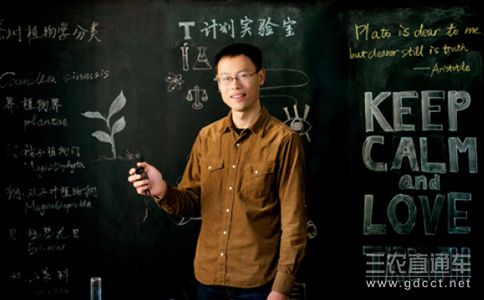
Investment in new agriculture is heating up day by day, and everyone is actively exploring how to play the new agriculture game. New farmer Zhao Yi has attracted much attention because of the new school of agricultural product marketing he created - "transparent traceability."
Zhao Yi is not old, yet people call him "Old Zhao." While in university, he was named a College Student of the Year. However, with one year left before graduation, he gave up his diploma, chose to drop out, and from then on began the arduous path of starting his own business.
Today, as the country strongly advocates "mass entrepreneurship and innovation," Zhao Yi's name is mentioned by more and more young people. Having dropped out of university, his entrepreneurial path has never left the hot soil of rural areas. Why did Zhao Yi choose to drop out and start his own business? Has his entrepreneurial path gone smoothly? And what exactly is transparent traceability?
According to a report by China National Radio's "Agriculture, Rural Areas and Farmers China," in 2002 Zhao Yi was admitted to China Agricultural University. As someone born in the 1970s, everyone around him called him "Old Zhao." When asked why, Zhao Yi said: We are still a startup team, and we lean toward the internet, so we are not particularly used to expressing things in that traditional, very formalized way like "President Zhao."
After enrolling, Zhao Yi led 34 university classmates out of the ivory tower, into the fields, and onto the heated brick beds of farmhouses. In April 2005, they created "high-quality popular science books steeped in a rich rustic flavor," and named the series "Rural Folks." Unexpectedly, the compilation of the "Rural Folks" popular science series on agriculture, rural areas and farmers received widespread attention from all sectors of society. Then-Premier Wen Jiabao even personally wrote back to the students, highly praising this "pure-hearted devotion of caring for the countryside and repaying the folks"! That year, Zhao Yi was selected as a College Student of the Year, his name appeared in "Xinwen Lianbo" and "People's Daily," and Old Zhao became a student leader under great acclaim.
It was also that year that Old Zhao chose to drop out to start a business and develop organic agriculture. This surprised many people greatly.
Zhao Yi: Because everyone had a strong sense of insecurity, they tried to grasp every opportunity. When I was little and read history, I remembered the idiom "burn one's boats." At the time I thought, young people like us definitely do not lack opportunities; the hard part is how I can focus on one thing for many years. When I decided to start a business, I had to cut off all choices other than entrepreneurship, so I used a rather extreme way to express that.
That year, Zhao Yi was in his third year of university, at the peak of his student days. He had only one year left before graduation, and given his situation, he surely could have found a good job after graduating. Yet he chose to start a business. Was it that the achievements and honors he had won one after another gave him more confidence, and that was why he burned his boats like this?
Zhao Yi: It has nothing to do with confidence. We thought it was quite fun, we thought it was pretty cool and quite fun. Conversely, I was very clear that I did not need to write a resume for others, so this thing was not important to me, and many of my entrepreneurial friends around me also did not have university diplomas. Part of it was also influenced by foreign examples, such as Bill Gates, Steve Jobs, and Dell; we thought it was a very cool thing.
Although Zhao Yi kept saying that his entrepreneurship had nothing to do with confidence, from his conversation the reporter could still feel that proud sense of having a well-thought-out plan. But like many people who are starting businesses, Old Zhao felt that when an opportunity comes, you have to seize it. So at that time, what kind of opportunity was right in front of him that made this student in the ivory tower resolutely give up his studies?
Zhao Yi: At the time we decided to do organic agriculture, so I first found a partner. We were doing organic tea then. We both put in money. He was chairman, I was general manager. We invested 200,000 yuan; he invested 102,000 yuan, and I invested 98,000 yuan. At the time I thought it was very simple. My dad told me that to find grapes you need to find a grape trellis, so first find a partner. My partner at the time was already a billionaire and a very influential entrepreneur.
After two years of cooperation, due to differences of opinion with his partner over the future development of organic agriculture, Zhao Yi's first entrepreneurial venture suffered a small setback, but he still held fast to his concept of organic agriculture and continued his entrepreneurial path. During this period, he also went through preparations for a joint venture with one of Japan's largest organic agriculture companies. Although it also ended without a result, this made Zhao Yi even more determined to make traceable food.
Zhao Yi: That experience let me know that, in fact, 40 years ago, in Japan, the United States, and Europe, ordinary people experienced the same anxiety about food safety as we do, and looking at the present from the perspective of the future lets us see that such change is possible.
In 2011, Zhao Yi founded "Rural Folks" and also created a new school - transparent traceability. So-called "transparent traceability" means guaranteeing product quality from the source, while on the consumer end adopting a membership system, gathering consumer demand, and doing C2B well. He hopes to use this to set off a transformation in the tea sector in which production methods are reverse-driven by consumers.
Zhao Yi: We believe the essence of the food safety problem is adverse selection under highly asymmetric information, so we believe we need to eliminate information asymmetry and use the internet to achieve this. We think openness and transparency are very important. The biggest problem with the original organic certification system was that all information was a black box.