Traditional Chinese Medicine Materials Market Q1 2016 Analysis Report
The first quarter of 2016 had the Spring Festival as its turning point. In January before the Spring Festival, the overall market was weak, with more varieties falling than rising, and traders watching in confusion. After the holiday, in March, the market instead launched a strong wave of price increases, staging a "little early spring" rally. Business attention, investment confidence and other "prosperity indicators" also reached their highest values in nearly 5 years of a bear market. Is this signal a rebound after the bottom was established? Or a repeat of the "V"-shaped reversal at the 2009 market trough? Or merely a "flash in the pan" after too long a period of weakness!
I. Market Monitoring and Summary
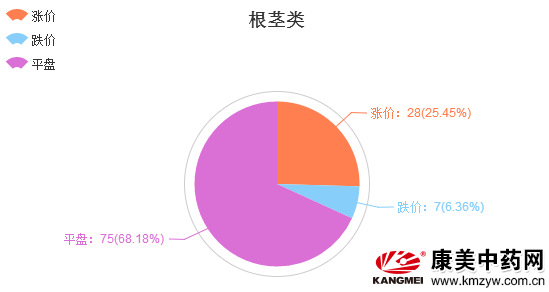
Root and rhizome category:
Rising varieties: Panax notoginseng, Pseudostellaria heterophylla, Corydalis yanhusuo, Ophiopogon japonicus, Fritillaria cirrhosa, Fritillaria ussuriensis, Fritillaria thunbergii, Chinese yam, Codonopsis pilosula, Angelica sinensis, Astragalus membranaceus, Coptis chinensis, Platycodon grandiflorus, Rehmannia glutinosa, Aucklandia lappa, Inula racemosa, Curcuma aromatica, Polygala tenuifolia, Aster tataricus, Paeonia lactiflora (red peony), Dictamnus dasycarpus, Trichosanthes kirilowii root, Anemarrhena asphodeloides, Belamcanda chinensis, Atractylodes lancea, Polygonatum sibiricum, Allium macrostemon, Morinda officinalis. A total of 28, out of 110 commonly used varieties monitored, with rising varieties accounting for 25.5%.
Among them, there were 14 large-volume staple varieties, accounting for 50%. Two varieties rose by 50%, 1 variety rose by 30%, 5 varieties rose by 20%, and 20 varieties rose by 5-10%.
Falling varieties: ginseng, American ginseng, Scrophularia ningpoensis, Ligusticum chuanxiong, Achyranthes bidentata, Isatis indigotica root, Ranunculus ternatus. A total of 7, out of 110 monitored. Falling varieties accounted for 6%.
Among them, there were 6 large-volume staple varieties, accounting for 86%.
Varieties that were flat or fluctuated slightly accounted for 68%.
Summary:
1. Root and rhizome varieties generally have large sales volumes, fairly obvious price cyclicality and high market attention. If the entire traditional Chinese medicine materials market is divided by sector, the root and rhizome category can account for 50%. The seed and kernel category accounts for 30%. Flowers, leaves and bark account for 15%, and animal-derived types account for 5%. Therefore, the frequency and amplitude of price fluctuations in the root and rhizome category can serve as one basis for judging the current level of market activity and the enthusiasm of traders' participation.
2. Price increases accounted for 30%, price declines accounted for 10%, and flat prices accounted for 60%, indicating that current downward pressure in the market is already small and upward potential has been nurtured. As a first step, it can be judged that the market bottom in the first quarter of 2016 shows signs of having completed its base-building. Next, it must be verified and corrected through the second, third and fourth quarters to prevent a market "false rebound."
3. The rises and falls of commonly used large-volume varieties have guiding significance for judging market activity. Price increases in large-volume varieties help funds enter, make the wealth-creating demonstration effect more obvious, and boost sentiment more effectively, thereby driving overall market activity and raising traders' enthusiasm for participation, and vice versa. Therefore, among rising varieties, large-volume varieties accounted for 50%, indicating a relatively large improvement in market sentiment and activity.
4. Among falling varieties, large-volume varieties accounted for 80%, indicating that the current market is still in a state of polarization, traders are still at a hesitant stage, and the market has not formed a unified consensus. The current overall market trend is not yet clear. Whether high-priced varieties move down toward low-priced ones, or low-priced varieties are driven upward by high-priced ones, still awaits verification.
Seed and kernel category:
Rising varieties: Schisandra chinensis, Rubus idaeus, Amomum tsaoko, Gardenia jasminoides, Amomum kravanh, Tribulus terrestris, Allium tuberosum seed, Cnidium monnieri, apricot kernel, Prunus japonica seed, Cannabis sativa seed, Euodia rutaecarpa, Citrus aurantium, bergamot, Coix lacryma-jobi seed, Citrus aurantium (bitter orange), Plantago asiatica seed, a total of 17. Out of 90 monitored, accounting for 19%.
Falling varieties: goji berry, Cuscuta chinensis, Brucea javanica, Ziziphus jujuba seed, Platycladus orientalis seed, Forsythia suspensa, lotus seed. A total of 7, out of 90 monitored, accounting for 8%.
Varieties that were flat or fluctuated slightly accounted for 73%.
Summary:
1. Seed and kernel varieties generally have strong specialization, and their cyclicality, volatility and price sensitivity are inferior to those of the root and rhizome category. Therefore, most of the time they play a supporting and complementing role and serve as secondary verification. If root and rhizome varieties rise and seed and kernel varieties also rise, it indicates that the overall market has already entered an upward phase.
2. There were more rising varieties than falling varieties, with flat varieties making up the majority. This is consistent with the trend of the root and rhizome category.
Herb, flower and leaf categories
Rising varieties: Cistanche deserticola, Cynomorium songaricum, Artemisia argyi, Lysimachia christinae, Corydalis bungeana, Epimedium, Scutellaria barbata, chrysanthemum, wild chrysanthemum, Magnolia biondii flower, Prunella vulgaris, Isatis indigotica leaf, Panax notoginseng flower. A total of 13, out of 100 monitored varieties, with rising varieties accounting for 13%.
Falling varieties: Agastache rugosa, Asarum, safflower. A total of 3, out of 100 monitored varieties, with falling varieties accounting for 3%.
Flat varieties accounted for 84%.
Summary:
1. Herb and flower categories are more highly specialized, light and bulky, and occupy storage space, making it very difficult for outside funds to enter. However, supported by rising labor costs and freight rates, the market bottom is also steadily rising. Historically, the market for flower and leaf varieties has mostly risen steadily. There has been no glory of excessively high prices, and the market has paid them little attention.
2. More rises and fewer falls, consistent with the overall market trend.
3. Herb and flower varieties generally have short production cycles, low production investment, and are easy to restore and adjust in production. These production characteristics determine the overall stability of their prices.
Bark, fungus and algae categories
Rising varieties: Dictamnus dasycarpus, Lycium chinense root bark. 2 rising varieties, out of 50 monitored varieties, accounting for 4%.
Falling varieties: Poria cocos, Polyporus umbellatus. 2 falling varieties, out of 50 monitored varieties, accounting for 4%.
Varieties that were flat or fluctuated slightly accounted for 92%.