Free-range chickens in many places are unsalable and cannot be sold. Is raising free-range chickens still profitable?
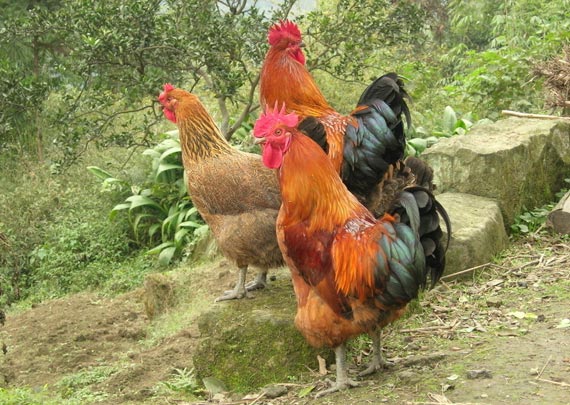
Free-range chickens unsalable in many places. Why can't green food be sold?
According to a report by China National Radio's "Sannong China,"free-range chickens, as a type of non-cage-raised meat chicken, are widely welcomed in urban and rural markets for their delicious meat, and the price of their meat is generally higher than that of cage-raised meat chickens. In recent years, as a type of specialty farming, free-range chicken farming has sprung up all over the country.
However, in the past two years, as farming volumes and market-ready volumes have increased, the market for free-range chickens has gradually become saturated, and this year free-range chickens in many places have become unsalable.
In Dongfeng Village, Nonghe Town, Tonghe County, Heilongjiang Province, villager Liu Guofeng rented a plot of land two years ago at the foot of the scenic Huazi Mountain and began raising Liangshan free-range chickens. Thanks to her green, original-ecology farming environment and methods, her Liangshan free-range chickens sold out last year. Seeing good prospects for development, this year Liu Guofeng raised funds to expand her farming scale, but at the time she forgot to take sales into consideration. Now the Liangshan free-range chickens, raised for more than seven months, have mostly reached more than 4 jin, exactly at their plumpest and most delicious stage, yet sales have now become a major problem:
Liu Guofeng: Last year, I raised more than 2,000 chickens and sold them all. This year, I wanted to raise more, thinking they should also sell well. As a result, I only sold more than 4,000, and there are still more than 6,000 left. I am quite worried. The chickens cannot be sold, and they still eat grain every day.
Liu Guofeng of Heilongjiang is not the only one facing unsalable free-range chickens. Wu Yunkang's family is a impoverished household in Nanming Town, Jianhe County, Guizhou Province. In May this year, he received 500 chicks from the local town government. During this period, other poor households also gave Wu Yunkang more than 300 of their own chicks. He had thought that after these 800 free-range chickens were ready for market, they could be sold for a good price and help him escape poverty as soon as possible. However, by October this year, these free-range chickens had all grown up, but Wu Yunkang still had not found a sales channel. Wu Yunkang, a villager of Nanming Town, Jianhe County:
Wu Yunkang: Sales are now quite difficult. They cannot be sold. It is already December, and I have only sold more than 50.
Wu Yunkang said that now is when these chickens have the best appetite, and feed alone costs nearly 200 yuan per day. Most of the chickens Wu Yunkang raises are roosters, which only eat feed and do not lay eggs. If they cannot be sold for a long time, the cost of the chickens will become higher and higher:
Wu Yunkang: It is very risky now. The feed is also gone, and there is nothing left to feed them. How can I recover the cost? I will still have to put in quite a bit more money.
The reporter learned from the Poverty Alleviation Office of Jianhe County, Guizhou Province that in 2016 the county purchased a total of 147,000 chicks. All townships distributed the chicks to poor households in April and May. By September and October this year, the unsalable chicken situation had already attracted the county's attention. Jianhe County began encouraging some public employees to buy chickens from poor households nearby, and contacted canteens of enterprises within the county to purchase as much as possible. At the same time, it also expanded sales through some introduced e-commerce enterprises, but the results were not very ideal. Zhang Zhuting, acting deputy mayor of Nanming Town, Jianhe County, Guizhou Province:
Zhang Zhuting: Recently, I have traveled around the entire Guizhou Province market. Because the whole of Guizhou Province is carrying out major poverty alleviation, and our area is mountainous, many farmers have no other experience, so quite a few have taken up chicken-raising projects. Everyone has crowded into the same space.
The situation in Guizhou can be said to be a microcosm of specialty pheasant farming across the country. In recent years, many places across the country have relied on their local geographical advantages to vigorously develop pheasant and mountain chicken farming, hoping to use specialty pheasant farming to drive local prosperity and poverty alleviation. However, most have focused only on increasing farming numbers while neglecting the grasp and analysis of market information, as well as the development and cultivation of the market.
Wang Yanhua, a specially appointed expert of the China Poverty Alleviation and Development Center, said that specialty pheasant farming has already become excessive. Local governments should, on the one hand, actively help farmers find sales channels, and on the other hand, actively bring leading enterprises into industrial development to open up and cultivate a larger market for specialty pheasant farming:
Wang Yanhua: Capital and society, that is, financial capital and social capital, are absent here. This is a very important issue. From the perspective of institutional design, what the government should do is design relevant plans, provide relevant policies, and guide the direction of the industry.
Shi Qingcai, an analyst at Beijing Shuitun Wholesale Market, said that farmers themselves should also take active action to cope with various risks in the market:
Shi Qingcai: First, they should use information-based means to grasp the national market situation as comprehensively as possible, not follow trends blindly, and stagger their market timing to ensure that what they grow can be sold at a good price; second, they should work hard on varieties and structure; third, it is recommended that farmers join rural cooperative organizations or establish rural cooperatives to increase their ability to withstand risks; fourth, they should innovate in marketing channels and business methods; in addition, they can also try purchasing insurance to prevent losing everything due to natural disasters.