Apple supply exceeds demand and prices keep falling; making money from apple growing is hard this winter
Qingdao, Shandong: this winter apples sell for radish prices; supply exceeds demand causes prices to keep falling, making it hard for fruit farmers to earn money
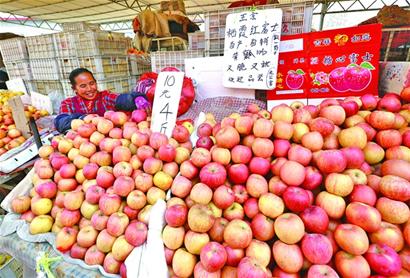
Every year in autumn and winter, apples flood the market, with local Golden Delicious, Yantai Red Fuji, ** Aksu…… all coming to Qingdao to grab market share. Recently, reporters found during visits that although it is again the season when Qingdao has “a hundred fruits blooming together,” this year's apple market is not as hot as in previous years, and some apple prices have even fallen to just over 1 yuan per jin. Some industry insiders analyze that rising apple production year after year and an imbalance between supply and demand are the main reasons for the shrinking prices, and suggest that fruit farmers develop online sales and open up export markets.
Market
Apples from many places compete for the Qingdao market
Yesterday, reporters learned from the Qingdao Orient Dingxin International Agricultural and Sideline Products Trading Center that the market currently handles about 2,000 tons of apples per day. “On the market now, Qingdao local and Yantai apples can account for about 70%, ** Aksu apples account for 20%, and the rest are from Shaanxi, Shanxi and other places, plus a small amount of imported apples.” said Yuan Ming, a relevant person in charge of the Qingdao Orient Dingxin International Agricultural and Sideline Products Trading Center. He said that every year around May 1, apples begin to come onto the market one after another, with the earliest variety being Gala from Shaanxi, though the quantity is relatively small; around October 1, apples from within the province begin to be marketed in large quantities, with the main varieties at present being Red Fuji and Golden Delicious, mainly from Yantai and Qingdao's Pingdu and Laixi.
According to Yuan Ming, Red Fuji apples currently occupy the mainstream of the market, among which Qixia Red Fuji is relatively popular. Yantai apples also all choose to come to Qingdao every autumn and winter to seek business opportunities, while local Red Fuji, as output and quality improve year by year, also has an expanding market, and many southern traders have set their sights on apples from Pingdu and Laixi. “There is another situation: because Yantai apple prices are generally low this year, this has squeezed the market share of other domestic apple-producing areas, and the market share of apples from other places such as Shaanxi is obviously smaller this year.” Yuan Ming said. In addition, reporters also learned that Aksu apples from ** have gradually gained their own customer base, and their rock-candy core characteristic and exquisite gift-box packaging have become selling points for Aksu apples in seizing the market. Today's Qingdao apple market presents a situation of “a hundred fruits blooming together” and “a hundred fruits competing in beauty.”
“Red Fuji apples are selling cheap, 2 yuan per jin, come take a look.” At the Fushun Road wholesale market, reporters found that in the fruit sales area, apples had already become the main attraction on fruit stalls, with Red Fuji, Golden Delicious, Guoguang and ** Aksu and other varieties all occupying a place on vendors' stalls. “What sells the most now is Red Fuji and Golden Delicious, among which Red Fuji accounts for a fairly large proportion.” When chatting about this year's apple business, stall owner Mr. Zhang sighed and said helplessly that this year apples were almost being sold at radish prices. Zhang said that at his stall Red Fuji sold for only 2 yuan per jin, while smaller ones sold for 10 yuan for 7 jin, and Golden Delicious was even cheaper, at only about 1.5 yuan per jin. “The overall price of these varieties is 20% to 30% cheaper than in previous years.” Zhang said.
In addition to the price cuts on relatively affordable loose apples, reporters learned that some branded apples with exquisite packaging and excellent appearance are also fairly affordable this year. “Boxed Qixia apples now sell for only 80 yuan, with better quality than before, but the price is more than 10 yuan cheaper.” Zhang said. At the Qingdao Orient Dingxin International Agricultural and Sideline Products Trading Center, Yuan Ming said that on December 1, the wholesale price of Red Fuji apples with a diameter of 80 mm was about 2 yuan per jin, more than 20% cheaper than in 2015 and more than 30% cheaper than in the best market two years earlier.
At the Zhenjiang North Road farmers market, reporters saw that Qixia Red Fuji was mostly priced at 10 yuan for 4 jin and 10 yuan for 5 jin. Vendors put up promotional signs such as “self-produced and self-sold” and “crisp and sweet,” but business was still slack. “At this time last year, the price was about 1 yuan higher than now, but sales were good; this year it is cheaper yet still does not move.” Fruit stall owner Ms. Wang told reporters that apple sales have been unable to pick up this year, and some apple vendors have in turn competed to lower prices, which has also led to the continued sluggishness of apple prices this winter.
Accounting
Fruit farmers repeatedly lament that it is hard to make money
“Planting costs are higher, but prices have come down. It is not easy to make money from apples this year!” Yesterday, reporters interviewed Sun Xuehao, a fruit farmer in Panjialing Village, Guanli Town, Qixia City, Yantai. He said that last year his family had just cut down some old fruit trees that had been planted for many years and replaced them with a new crop of fruit trees. Because the new fruit trees could not yet bear fruit, this year's harvest was not considered good, with a total of more than 50,000 apples harvested.
Sun Xuehao told reporters that there are quite a few fruit farmers like him locally. Under normal circumstances, managing an orchard each year requires the following expenses: apple bags, fertilizer, fuel for agricultural vehicles, and hiring people to bag, remove bags and pick apples. “This year my family had relatively few apples, so when bagging, removing bags and picking apples, we did not hire people, which saved a large sum.” Sun Xuehao said. Even so, his family's apple tree management cost this year still reached tens of thousands of yuan. According to Sun Xuehao, there are still quite a few large apple growers in their village, with more than ten mu of orchards at home, who need to hire help every year. Based on this year's market, bagging costs 260 yuan per person per day, bag removal costs 150 yuan per person per day, and apple picking costs 130 yuan per person per day. “For example, if a household hires 3 people for bagging and hires them for 8 days to finish bagging, in just 8 days the hiring cost alone is 6,240 yuan.” Sun Xuehao said that for some large local apple growers over the course of a year, excluding their own labor costs, visible costs alone reach 40,000 to 50,000 yuan.
Ways out