What is the long bean price situation this year? Will "Bean You Play" happen again?
Long beans, also called pole beans, are an indispensable dish on the table all year round. At this time last year, long beans were selling extremely well. As another winter arrives, the production areas for bean-type vegetables are continuously shrinking, and market supply has also dropped sharply.
So, will this winter's long bean market repeat last year's boom? And how should vegetable farmers view the price signals given by the agricultural product market?
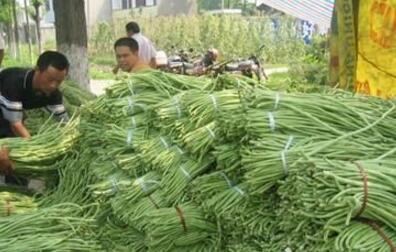
Sun Chengwen, a farmer in Shishugang Township, Feixi County, Anhui Province, grows dozens of mu of vegetables at home. Every spring, he plants five mu of greenhouse long beans, and in summer, he plants another ten mu of open-field long beans. This year's long bean market has been fairly good, which has filled Sun Chengwen with confidence for next year's harvest.
Sun Chengwen: This year's price is still okay. The wholesale price in spring was about 3 yuan per jin, and in summer about 2 yuan. Spring was a bit higher. This year's long beans are a bit higher than last year, about 5 to 6 mao higher. This year I earned a bit more than last year, and a bit more than growing other things. It is a cash crop, so the economic return is definitely a bit higher.
It is understood that the long beans currently sold on the northern market, apart from a small amount of greenhouse long beans from Liaocheng, Shandong, mainly come from Yuanmou and Baoshan in Yunnan, Hepu in Guangxi, and Zhangzhou in Fujian. Buyers from all over the country gather in these production areas to snap them up, causing long bean prices to rise slightly. We also interviewed Liu Tong, head of the Statistics Department of the Beijing Xinfadi Market.
Liu Tong: Last week there were still a small amount of long beans produced in Hebei, Tianjin, and Liaoning entering Beijing. This week, long beans produced in these places have completely withdrawn from the market. On November 4, the wholesale price of long beans at Xinfadi Market was 2.2-2.8 yuan/jin, and the price on October 28 was 2-2.8 yuan/jin, a slight week-on-week increase of 4.17%; the price in the same period last year was 2.9-3.2 yuan/jin, a year-on-year decrease of 18.03%.
In the southern market, the situation is roughly the same. The current long bean supply at the Baishazhou Market in Wuhan, Hubei, mainly comes from Guangxi, with only a very small amount of tail-end supply from within the province and nearby suburbs. Wang Lianggui, an analyst at the Baishazhou Market, said that affected by weather and temperature, Guangxi long bean prices fluctuated frequently in October and were still rising in November.
Wang Lianggui: Entering November, local long beans have recently come to an end. At present, only Guangxi remains as a source of long bean supply, and purchase prices in Guangxi's long bean production areas have risen, causing wholesale prices to follow suit. This week, long bean prices rose to 6-6.5 yuan per kg, and at the highest reached 7-7.5 yuan. The main reason is that the volume entering the market has recently decreased while demand has not diminished, causing long bean prices to continue rising.
At this time last year, the prices of bean-type vegetables were relatively high, which led to obvious expansion of planting by growers this year. However, because southern regions experienced repeated rainfall and high temperatures this year, bean-type vegetables were affected to varying degrees in the earlier period, and yields per mu declined somewhat, so bean-type vegetables did not see a situation of supply exceeding demand.
Although pole bean prices have fallen year on year, supply capacity is still relatively fragile. Once the weather in the production areas changes, output will be affected, and prices will fluctuate noticeably. Wang Lianggui said that it may take about another month for this situation to reverse.
Wang Lianggui: Southern China was hit by typhoons twice this year, which had a major impact on agricultural products. Most crops suffered reduced output and income, and supply decreased, which is the main reason for this year's rise in long bean prices. Later, after Guangdong long beans come onto the market and supply increases, there should be a possibility that long bean prices will fall. At the same time, the possibility of prices rising due to low supply cannot be ruled out.
Due to the impact of cold waves, from last winter to this spring, vegetable prices reached their highest point for the same period in previous years. Liu Tong advised farmers not to base their decisions solely on last year's prices and market conditions, but to arrange production reasonably and not blindly expand planting.
Liu Tong: At present, the prices of bean-type vegetables are still relatively normal. What we are more worried about now is vegetable production this winter and next spring. We hope farmers will not arrange next spring's production based on this spring's prices, and will prevent some vegetables from becoming difficult to sell this winter and next spring. Do not be influenced by this price. You should still arrange your own planting area reasonably and not blindly expand planting.