Growing Green Strawberries with "Mites to Control Mites"
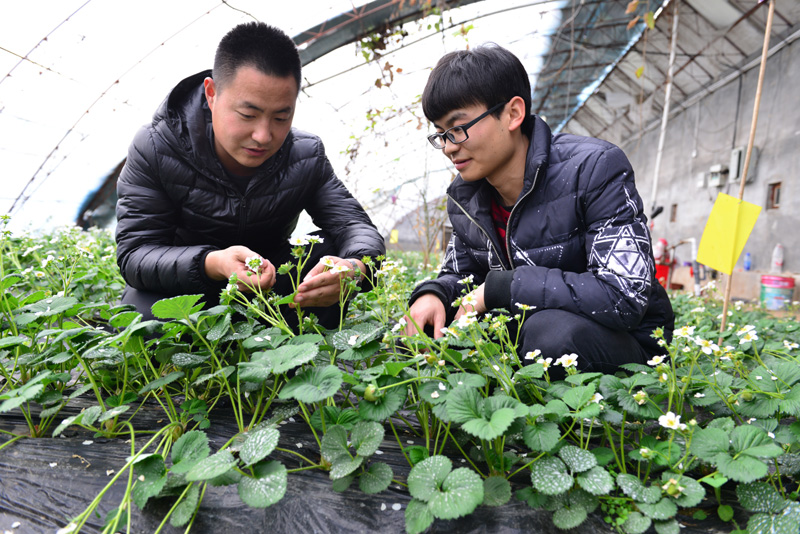
Zhenyu (left) and his partner inspect the strawberry growth.
These past few days, the first batch of strawberries of this winter has ripened, and this is the busiest time for Zhao Zhenyu.
"My family's strawberries truly have not a single drop of pesticide sprayed on them." Zhao Zhenyu is a graduate student majoring in vegetable science at the College of Agriculture, Inner Mongolia Agricultural University. He grows strawberries a bit differently from others. At the greenhouse entrance there is a "door curtain" that looks like gauze netting. It turns out this "door curtain" is an insect-proof net. Not just at the entrance, the entire greenhouse is covered with insect-proof netting, just like a giant mosquito net. With it, insects from outside the greenhouse cannot even dream of getting in.
Upon entering the greenhouse, small bags about 2 cun square are hung every few meters. "Each small bag contains more than 200 predatory mites. Using them to prey on the two-spotted spider mites and red spiders in the strawberry field means we don't need to spray chemical pesticides," Zhao Zhenyu explains. "Don't underestimate these bugs, which are even smaller than a sesame seed; they are genuine biological guardians. Take the greenhouse in Genbao Village, Jinhe Town, Saihan District, Hohhot as an example: relying on them, the control rate against the two main pests and diseases of strawberries, tomatoes and other fruits and vegetables, the two-spotted spider mite and the red spider, has reached 100%." In addition, green control methods such as solar insect-killing lamps, insect-attracting boards, and planting garlic between the ridges are widely applied here.
The benefits of green control need no elaboration. In recent years, the public has placed ever higher demands on eating healthily, and the problem of excessive pesticide residues in agricultural products has attracted widespread attention. In some places, excessive reliance on chemical pesticides has led to rising pest resistance, declining control efficacy, intensified agricultural non-point source pollution, and damage to biodiversity. Transforming traditional control methods and vigorously promoting green control technologies to control pesticide and harmful biological toxin residues from the production process can be said to be an effective way to promote the quality and safety of agricultural products and the safety of the ecological environment.
Saihan District is the capital's green pollution-free vegetable base. Vegetable cultivation has become the main way for farmers to get rich and increase their income. Green control technology was first promoted here, and Zhao Zhenyu is the science and technology commissioner stationed in Genbao Village.
"I really never expected that without using the old method of spraying pesticides, pests and diseases could still be kept under control!" From initial skepticism to now complete conviction, some villagers in Genbao Village have begun to change their thinking, gradually shifting from passive acceptance to active application, and from traditional pesticide spraying for pest control to biological pest control.
However, promoting green control technology is not easy. Farmers tend to believe what they see with their own eyes. When they see a large patch of pests die after crops are sprayed with pesticide, they are convinced. Yet biological control cannot achieve such an immediate effect. Every organism in nature has one or several natural enemies. Green control technology works by introducing and using natural enemies, which can effectively suppress the mass reproduction of pests, achieve balance among biological populations, and accomplish the goal of pest control.
"Pest control is not about killing all pests, but about preventing pests from running rampant. However, green control technology has not yet formed a systematic framework, and not all pests and diseases can be controlled in a timely manner. Add to that the relatively high cost of control, and it is somewhat difficult to get farmers to quickly accept such a concept." Since he began growing strawberries in 2014, Zhao Zhenyu has been committed to promoting green control technology for strawberries.
Today, his entrepreneurial team already has 8 people, each with their own responsibilities, and together they founded Inner Mongolia Chiqing Agriculture and Animal Husbandry Technology Co., Ltd. They have proposed the "Chiqing Premium Products" plan, which is to have one product drive one village, use green control technology to help farmers truly become prosperous, and let more people eat healthy agricultural and livestock products.