The fortune-building story of Ma Wenying, a leader in mango cultivation
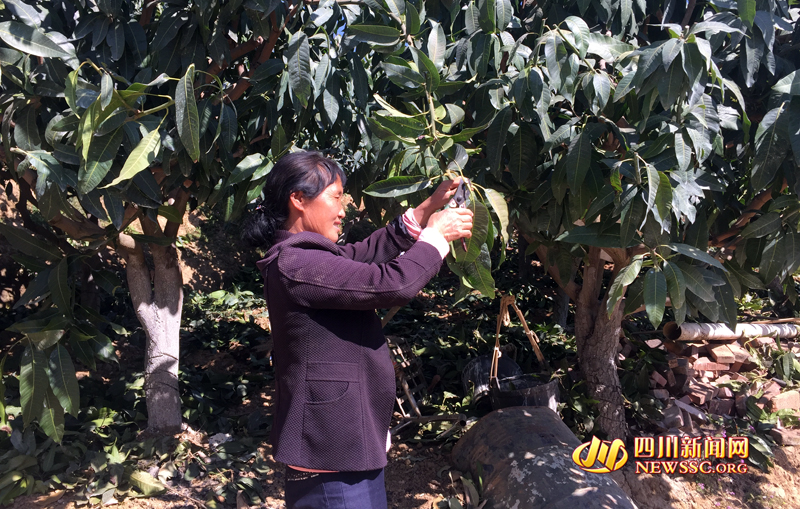
The photo shows Ma Wenying pruning mango flower seedlings.
Her dark skin complements Panzhihua's bright sun perfectly, her cheerful smile is as warm and gentle as a February breeze, touching the heart, and her plain yet confident words reflect the proud changes this village has undergone over the years.
Ma Wenying, a native of Na'erhe Village, Tongzilin Town, Yanbian County, Panzhihua City, was born in October 1966 and joined the Communist Party of China in February 2006.
Among the first to try growing mangoes, facing numerous difficulties
Ma Wenying, now 50 years old, was born into an ordinary farming family and has been farming at home since graduating from junior high school in September 1980. For a long time, the family's main source of income was growing corn and other grain crops, and family life was relatively difficult. After marriage, the arrival of two children left her at even more of a loss.
How to escape poverty and embark on the road to moderate prosperity became a problem that troubled Ma Wenying for many years.
In 1999, the nearby Jinhe Village achieved initial success in mango cultivation, and Ma Wenying saw hope in it. Na'erhe Village's geographical location is similar to Jinhe Village's special geographical location, with abundant mountain resources, no pollution from surrounding industrial or mining enterprises, and exceptionally favorable climate, sunshine and temperature conditions.
At this time, after continuous exploration and investigation, the village Party branch also decided to grow mangoes. Ma Wenying became one of the first people in Na'erhe Village to "eat the crab": she decisively took the lead in purchasing more than 1,000 mango seedlings and began a long road of learning and practice. However, due to relatively low cultivation techniques, problems such as small fruit size, low quantity and poor taste appeared, and economic returns remained less than ideal.
"The mango growing cycle is generally 5 years. When my family's trees bore fruit for the first time, we only sold a little more than 1,000 yuan," Ma Wenying recalled.
Overcoming difficulties, earning nearly a million yuan a year
In 2006, with strong support from the Party committee and government, agricultural technicians began going to Na'erhe Village to guide mango cultivation techniques and provide theoretical and technical training to growers. The eager-to-learn Ma Wenying not only actively participated herself, but also mobilized neighbors and relatives who thought technicians focused only on theory and were not good at practical operations to go listen to the technicians' explanations together.
For Ma Wenying, who had only a junior high school education, the training process was not easy, but she did not complain of hardship or fatigue, and secretly resolved that she must master the techniques thoroughly. In class, Ma Wenying took careful notes, actively asked the teacher about knowledge she did not understand, and after class bought relevant books and studied them carefully.
In order to put the theories she learned into practice, Ma Wenying carried out mango cultivation experiments on her family's 2 mu of land, applying the theories she had learned to practice, constantly discovering new problems and solving new problems in the process.
In 2007, Ma Wenying carried out two experiments, testing mango cultivation techniques under different environments, and achieved success in the new technology experiments. The success of the new mango cultivation technology experiments greatly encouraged Ma Wenying.
In 2008, she decided to invest all of the family's more than 50 mu of hillside land, mainly planting two varieties, "Keitt" and "Ivory". Due to changing environmental factors, in May 2008, about 6 mu of mangoes in Ma Wenying's plantation were infected with bacterial fruit spot disease.
"At that time, the mango trees had just set fruit. If not handled well, it would have a very big impact on the whole year's harvest," Ma Wenying did not dare be careless. She actively consulted books, watched series programs on mango cultivation, asked technicians, and worked hard to find the cause of the problem and solutions. With everyone's joint efforts, the disease was finally brought under control, greatly reducing the impact of the trees' illness.
Over the years, Ma Wenying did not slacken, continuously learning new knowledge and new technologies, constantly improving cultivation techniques, and constantly broadening her learning channels. By 2011, her family's mango orchard output value reached more than 800,000 yuan, and in 2015, the year with the highest annual output value, it reached nearly one million yuan. The former barren hills and slopes became a "prosperity orchard" with an output value of tens of thousands of yuan per mu, and Ma Wenying also became an advanced household in mango cultivation in Na'erhe Village and a good example of building wealth.
"As long as the market is stable and the weather doesn't cause major problems, I think it can break a million this year," Ma Wenying said happily.
Entering moderate prosperity early, quality of life greatly improved
In 2008, the government built a road directly to Ma Wenying's doorstep as a reward for her earning more than 500,000 yuan a year from mango cultivation, and Na'erhe Village's former dirt roads gradually became cement roads.
In the same year, Ma Wenying built a 280-sq-m villa, bidding farewell to the bitter days when "rain leaks through the roof just when it rains all night". Not only that, she also bought a house in the city worth more than 700,000 yuan as a place for the family to rest when doing business in town. When Ma Wenying was just over 40, she also obtained a driver's license and bought an off-road vehicle worth more than 200,000 yuan as transportation for travel and tourism. "When I'm not busy, I close the door and take the whole family out to travel and relax," Ma Wenying said.
After Ma Wenying's son graduated from university, he gave up a good opportunity for employment in a big city and resolutely returned to the countryside to grow mangoes with her, leading the villagers to prosperity together.
Only when everyone is prosperous is it true prosperity
While enjoying a bountiful harvest, Ma Wenying did not forget to give back to society. She often says that her success relied on the care and support of the Party and the government. As a member of the Communist Party of China, she actively gives play to the advanced nature of Party members. While developing herself, she does not forget to reach out a hand, using her own advantages to call on more people to participate in mango cultivation. In helping and guiding others, she insists on taking the lead in doing, learning and demonstrating, constantly raising the enthusiasm of the people for growing mangoes.