Cattle-raising expert Wang Weiwei: Never forgets his fellow villagers on the road to prosperity
In Yanglang Village, Guyuan City, there is a famous cattle-raising "expert." When people mention him, the villagers cannot help but give a thumbs-up. He is Wang Weiwei. Young as he is, through working with cattle, he not only found his own path to prosperity but also led the villagers into the battle against poverty.
Be a mindful person, and cattle raising can bring prosperity
Wang Weiwei, 34 this year, started working as a carpenter right after graduating from middle school. Though young, he was full of ideas. At that time, many villagers were leaving home one after another to work elsewhere. Unwilling to leave his hometown, he borrowed 5,000 yuan from his family and set up a small household workshop to produce and sell wooden products. Unexpectedly, business went quite well, and after several years of hard work he had saved several hundred thousand yuan. A few years later, Wang Weiwei found that the timber business was gradually becoming difficult, as wood was being replaced by steel in many places. Starting in 2011, he tried working as a laborer in Guyuan City, carrying bricks and mixing cement, earning only 25 yuan a day. Not only was it hard work with little pay, but he was often scolded and made to feel wronged. With no other choice, he returned to the village to learn carpentry and also did a bit of small-scale farming at home. At that time, the village households all had a tradition of raising cattle, so Wang Weiwei set his sights on cattle raising.
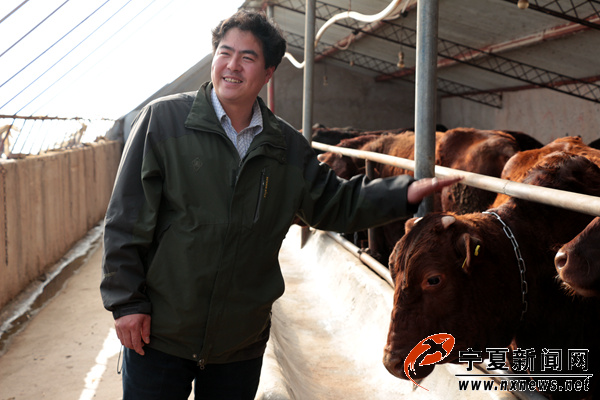
Wang Weiwei with his cattle.
In 2014, Wang Weiwei took out more than 200,000 yuan of his savings and scraped together another 400,000 yuan, built a 1,000-sq-m cattle shed, and raised 70 head of cattle. "That year, the beef cattle market was very promising. One of my cattle sold for a high price of 15,000 yuan, with a net profit of 3,000 yuan per head. That year I made more than 200,000 yuan." Wang Weiwei tasted the sweetness that cattle raising brought and dug up his first pot of gold. That same year, he also received government support, expanded the cattle shed, and established Weiwei Family Farm, becoming the village's cattle-raising king.
Diligent study and eager questioning made him a cattle-raising expert
In the process of raising cattle, Wang Weiwei persisted in taking the path of scientific breeding, often exploring and learning new methods and new technologies. He frequently held video conversations with breeding experts from the city and county through the village's call center for agriculture, rural areas, and farmers. After several years of exploration, Wang Weiwei transformed from a layman into a cattle-raising expert.
Now, he has a schedule for what time to give the cattle fodder every day; every time there is epidemic prevention, he writes it down in a notebook; when they are due to give birth, he records it on the cow breeding record registration card... Wang Weiwei uses cattle manure to fertilize crops and feeds corn to the cattle, achieving circular and sustainable economic use. He also stumbled into a highlight of cost saving and efficiency improvement: because he felt it was too troublesome to thresh and remove the cobs every time he used corn to make feed for the cattle, he put the whole corn and corn stalks into the feed machine to make feed. "Once an expert came and saw that my cattle were growing well, so he asked me what I fed them. I said it was corn with the cobs still on. The expert said the protein content of corn cobs is second only to corn kernels. I did the right thing by accident," Wang Weiwei said with a smile.
On the road to prosperity, one must not abandon fellow villagers and elders
"Although our village became the first '100-million-yuan village' in the southern mountainous area ten years ago, there is still a large gap between rich and poor and uneven income. We still have 83 impoverished households," Cao Hui, Party secretary of Yanglang Village, told reporters. Wang Weiwei has become rich himself, but he has not forgotten his fellow villagers and elders.
Starting in August 2016, six registered poverty-stricken households in the village placed the cattle they had bought with their savings or national loans into Wang Weiwei's family farm for foster care. Yang Bao, in her fifties, lives alone at home; her children all work elsewhere, and her husband has passed away. It was inconvenient for her to build a cattle shed and feed the cattle, so she placed 3 cattle with Wang Weiwei. "I feel at ease leaving them with him. We come to see them once every ten days or half a month. They are raised much better than if we did it ourselves!" Yang Bao told reporters. If the cattle placed by villagers with Wang Weiwei give birth to calves, after the calves grow up the villagers can either ask Wang Weiwei to help contact buyers or sell them to him. "You help raise them for free and do not charge them money?" a reporter asked Wang Weiwei. "They are all people from our village, and their conditions are not good. If I can help, I help. How could I charge them money? After the cattle are sold, I only take the fodder cost, and the rest of the money all goes to them."
Wang Weiwei also hired 2 people from the village's most vulnerable households to work as full-time feeders on the family farm. "Working as a full-time feeder earns about 18,000 yuan a year. Now the two of them have also escaped poverty," Wang Weiwei said happily.
In October 2016, Wang Weiwei was elected deputy Party secretary of Yanglang Village. "I am especially grateful for everyone's trust. Last year I built two new cattle sheds. Now my greatest wish is to expand the breeding scale to 500 head, let the villagers all come in as shareholders, and help everyone live a good life!" Speaking of his plans for the new year, Wang Weiwei said earnestly.