Guiyang, Guizhou: Ten Thousand Mu of Kiwifruit Thrive Through Technical Cultivation, Becoming Farmers' Path to Prosperity
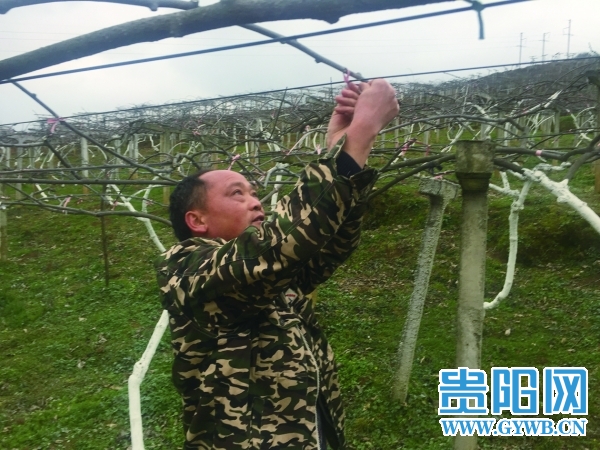
Villager Li Xingxiang prunes and trains the vines of kiwifruit trees.
Starting from Xiuwen County town and heading southwest toward Pingtan Village in Gubao Township, the undulating mountain roads are flanked by rocky hills and earthen slopes, with small patches of farmland scattered intermittently among them. "Little farmland, many barren hills" was once the most awkward scenery of Pingtan Village. Now, kiwifruit trees cover the hillsides everywhere, and over ten million kilograms of kiwifruit leave the mountains each year, their fragrance reaching Guiyang and even beyond the province. Each fuzzy, unassuming kiwifruit has become the local villagers' "fruit of prosperity."
Technology Enriches Farmers: Household Annual Income Exceeds 300,000 Yuan
On February 21, a "late spring cold snap" struck, with freezing rain falling from the sky. Spring plowing had not yet begun, but the fruit orchards of Pingtan Village presented an entirely different scene. Along both sides of the village road, the "T"-shaped concrete trellises erected on the hillside fields grew increasingly dense. Standing at a high point and looking down, the concrete "T" shapes spread across the hillsides, and villagers were busy weaving among them at work.
The temperature had already dropped to zero degrees, yet 52-year-old Li Xingxiang still insisted on coming to his family's orchard early in the morning to prune and train the kiwifruit vines. "The T-shaped trellis is very important. Good fruit depends on it. Pruning is even more important. I know exactly how many fruits my pruned branches will bear this year, 10 jin or 20 jin. For branches that could only bear 10 jin of fruit, after my pruning they can bear 15 jin." Li Xingxiang was one of the first villagers in Pingtan Village to plant kiwifruit, and his oldest trees are already 23 years old. Now all three members of Li Xingxiang's family are well-known "fruit tree experts" in the village, and farmers often "invite" them to prune kiwifruit. A single "technical house call" costs 300 yuan in service fees. Li Xingxiang said that if he, his wife, and his son all went out together, they could earn nearly a thousand yuan a day just from "side income."
"Since planting kiwifruit, the whole family's income has increased more than tenfold compared to when we grew vegetables." Li Xingxiang did the math: in the past, growing vegetables with little farmland and many barren slopes, after a year of hard work, there wasn't even enough to eat. In recent years of planting kiwifruit, both yield and quality have improved year after year. Last year, the family's 7 mu of kiwifruit trees produced 40,000 jin, with an income of 260,000 yuan. Adding other technical service income, earning 300,000 yuan a year is no problem.
Support from All Sides: Kiwifruit Trees Bear the "Fruit of Prosperity"
Li Xingxiang's happiness did not come easily. Going from an annual income of a few thousand yuan to 300,000 yuan, from a poor vegetable farmer to a comfortably well-off technical fruit grower, Li Xingxiang spent 20 years and shed countless drops of sweat in effort.
"When we switched from growing vegetables to growing trees, nobody in the village knew how, nobody could do it. What to do? Learn everywhere, ask everywhere! Wherever there was an expert giving training, I would go to listen. If the expert couldn't come, I'd buy books and study on my own. How to prune branches, how to thin fruit -- constant experimentation, and starting over after failures. I didn't have much education originally, but planting kiwifruit practically 'forced' me into becoming a scholar." Li Xingxiang said.
Pingtan Village Party Secretary Cai Renzheng introduced that there are many kiwifruit "large-scale growers" just like Li Xingxiang. There is no secret to success, only four words: "never give up." Cai Renzheng said that when Pingtan Village first began promoting kiwifruit cultivation, only a few households participated. In the early years, kiwifruit prices couldn't rise, but the village party secretary at the time led the villagers in never giving up, firmly believing they could not return to the hard days of depending on the heavens for a living.
Over the years, the village committee actively sought provincial, municipal, and county financial poverty alleviation project funds, and vigorously promoted and mobilized villagers to build T-shaped concrete trellises to raise the level of standardized cultivation. At the same time, infrastructure construction was intensified, including upgrading the village access road, group access roads, and orchard tractor roads, and building cold storage facilities, solar insect-killing lamps, and street lights. Meanwhile, technical experts from Guizhou University, the Provincial Academy of Agricultural Sciences, and the Science and Technology Department were actively invited to the village to carry out technical trials and demonstrations such as mechanical pollination, soil testing and formula fertilization, and integrated pest and disease control.
In 2016, Pingtan Village's kiwifruit planting area reached over 12,000 mu, with 9,510 mu bearing fruit. Total output reached 11,887,500 kilograms, total income reached 130 million yuan, and per capita income reached 35,000 yuan. The village's student enrollment rate reached 99.17%, with 1,982 mobile phones, 101 agricultural vehicles, and 215 cars.
Integrating Agriculture and Tourism to Build a Full Kiwifruit Industry Chain
Driven by the demonstration effect of Pingtan Village, "If you want to get rich fast, planting kiwifruit is a path" has become a common saying among farmers in Xiuwen County.
Li Xingxiang said that Pingtan Village's kiwifruit industry is now developing in a standardized way, and the expansion space for each household's land is also limited. Since last year, he began working on improving the taste of kiwifruit, creating premium fruit and branded fruit, and using organic fertilizer for green ecological management. "Only by improving quality can the market develop sustainably." Li Xingxiang said.
Gu Qingjun, deputy head of Gubao Township in Xiuwen County, said that currently over 95% of villagers in Pingtan Village have been mobilized to plant kiwifruit. Among them, households with high yields can earn annual incomes approaching one million yuan, while ordinary households earn between 100,000 and 200,000 yuan per year.
According to natural patterns, kiwifruit blooms in May each year and is harvested from September to October. Fresh fruit storage period is only 1 month. Currently, Gubao Township's cold storage capacity has reached 10,000 tons, and through the cold chain, the kiwifruit sales period can be extended to 2 to 3 months. Gu Qingjun introduced that next, the entire township will continue to increase cold storage capacity, extend farmers' fresh fruit sales period, and continue to advance kiwifruit industry development, relying on large companies and large bases to gradually transform more farmers into industrial workers. In terms of integrating agriculture with tourism, Gubao Township already has 25 farmhouse restaurants, and plans to integrate resources from Pingtan Village and other villages to build a kiwifruit ecological park, establish a full industry chain, and promote integrated agricultural and tourism development.
Currently, Pingtan Village's kiwifruit industry has gradually formed a "company + cooperative + base + farmer" development model, powerfully driving the large-scale development of the kiwifruit industry in surrounding areas and even the entire county.