Farmer returns home to start a business, digging a road to wealth out of the farmland
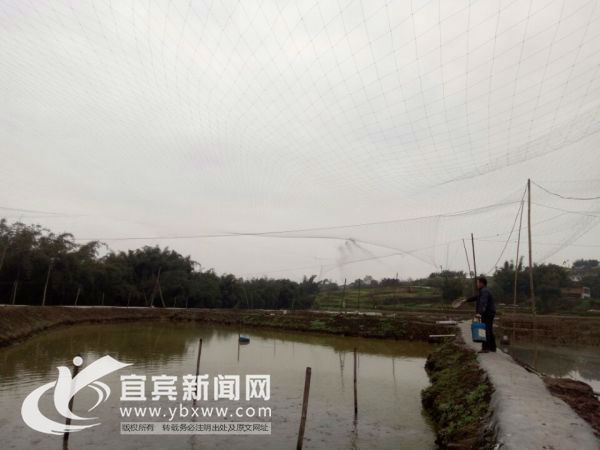
Yang Hongquan is feeding the loaches.
Yang Hongquan, now 44 years old, is a native of Shihe Village, Shahe Town, Gao County. In just three short years, this returning entrepreneur has "dug" a road to wealth out of the village's idle farmland. Today, many of the village's fields have been contracted by Yang Hongquan for loach farming, bringing in an annual income of around 300,000 yuan.
Field trips and returning home to start a business
Previously, Yang Hongquan had always worked away from home. To make it easier to care for the children and elderly at home, in 2013 Yang Hongquan came up with the idea of returning home to start a business. "When I was little, there were plenty of wild loaches in our fields, and I used to dig for loaches in the fields. It's just that wild loaches have gradually declined, yet market demand for loaches is still very large, so I wondered whether I could use the family's farmland to raise loaches."
According to Yang Hongquan, after deciding to try loach farming, he travelled to places such as Jiangsu and Zhejiang, Chongqing, Neijiang and Leshan to study their farming experience and techniques. "Through continuous research, I found that loaches not only have strong adaptability and are simple and easy to farm, but also require little investment and offer high returns. Among them, the Taiwan loach grows fast and can be sold after about every three months, so I decided to give farming them a try."
In 2014, Yang Hongquan bought 300,000 fry from Leshan and began his journey of returning home to start a business. "Because I'd dealt with loaches since childhood, I understood their habits fairly well. Add to that their strong adaptability and the village environment being well suited to loach growth, and things went fairly smoothly at first."
Artificial hatching.
Accumulating experience and studying with dedication
But the good times did not last. Soon afterward, Yang Hongquan's loaches began dying in large numbers. "After careful observation, I found that most of the loaches were floating belly-up on the water surface, with swollen abdomens and listless energy. Based on their symptoms, I looked up a great deal of relevant information online and consulted experts, and finally found the root of the problem: enteritis." Once the root cause was found, of course the right remedy was applied. Yang Hongquan said there are many causes of enteritis; overfeeding, spoiled feed and changes in weather can all trigger it. After this lesson, Yang Hongquan actively paid attention to preventing various loach diseases during farming.
Yang Hongquan said that in the first year he brought in fry twice and found that not only was the survival rate of the fry low, but after a whole year of hard work there was almost no profit, which gave him the idea of researching loach fry breeding himself. "In 2015, I consulted a lot of information and found that after spawning, loaches eat the eggs they have laid, so the survival rate of semi-artificial breeding is very low. I therefore decided to conduct experiments in artificial breeding."
"We squeezed the loach eggs and sperm at the same time within a short period into a previously cleaned basin, stirred to mix them evenly, and after full fertilization added clean water, rinsed them, evenly sprinkled the fertilized eggs onto a disinfected fish nest, and placed them in artificial hatching equipment for incubation. After the experiment succeeded, we began large-scale breeding." According to Yang Hongquan, since he worked out artificial breeding, his loach farming has gradually gotten on track.
Loaches in the field.
Driving villagers to develop ecological farming
"At present, the loaches I raise are mainly sold to places such as Chengdu and Chongqing, and demand always exceeds supply. At the same time, I hope to encourage the people around me to raise loaches together, scale up production, strive to meet market demand and help more people increase their incomes and get rich," Yang Hongquan said. As Yang Hongquan's farming gradually got on track, quite a few villagers also came to learn from him. Yang Hongquan never held back, passing on the experience he had accumulated, taking them to visit his farming base, patiently guiding them and providing fry.
Wang Shulin, a villager from the same town, said that in 2015, seeing Yang Hongquan's loach farming gradually get on track, he approached Yang Hongquan to ask about his experience, and Yang Hongquan shared it with him without stinting. "At present, I raise loaches on more than one mu myself. It doesn't take much effort, and they're fairly easy to keep alive."
According to Yang Hongquan, next he plans to shift loach farming to ecological farming. "There is a big difference in taste between loaches raised on feed and those raised ecologically. Right now we are studying how to effectively cultivate microorganisms. If we can cultivate microorganisms on a large scale to create ecological loach farming, I believe we can also turn loaches into the village's signature industry."