Pheasant Farming Helps a Post-90s Young Man from Ding'an Open the Door to Wealth
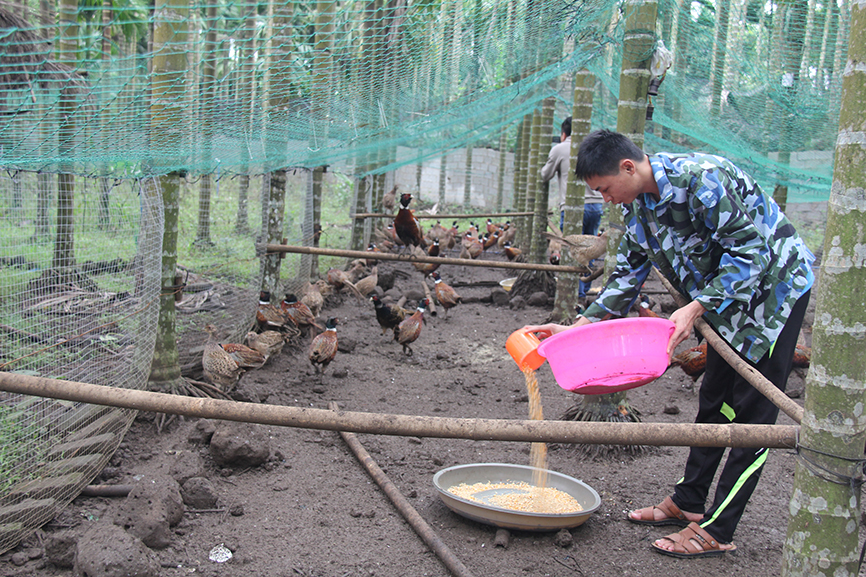
The colorful pheasants raised by Lao Wansong are growing well.
Recently, following a winding path, the reporter walked into the Yiwan Rare Poultry Farm in Longhe Town, deep in a betel nut grove, and a simple chicken shed built from woven netting appeared before their eyes. Lao Wansong, a post-90s young man, was walking into the shed carrying a basin of feed, and one after another of the colorful pheasants rushed over, surrounding the feed basin and starting to scramble for it.
After a full meal, some of the colorful pheasants wagged their tail feathers and strolled leisurely around the shed, while others rested in place.
Lao Wansong, who had been busy all morning, finally had a moment to pause. Speaking of his original reason for raising colorful pheasants, Lao Wansong smiled honestly and said: "After graduation, I worked in Guangzhou. Once I ate a dish made with colorful pheasant at a restaurant, and it tasted very delicious. At that time, very few people in Hainan Province were raising colorful pheasants, so I wanted to return to my hometown and try raising them. I felt it had a pretty good 'money prospect.'"
In June 2015, after returning home, Lao Wansong saw the betel nut groves covering the hills and fields of his hometown. After some investigation and market research, he found that raising colorful pheasants under the forest had huge market potential, so he made up his mind to begin planning his entrepreneurial path of raising colorful pheasants.
Once he had the idea, he acted on it. Lao Wansong bought relevant professional farming books and began learning farming techniques. In the betel nut grove, he built a simple chicken shed with woven netting, used an online platform to order chicks from Guangzhou, and bought cornmeal, coarse grains and other raw materials to mix feed himself...
"In the early stage of farming, my chicken-raising skills were completely in a state of crossing the river by feeling for stones." Speaking of the difficulties in the process of raising chickens, Lao Wansong felt it deeply. "When I ran into problems, I could only hold books every day and look up the relevant technical requirements one by one."
But theoretical knowledge and actual farming were still different. During the process of raising chickens, Lao Wansong encountered many problems that were not mentioned in the books. Watching many chicks successively fall ill and have diarrhea for no apparent reason troubled him greatly.
"Raising chickens is raising chickens; the methods should be more or less the same." Lao Wansong began visiting several local chicken farms and asking his neighbors for advice on the problems he encountered in raising chickens. After everyone studied the matter together, they found that the diarrhea was actually caused by the chicks being unsuited to Hainan's environment just after arriving, plus catching a chill from the night wind. After understanding the cause of the chicks' illness, Lao Wansong began renovating the brooding room himself, spreading a layer of fine sand inside it and installing heat lamps to ensure the temperature of the brooding room. Under his careful care, the sick chicks gradually began to improve.
With the support of his neighbors, Lao Wansong felt he had "solid ground" beneath him.
"At the beginning I didn't know anything. Every time my neighbors reminded me when to vaccinate the chickens or treat them, I would write it down in a notebook: what symptoms meant what disease, how to administer medicine, which medicine to give. Over time it was all imprinted in my mind." Lao Wansong said proudly.
Through constant exploration, Lao Wansong gradually mastered farming techniques, and through his unremitting efforts, the colorful pheasants he raised grew well.
"Colorful pheasants have only 0.9% fat content. They are low in fat and also contain high protein, and they taste delicious. They can be eaten and also used medicinally..." Speaking of the benefits of colorful pheasants, Lao Wansong explained them in detail. The colorful pheasants he raised adopted an under-forest ecological captive breeding model. The woods were a natural "gym," and they were usually fed cornmeal, rice husks and other coarse grains, which improved the quality and taste of the chicken.
Seven months later, Lao Wansong sold his first batch of colorful pheasants. Looking at the heavy stack of cash in his hands, his heart blossomed with joy.
"There are still relatively few colorful pheasants on the Hainan market, so now I basically don't worry about selling the chickens I raise. Usually fixed farmstays and restaurants place regular orders, so the sales channel is still quite stable." Lao Wansong said with a smile. "Each finished chicken weighs about 2-3 jin, and sells for 40 yuan per jin, so one chicken can bring in 100 yuan." He happily calculated the economic account.
In 2016, the breeding base sold more than 1,000 colorful pheasants, with income reaching more than 100,000... Having tasted the sweetness of success, Lao Wansong was not satisfied with something small and began working on longer-term plans.
"For raising chickens, technology is important, and the hardware cannot be sloppy either. Only by improving the hardware conditions can the chicken farm truly develop. Our current chicken shed is relatively simple and the sanitary conditions are poor. Now the town government has also provided me with 20,000 yuan in support funds. Next, I plan to build an iron-sheet shed and learn chick hatching techniques. In the future, I will not only be able to produce and sell myself, but also sell chicks, improve the functions of the breeding base, and further expand the scale of breeding." Speaking of this year's plans, a bright smile appeared on Lao Wansong's face.