Strawberry Xi Shi Lu Miaoxia: Paving a Road to Prosperity with Small Strawberries
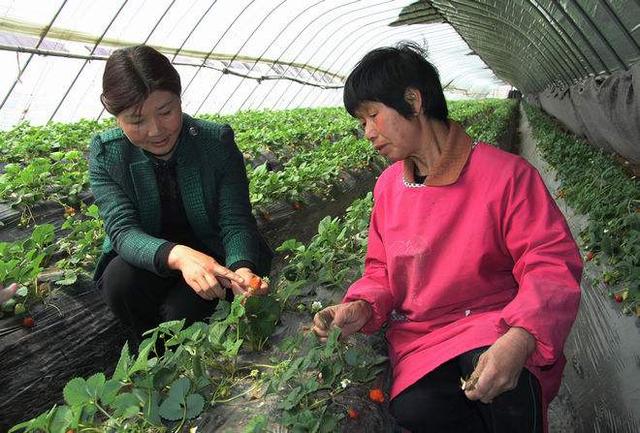
Lu Miaoxia (first from left)
Inside the greenhouses of the "Shilixiang" Strawberry Eco-Park in Mengjin County, Luoyang City, Henan Province, waves of fragrance filled the air, plump red strawberries hung down to the ground, dotted with yellow centers and white flowers. The owner of this strawberry plantation is named Lu Miaoxia, a prosperous woman entrepreneur well known throughout the surrounding villages, whom the villagers affectionately call "Strawberry Xi Shi." Lu Miaoxia has successively won honors including National March 8th Red Banner Pacesetter, National Outstanding Female Migrant Worker, and National Advanced Individual in Women's Meritorious Service.
Returning Home in Glory to Start a Business Again
In 1989, to escape poverty, 21-year-old Lu Miaoxia left her hometown to work in Beijing. With the help of relatives and friends, she began selling fruit. She got up before dawn every day, pedaled a flatbed cart over 30 km to the fruit wholesale market to buy fruit, and could only return home at eight or nine in the evening. Relying on the spirit of the "honest scale" and a good service attitude, from hawking along the streets to setting up a stall, and then to having her own retail shop, she gained a firm foothold in Beijing.
During the 2008 Spring Festival, when Lu Miaoxia returned to her hometown in Luoyang for the holiday, she found that there were very few high-end fruits locally, and most were purchased from other places. Especially strawberries, whether in size, variety, or taste, were far inferior to those sold in the Beijing market. Luoyang also had no large-scale, high-quality strawberry plantation, so she developed the idea of leading the villagers to grow off-season fruits and melons in greenhouses to become wealthy.
Right after the Spring Festival, Lu Miaoxia went to Shandong and other places to investigate strawberry cultivation, and found that the benefit per mu of growing off-season greenhouse fruit was several times higher than growing grain, and strawberries in particular had higher economic returns than other fruits. So she specially invited two technical experts from Shandong to Mengjin for an inspection. After on-site investigation, the experts concluded that Mengjin's soil and water quality were both suitable for growing greenhouse fruit, and even had advantages over Shandong. Because the temperature here is higher than in Shandong, the fruit could ripen half a month earlier than in Shandong. Hearing the experts' analysis, Lu Miaoxia became even more determined and confident about growing greenhouse fruit.
However, how to persuade the villagers to change their fixed ideas and work with her became the biggest challenge. Before this, no one locally had ever grown greenhouse fruit. Lu Miaoxia went door to door to persuade people, but even after exhausting her words, it was still hard to dispel the villagers' doubts, and some even gossiped behind her back, calling her a "silly girl." Her elderly mother also repeatedly urged her: "You've finally saved up a little, and you're putting in so much all at once. What if it all falls apart?"
The villagers' doubts and her family's opposition did not shake Lu Miaoxia's determination to start a business.
In 2009, she contracted 150 mu of land in Zhuzhai Village, Songzhuang Town, Mengjin County, and gave it a resounding name: Shilixiang Strawberry Base. With the help of the local women's federation, she borrowed more than 2 million yuan and built greenhouses to grow off-season fruit. Once the greenhouses were built, she bought strawberry seedlings from Shandong and began raising them. Every morning, she arrived at the base at five or six o'clock and did not return home until ten or so at night. Watching the little seedlings grow day by day, her heart was filled with joy. She spent three months leveling the land, installing water pipes, purchasing steel pipes, fitting greenhouse film, and laying drip irrigation. She traveled to four provinces, back and forth thousands of li, purchasing piece after piece of material, and built a total of 67 greenhouses. But she became thin and dark. Her mother said with distress: "You've gotten so thin that your mother hardly recognizes you!"
However, fortune is fickle. In November 2009, a sudden heavy snowstorm caused the strawberry greenhouses to collapse or tilt. She felt as if her heart were being cut, and nearly cried aloud. But she gritted her teeth and decided to lead the workers in self-rescue production, striving to minimize the losses. After several days of effort, one strawberry greenhouse after another finally stood firm again in the cold wind.
In September 2010, a once-in-many-years Level 14 tornado and heavy rainstorm washed away the strawberry seedlings that had just been planted in dozens of greenhouses. But none of these disasters knocked her down. She wiped away her tears and started all over again.
Before the 2011 Spring Festival, the strawberries came onto the market. In the strawberry park, people came and went, and demand exceeded supply. The phone rang nonstop with orders. After two years of unremitting effort, economic returns were finally seen.
Helping Neighbors Get Rich Together
"Being rich alone doesn't count as being rich; helping more people get rich, that is what real ability means." This saying is Lu Miaoxia's motto. In order to help more villagers get rich, Lu Miaoxia established the Mengjin County Jingmeng Planting Professional Cooperative, and actively found ways for the villagers: those with funds could contract land, build their own greenhouses, and manage them themselves; those without funds could rent greenhouses in the park and pay after the greenhouses produced returns. Everyone used the same brand, the same seedlings, the same technology, unified packaging, unified purchasing, and unified sales. She also successively provided more than 400,000 yuan in free funds to help poor households build more than 40 greenhouses and supported them onto the road to prosperity.
In the household of Wang Wencan, a disabled family in Hebei Village, Baihe Township, both husband and wife are deaf-mute and previously relied on going out to work to earn a little living expenses. In 2011, with Lu Miaoxia's help, they built 10 greenhouses. After seeing returns, they called their two sons, who had gone out to work, back home to grow strawberries. Now their family's annual income is above 300,000 yuan. Wang Donghui of Hexi Village had always earned money by going out to work. Since 2011, with Lu Miaoxia's help, he has successively rented 100 mu of land and built 40 greenhouses. He said: "Now I can make big money right at my doorstep, and I no longer have to go out and suffer."
Lu Miaoxia also took out more than 100,000 yuan from her own earnings to support college-graduate village officials in Baihe Town in starting businesses. Driven by her, the surrounding farming households' average annual income reached 100,000 to 300,000 yuan. As the number of planting households gradually increased and technical guidance was needed, she established the Mengjin County Xiaguang Agricultural Skills Training School to provide farmers with technical support.
In order to help more disabled people become wealthy and escape poverty, she also held 3 sessions of professional skills training classes for disabled people in the surrounding area, training 150 students, with systematic training in planting theory and practice, enabling these disabled people to master the skills to become wealthy. Her deeds were affirmed by the China Disabled Persons' Federation, and the training school was named a model base for vocational training for disabled persons by the China Disabled Persons' Federation. It now has 2 training classrooms, a large dining hall that can accommodate more than 300 people for meals, a practice base, a rehabilitation room for disabled persons, a caring library, and other facilities, and has cumulatively trained more than 3,000 people in planting and breeding techniques.