Liu Yuwei gladly serves as a leader in entrepreneurship and wealth creation
On February 24, People's Daily published on page 9 an article titled "Chasing Dreams into the Mountains," reporting on Liu Yuwei, a 2009 graduate of Xiangyang Vocational and Technical College (hereinafter referred to as "Xiangyang Vocational College"), who, harboring an entrepreneurial dream, returned to the countryside to become a farmer, achieved independent profitability by building a farm and engaging in livestock breeding, and led more than a dozen nearby impoverished households onto the path of poverty alleviation and prosperity. Subsequently, major media outlets across the country reprinted or reported on the story, drawing widespread attention from all sectors of society. Many people were pleasantly surprised to discover that hidden deep in the mountains was a veritable "Goat Concubine."
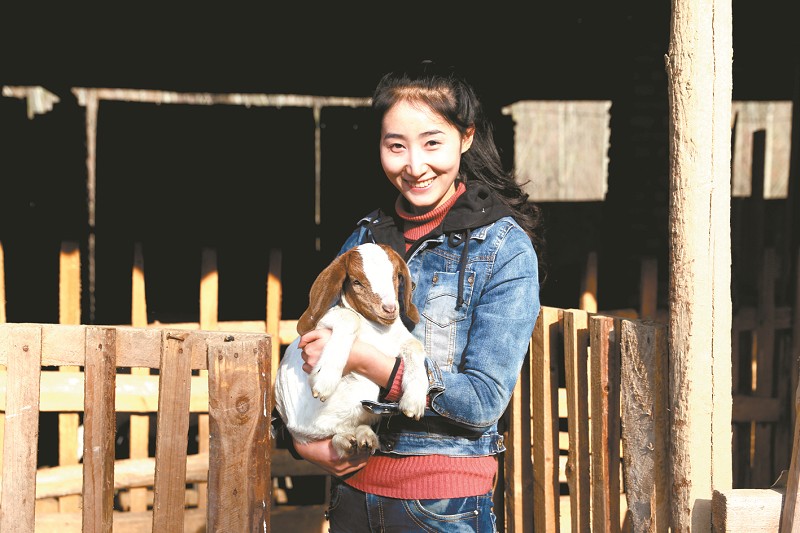
On February 26, this writer accompanied relevant leaders of Xiangyang Vocational College to the Yunting Breeding Professional Cooperative, located at the Zhou'san Gully Forest Farm in Dalingtang, Baihepu Village, Liupi Town, Yunyang District, Shiyan City, where we met "Goat Concubine" Liu Yuwei and heard her share her experiences and reflections since starting her business.
Giving up the "iron rice bowl" to return home as a farmer
Liu Yuwei was born in 1989 and lives in Yunyang District, Shiyan City. In 2009, she was admitted to Xiangyang Vocational College to study Agricultural Technology and Management, becoming a member of the "One College Student per Village Program." "Liu Yuwei is quiet, beautiful, and talented. She excels at painting and calligraphy, and her academic performance was always among the best." Speaking of her former student, Yang Hua, Director of the Admissions Office at Xiangyang Vocational College, was lavish in her praise, though she was still quite surprised by Liu Yuwei's choice: after graduation, Liu Yuwei was assigned to work at the grassroots level with a monthly salary of more than 2,000 yuan. She already had an "iron rice bowl," yet she turned to contracting barren hills, building a farm, and engaging in livestock breeding. "The 'One College Student per Village Program' aims to cultivate reserve cadres or wealth leaders for rural areas. I chose the Agricultural Technology and Management major because I hoped to return to the countryside after graduation and make a difference," Liu Yuwei said. Her alma mater emphasized cultivating students' entrepreneurial awareness, not only offering entrepreneurship courses but also holding entrepreneurship competitions multiple times, creating a good entrepreneurial atmosphere. Influenced by this environment, she had already conceived the idea of starting a business at that time, but due to various constraints, she could only keep this thought deep in her heart.
After graduating from college, Liu Yuwei returned to her hometown and worked a routine job. Over three years, she lived frugally, rarely buying clothes or cosmetics, quietly saving money to prepare for entrepreneurship. When she learned that many impoverished households still existed in her hometown, the entrepreneurial idea in her heart resurfaced: contract barren hills to build a farm, and use the breeding and planting techniques she had learned to lead her fellow villagers to prosperity. Her idea met with firm opposition from her parents: "We worked so hard to put you through college because we hoped you'd have a stable and respectable job, and now you want to come back and be a farmer!" "Our family has been farmers for generations. You should know that you can't dig gold out of the soil."
Her parents' attitude could not stop Liu Yuwei's actions. In June 2014, without telling her parents, she raised funds on her own and contracted more than 1,000 mu of barren hills, and registered Hubei Goat Concubine Ecological Agriculture Co., Ltd.
The former young girl became a "tough woman"
"When I first started my business, I didn't think too much. I originally thought the funds I raised could accomplish a lot, but reality was not as ideal as I had hoped." Liu Yuwei explained that the forest farm is located halfway up the mountain, and water, electricity, and roads all had to be sorted out on her own. As the "little princess" of the family, she had hardly experienced any hardship growing up, but since starting her business, she has gone through many firsts in life: building roads, planting trees, carrying bricks, constructing buildings, running approvals, building goat pens...
One night while staying at the forest farm, she woke up in the middle of the night and saw wild boars attacking the guard dog. She was so frightened that she hid in the house, not daring to make a sound until dawn. When building the goat pen, she personally carried bricks, hauled timber, and hammered boards, aching all over from exhaustion but refusing to rest. Late at night, she discovered a lamb had no milk to drink and was crying from hunger, so she drove to the city to buy milk powder and saved the lamb through hand-feeding with milk powder. When a goat raised in the deep mountains unfortunately went missing, she took a flashlight and carried dry rations, searching in the mountains for two days and nearly losing her way back to the farm... "Along the way, although it has been very hard, I have also gained touching moments, and these are the motivation that keeps me moving forward." Liu Yuwei explained that when funds were insufficient, her family, who had once firmly opposed her, lent a helping hand, helping her raise funds to build roads, construct buildings, dig wells, clear land for planting trees, and put up sheds. When a lamb got sick, a junior schoolmate from her alma mater provided free technical support throughout the process. Upon learning that she was building a farm, her former homeroom teacher made a special trip to Shiyan to give her encouragement and help.
Through Liu Yuwei's efforts, the former barren hills have been transformed into a vibrant estate: landscaping trees of different varieties and slope-protecting grass are planted along both sides of the newly built roads; the goats, chickens, geese, and black pigs being raised have broken the silence of the valley; and the cherry trees and grapevines that have been introduced are nestled among the green mountains and leaves, like a hidden paradise.
Not forgetting to give back to the folks back home after achieving prosperity
"Although I graduated several years ago, I have always kept learning for the dream in my heart, and every few years I make a special effort to attend training courses to systematically learn entrepreneurial knowledge and skills." Liu Yuwei told this writer that she had participated in entrepreneurship training, e-commerce training, and modern young farmer training, gradually developing her own approach to raising goats: using a combination of pen-feeding and free-range grazing, and using green feed such as plant stalks and forage grass. She uses goat manure to fertilize the fields, forming a circular ecological industrial chain of "goat breeding + plant cultivation + goat manure fertilizing fields," achieving an ecological model that combines planting and breeding and recycles resources.
According to statistics, in 2016, Liu Yuwei sold more than 5,000 free-range chickens, more than 300 goats, more than 100 free-range pigs, and 700,000 free-range eggs, achieving profitability. Today's "Goat Concubine" has become a well-known brand in the Qinba Mountain area, and many customers proactively seek out Liu Yuwei to place orders and request cooperation.
While achieving prosperity, Liu Yuwei has not forgotten to give back to her fellow villagers. She helps nearby farmers sell local specialty products through e-commerce platforms; gives priority to hiring impoverished villagers, driving local employment; purchased more than 50,000 jin of corn from fellow villagers, enabling more than 50 impoverished households to increase their income; provides free technical guidance to breeders; provides free seedlings to impoverished households and helps with sales, among other things. "I started my business in the first place to lead my fellow villagers to prosperity together, and building roads back then took up quite a bit of my neighbors' land. Not only did they not come to me to 'argue about it,' they even actively helped. I must know how to be grateful." Liu Yuwei stated.