Three-dimensional planting and breeding yield rich returns: abandoned land becomes a "treasure bowl"
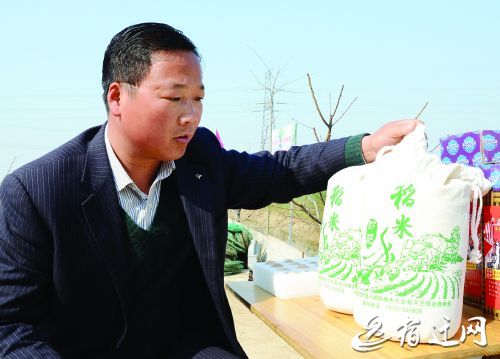
"I've farmed all my life. Why can't I beat that young Zhang Miao? The reason is that we older farmers are set in our ways and won't let our minds turn." On March 13, when the reporter came to Yannan Village, Zaohe Town, Hubin New Area for an interview, a local man in his seventies pointed to a peach orchard full of buds and said that other people's peaches all hit the market in summer, but the new "Yingshuanghong" honey peach variety introduced by Zhang Miao does not come to market until after the Mid-Autumn Festival. It would be strange if it didn't sell for a good price.
A small business owner becomes a village official
In fact, what this old man admires about Zhang Miao is not only his planting of off-season peach trees, but also his promotion of three-dimensional planting and breeding, which brings in yields per mu far higher than traditional planting, making many local old farmers who "rely on the weather to eat" feel ashamed. They did the math: with traditional planting of wheat and rice, after deducting the cost of seeds, pesticides and so on, and in the absence of natural disasters, the annual return per mu is only about 2,000 yuan. But the "water, land and air" three-dimensional planting and breeding promoted by Zhang Miao can reach an annual return of 5,000 yuan per mu. Under the same sky and the same sunlight, why is there such a huge difference in land returns? Zhang Miao said, don't fear that you cannot do it; fear only that you cannot think of it. People used to say that however bold a person is, the land will produce that much; in fact, the most critical thing is that thinking determines success or failure.
Zhang Miao's home is in Group 12 of Yannan Village, Zaohe Town, Hubin New Area. After graduating from technical school in 1998, he had studied electrical work but did not go looking for a job. Instead, he did business in agricultural supplies on Binhe Street. "My agricultural supplies business is still running. Perhaps because I have been in contact with large grain growers for years and am no stranger to high-efficiency agriculture, it has been very helpful in making me a good farmer in the new era," Zhang Miao said. Because he operated with integrity locally, he became a leader in helping the village get rich. In 2013, through a public election, he was elected deputy director of the Yannan Village Committee.
After Zhang Miao took office, a "hot potato" was placed in front of him. A boss from Northeast China came to Yannan Village through investment promotion and transferred a total of 360 mu of land from 7 villager groups in Yannan Village, of which 200 mu was used to build a blueberry planting base. The problem was that after the blueberries were planted, they died one after another. Before the boss from Northeast China had even finished paying the first year's land transfer fee, he packed up and left.
Full of confidence, he takes on the mess
"I am in charge of agricultural work in the village. After the blueberry base was abandoned, I was very anxious. Not only was so much land overgrown with weeds, but more importantly, the villagers would not receive the land transfer fee next. Who would bear this kind of economic loss?" Zhang Miao said. In view of the Northeast China boss's breach of contract, the village tried every possible way and successfully defended its rights, and the villagers suffered no loss.
Although the villagers received the first year's land transfer fee, looking at the transferred land overgrown with weeds, no one could come up with a good idea. Facing such a mess, none of the villagers took the lead to clean it up. By 2015, when everyone was full of worry, Zhang Miao, as deputy director of the village committee, stepped forward. Full of confidence, he leased the 360 mu of abandoned land. The villagers' land transfer fee, according to the standard transfer bid price of 910 yuan per mu, would be paid by him year by year according to the lease term. The already abandoned land was taken up and operated by Zhang Miao, and the local villagers also breathed a sigh of relief.
To clean up such a big mess, how should Zhang Miao respond? During the interview, Zhang Miao explained his approach. After these lands were contracted by him, he began weeding and clearing ditches and improving the soil moisture conditions, first completing the supporting ditches and canals. Next, he set out to engage in three-dimensional ecological planting and breeding, first setting aside 60 mu for an experiment, planting high-quality japonica rice and raising crayfish in the rice fields. "This 60-mu co-culture experiment was very successful. The high-quality japonica rice yielded 450 kg per mu, and the crayfish reached 80 kg per mu. Calculating this season, the output per mu exceeded 5,000 yuan, and the economic benefit was more than twice that of traditional rice planting," Zhang Miao said.
Three-dimensional planting and breeding yield rich returns
On the plots operated by Zhang Miao, the reporter saw "water, land and air" three-dimensional planting and breeding. There were not only rice fields with co-cultured crayfish, but also peach orchards, with many free-range chickens raised on the field ridges and in the woods. "This year I expanded rice-field co-culture of crayfish to 200 mu. The rest of the land is used for off-season peach planting, chicken raising and planting vetch. The tender part of the vetch is cut and sold on the market as a seasonal vegetable, and the older part below is buried in the ground as green manure returned to the field. This not only improves the economic benefit of land planting, but also drives employment for some of the local leftover labor force," Zhang Miao said with a smile. Traditional planting is one season of wheat and one season of rice. If you do not change your way of thinking, growing crops can only hover at a low level of benefit.
The reporter learned that Zhang Miao's rice-field co-culture of crayfish uses all water introduced from Luoma Lake. Because of its good quality, the high-quality rice was appraised by the agricultural department as "national standard grade-two rice," sold in online malls at 19.8 yuan per kg, and 23.6 yuan in premium packaging. Because the crayfish look good, vendors buying at the field edge pay 40 yuan per kg. "In the past, because of poverty, everyone just wanted to eat their fill. Now people pursue a green life and pay attention to eating well. Developing high-efficiency ecological three-dimensional planting and breeding should be the pursuit of farmers in the new era," Zhang Miao said. All the agricultural products he harvests are sold through the internet, attracting many nearby farmers to come and learn from him.
The reporter learned that Zhang Miao's approach to three-dimensional planting and breeding has won the approval of the local government. This year, Zaohe Town plans to plant 2,000 mu of high-quality rice and has designated Zhang Miao as chief technical adviser.