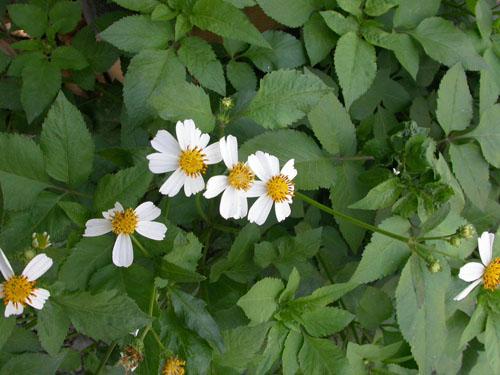
Is Xianfeng grass the same as Spanish needles? What are its medicinal value and effects?
Many people mistake Xianfeng grass forSpanish needles, or treat them as one plant, but they are not; they are two different plants.The Xianfeng grass seen everywhere belongs to the genus Bidens in the Asteraceae family. In Taiwan, China, the more commonly seen species are large-flowered Xianfeng grass, small-flowered Xianfeng grass, and Spanish needles. Among these 3 kinds of Xianfeng grass, only Spanish needles is a native species; the first two are introduced species. It is worth noting that large-flowered Xianfeng grass is a perennial herbaceous plant (small-flowered Xianfeng grass and Spanish needles are annual), blooming in all four seasons, and unlike other annual plants it does not have a season in which it dies.
Xianfeng grasscombined with its many flowers, abundant nectar, and fruits with barbed spines, has thus become the most dominant Xianfeng grass, even affecting the entire environmental ecology. In Taiwan, China, Xianfeng grass is often used to make herbal tea that relieves summer heat and reduces internal heat. It has the effects of clearing heat, detoxifying, promoting urination, and dispersing blood stasis, and can also treat gastrointestinal diseases and bacterial infection and inflammation.
The literature points out that Xianfeng grass contains many plant secondary metabolites with different chemical structures, including flavonoids, phenylpropanoids, polyacetylenes, and others. It is worth noting that the methanol extract of Xianfeng grass and its polyacetylenes have blood sugar-lowering activity in a type 2 diabetic mouse model.
Using high-performance liquid chromatography to separate the active substances in Xianfeng grass, it was found that Xianfeng grass extract and its polyacetylenes can effectively prevent the occurrence of type 1 diabetes in a non-obese mouse animal model. This shows that Xianfeng grass extract and its polyacetylenes may have the effect of treating type 1 diabetes. Its mechanism of action is mainly by regulating the differentiation of helper T lymphocytes (a type of lymphocyte cell produced by the thymus), to ease the immune system's attack on pancreatic islet cells, thereby indirectly protecting the pancreatic islet cells. In addition, researchers have also found that Xianfeng grass has a blood sugar-lowering effect, but its mechanism of action is still under study.
The above modern research on herbal medicine has given a scientific interpretation to Xianfeng grass, which is commonly used in folk medicine to treat diabetes, but there are still many issues worthy of in-depth study, for example, through what mechanism does Xianfeng grass achieve its blood sugar-lowering effect? This is an important research direction. In addition, although Xianfeng grass is considered edible by the United Nations Food and Agriculture Organization and our country's Department of Health, the safe dosage and side effects of its use still need to be clarified. These research results may not only give Xianfeng grass a chance to become a health food or botanical drug on the market, but the related research experience can also provide substantial help for establishing the modernization of Chinese herbal medicine.