Veteran-turned-entrepreneur Zhang Degang returns home to start a family farm and lead his fellow villagers to prosperity
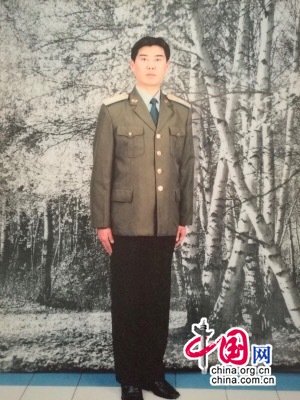
Zhang Degang, who was awarded the rank of Air Force Lieutenant Colonel during his service in a unit of the Air Force
Zhang Degang, a native of Yicheng Village, Qucun Town, Quwo County, Linfen City, Shanxi Province, is a member of the Communist Party of China. He enlisted in November 1986 and served in a unit of the Air Force, during which he was awarded the rank of Air Force Lieutenant Colonel and was cited for meritorious service and awards on multiple occasions. In December 2005, he responded to the call of the state and the military and chose to transfer to civilian life under the self-employment option. That hot-blooded young man of years past devoted himself to the cause of national defense construction; now he has chosen self-employment, transforming from a PLA officer at the battalion level into a typical new-type professional farmer. Together with his wife (Li Ling, who served in a unit of the Air Force, was awarded the rank of Air Force Colonel during her service, and chose self-employment in 2008), he gave up a comfortable life in the city and returned to his hometown to lead the elders and fellow villagers onto the road to common prosperity. The moving story of his entrepreneurship moved the elders and fellow villagers of his hometown, and also moved all the senior officers and comrades-in-arms of his former unit.
The unit where he once served was located at the foot of Ula Mountain in Bayannur League, where the living environment was extremely harsh. No grass grew on the mountain or at its foot all year round, and a single wind blew from spring to winter. The local villagers made up a rhyme: "With Ula Mountain at our backs and the Yellow River beach beneath our feet, no grass grows on the ground, and stones roll when the wind blows." He stayed in this harsh environment for more than a decade, where he tempered his firm will to endure hardship and established his values in life. During his time as commander of the motor transport company, Zhang Degang led the officers and soldiers of the company to use their rest time to reclaim wasteland beside the camp and improve the Gobi desert. They carried the stones out of the reclaimed land, kept the sandy soil that could grow vegetables, and brought in good soil hauled back from the Yellow River beach. After a year of hard work, they had improved more than ten mu of vegetable plots and planted all kinds of vegetables, solving the company's difficulty in eating vegetables in summer. His deeds moved the senior officers of the Air Force, and he was praised as the Air Force's Number One Company by then-Air Force Deputy Commander Jing and Commander Ma Xiaotian of the 10th Air Force (now Air Force Commander).
Today, he has returned to his hometown to lead the elders and fellow villagers toward common prosperity, and his concrete approach of combining planting with breeding has effectively broadened the path for farmers to increase their incomes.
The Wangshun planting-and-breeding family farm founded by Zhang Degang is located in Yicheng Village, Qucun Town, Quwo County. It was established on March 5, 2014, has 5 family members, and has a total investment of 500,000 yuan. Centered on Yicheng Village, it has cooperated, leased, and transferred a total of 3,000 mu of land across 6 villages, built 30 standardized large-scale sheep sheds, two 5,000-cubic-meter silage pits, and purchased 1 large corn harvester, 3 harvesters, 1 straw silage compressing and planing machine, 1 three-wheeled agricultural transport vehicle, and 1 model 30 loader. It mainly engages in the cultivation of wheat, corn, melons and fruits, and greenhouse vegetables, as well as straw silage. This is used for raising cattle, sheep, donkeys, and chickens. With planting driving breeding and breeding promoting planting, it pursues a rolling and circular agricultural economic development model.
At present, it raises 1,500 ewes and 50 breeding rams. By the end of 2017 it can breed up to 2,500, and by the end of 2018 up to 5,000, making it the largest family farm within Quwo County. In 2015 it was rated as a municipal-level family farm, and in 2017 it was rated as a provincial-level family farm.
The Wangshun planting-and-breeding family farm uses cooperation with farming households, leasing, and land transfer to carry out large-scale planting and large-scale breeding, solving the problems of idle rural land and losses in farming, and effectively broadening the path for farmers to increase their incomes.
Specifically, in combining planting with breeding, the corn and wheat straw grown on the 3,000 mu of land is ensiled and turned into high-quality feed for the sheep, which solves the sheep's feed supply, solves the problem of high feed costs, also solves the recovery of straw, and further solves the pollution problem caused by burning straw. At the same time, it can also supply high-quality feed to other breeders, lowering breeding costs and achieving maximum returns from breeding.
The family planting-and-breeding farm adopts self-breeding and self-raising methods to expand the size of the flock and improve breed quality. It sells more than 1,200 commercial sheep annually, with an annual output value of more than 1 million yuan, while the annual output value from land returns reaches more than 5 million yuan. The 800 cubic meters of sheep manure produced by breeding is fermented into high-quality organic fertilizer. Making full use of the favorable conditions of high-quality organic fertilizer, all 3,000 mu of land will be treated with organic fertilizer within two years. It insists on deep plowing the cultivated land once every two years to improve the soil and kill pests and weeds, enabling the land to release its greatest efficiency, producing grain above the local average per-mu yield, with output increasing year by year, embarking on a sustainable, rolling, and circular development track, and achieving steady growth in organic agricultural and sideline products.
At the same time, family members are sent to make great efforts to learn new planting and breeding techniques and to train professional technical personnel. At present, 2 family members have obtained new-type professional farmer qualifications. Various rules and regulations for farm production management have been established and improved, so that every task has institutional support, a scientific outlook on planting and breeding is established, and modern scientific and technological means and skills are fully used to improve production efficiency, reduce production costs, and maximize returns. It is reported that in 2015 and 2016, the Wangshun planting-and-breeding family farm achieved an average annual output value of 6 million yuan from land returns and breeding returns.
Over the past few years, Zhang Degang has driven and influenced a large number of farming households toward common prosperity. He discusses good experience and practices together with farming households, selects fine varieties, and achieves stable per-mu yields of more than 1,000 jin for wheat and more than 1,500 jin for corn. After the establishment of the Wangshun planting-and-breeding family farm, a total of 126 households and more than 300 laborers in the village went out to work. Through farmland consolidation, the economic income of farmers has increased, and the problems of idle rural land and losses in farming have been solved.
Zhang Degang said that in the future he will add new organic specialty varieties, increase per-mu yields, raise the added value of products, create a local specialty brand, further increase farmers' incomes, and lead the elders and fellow villagers toward common prosperity.