Small wild geese farming supports farmers' dream of prosperity
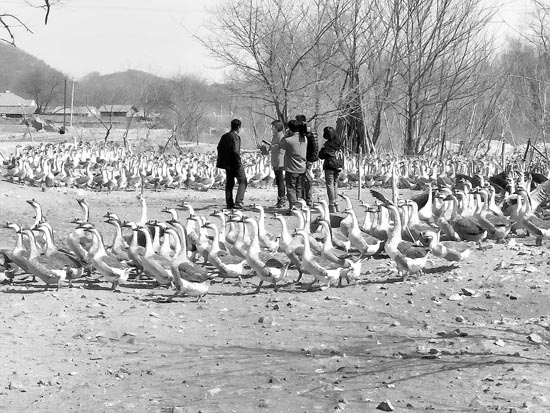
On March 16, when I once again came to the home of Li Mingguo, a villager from Group 2 of Dougongzi Village, Jiguanshan Town, Fengcheng City, what first caught my eye were boxes upon boxes of white, plump wild goose eggs. Li Mingguo, who was collecting eggs in the goose shed, did not bother to wipe the sweat from his forehead and hurried out. While welcoming me, he said with a chuckle: "Look at these little guys starting to shake money out for me. They started laying eggs on March 1 and can keep laying until November. Now they can lay more than 600 eggs a day, and by April, May and June they will be able to lay more than 900 eggs a day."
Just as he was speaking, more than 2,000 wild geese came rushing out of the pen. It turned out that they had seen their other owner pouring concentrated feed into the trough, and these plump large geese could not help gathering toward the "dining table." But when they saw a stranger enter the yard, the little guys scattered in all directions again, honking "ga ga" nonstop, their calls especially loud and slightly panicked. While busy helping his wife stir the feed evenly, Li Mingguo introduced: "Because the wild geese are in the laying period, we need to add soybean meal, fish meal, bone meal and other concentrated feed to the feed so they have enough nutrition, and we cannot let the wild geese go to the nearby river to play in the water anymore, for fear they will use up too much energy. These little guys walk around the yard every day. They are probably bored stiff and are honking more enthusiastically than usual, but we are used to hearing it too."
When it comes to Lao Li's experience raising wild geese, there really is a story. According to him, he had been raising chickens for more than ten years, but in recent years market demand for meat chickens had been declining day by day. Raising chickens requires attention to technique, has high disease-prevention costs and high risks, and its relative economic benefit is now no longer viewed favorably. So Lao Li, who had already found the secret to prosperity in the breeding industry, spent more than half a year investigating markets in the north and south and found that wild geese in Jiangsu had very good prospects. Raising and managing them was relatively simple, investment in disease prevention was low, breeding costs were low, and output value was high, making them the first choice for raising poultry. In July 2016, he introduced this kind of wild goose from Jiangsu and began raising them. At present, the scale has reached about 2,400 birds. To prove that the wild geese he raised were different from ordinary large geese, Lao Li casually grabbed one and described it in detail: "In appearance, these little guys of mine look very similar to domestic geese and wild geese, but they are more valuable than domestic geese and, unlike wild geese, they cannot fly. They were developed from a kind of wild goose that lives in Northeast and North China through long-term artificial selection and natural domestication, and they are a rare and fine poultry breed."
I asked Lao Li why wild geese had to lay eggs in March. Lao Li smiled mysteriously and opened up again: "If you want to do business well, you first have to understand the laws of the market. Entering April, the weather in the south starts to get hot. At this time, wild geese in the south basically stop laying eggs, and goose eggs are mainly supplied by the north. Then my goose eggs will be in short supply and will sell for a good price. But before March, even if the wild geese have already entered the laying period, we still have to control their diet to keep them from laying eggs. Now, my goose eggs are in short supply, orders keep pouring in, and they are sold as far away as Jiangxi, Jiangsu and other places. Basically, a truckload can be shipped every 5 days. One truck can carry 3,000 eggs, and at 4 yuan each, the gross profit from one shipment can reach 12,000 yuan."
Because wild geese are a crossbred and domesticated breed, not only can their breeding eggs sell for a good price, but their meat is tender and its taste far exceeds that of ordinary domestic geese, so goose meat is also highly favored by the market. Lao Li calculated an account for me in practical terms: each goose can bring a profit of about 60 yuan per year. He currently has 2,400 geese, and over a year the profit is more than 100,000 yuan. This figure is quite considerable.
Li Mingguo has tasted the benefits of wild goose production, and the village cadres of Dougongzi Village have also paid special attention. They often go to Lao Li's home to learn about the breeding situation and conduct investigations from many aspects. Just as Zhao Xiqiang, director of the village committee, said: "Broadening prosperity channels for the common people and finding suitable industrial projects is the primary task of village cadres in developing people's livelihood undertakings, and it is the fundamental move to comprehensively win the battle against poverty and create self-sustaining capacity for poor households. If the little wild geese can support the common people's dream of prosperity, then the village will consider pooling poverty alleviation funds for poor households and establishing a mutual-aid cooperative to develop the breeding industry."