Raising pigeons helped impoverished Feng Xiangquan realize his dream of prosperity
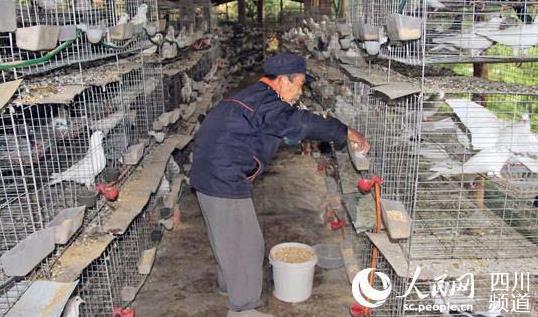
Rows of neat pigeon cages hang on the posts, and pure white pigeons scramble to peck at the food in the troughs, letting out "coo coo" calls from time to time. "As long as I hear the pigeons' calls, and that flapping sound of their wings, I'm especially happy." On April 9, in Fengliang Village, Mingyang Town, Enyang District, Bazhong City, Sichuan Province, villager Feng Xiangquan came to his own meat pigeon farm early in the morning, and while feeding them, happily introduced things to the reporter.
"In our village, whenever you mention Feng Xiangquan, everyone calls him the 'Pigeon King.'" said village Party branch secretary Liu Jun. In recent years, Feng Xiangquan has made his fortune by raising meat pigeons. His farm sends more than 10,000 meat pigeons to market each year, with an annual income of more than 70,000 yuan.
Who would have thought that today's "Pigeon King" was once a well-known impoverished household.
It is understood that Feng Xiangquan is a registered impoverished household, with a family of 3, mainly relying on growing grain for a living. He and his wife have been ill year-round, and their backs and hands can hardly straighten, so they cannot do heavy work. Their son works odd jobs away from home and often cannot find work for days on end, and the family's life has been poor.
"My earliest venture was raising ducks and goats." Feng Xiangquan said. In 2012, he borrowed 2,000 yuan from relatives and friends as "start-up money" and began raising ducks and goats. Unexpectedly, the goats could not fetch a good price, and the ducks caught an epidemic disease. By the end of the year, the family not only had no spare money, but also owed more than 10,000 yuan in debt.
"I don't believe I can't turn things around. Even the poorest days can be changed." Although seriously ill and deep in debt, the strong-willed Feng Xiangquan refused to admit defeat. He was unwilling to live on government subsidies, and was determined to change his situation and become prosperous through his own hands.
By a chance opportunity, a friend who liked pigeons came to visit him and told him a lot about the knowledge and benefits of raising pigeons, once again igniting Feng Xiangquan's determination to escape poverty and become prosperous.
Everything is hard at the beginning. "At first I had no money, so I only bought 200 pigeons." Feng Xiangquan still looked helpless when talking about the situation back then. What could he do with only pigeons and no pigeon shed? Feng Xiangquan and his wife carried things on their shoulders and backs and built the pigeon shed and repaired the pigeon house themselves. At his most difficult time, the village "two committees" helped him coordinate a loan of 10,000 yuan in industrial revolving funds, and he himself borrowed another 30,000 yuan from friends, which finally solved the urgent shortage of start-up capital.
Hard work pays off. Through careful feeding and cautious care, in less than half a year, Feng Xiangquan's stock of meat pigeons grew from the initial 200 to 600. By the end of 2014, he successfully escaped poverty and threw off the "poor" label.
"After I started raising pigeons, I began reading books about pigeon raising. When I came across characters I didn't know, I went to ask the village school teacher, and I often traveled elsewhere to learn from masters. I went to quite a lot of places." Feng Xiangquan said. It was hard, but he also made no small progress.
By day he fed and managed them, and by night he carefully observed the pigeons' living conditions. Every morning before feeding, Feng Xiangquan and his wife would clean and disinfect the pigeon cages. "We feed the pigeons corn, wheat and peas we grow ourselves, so the pigeons raised this way are green and healthy."
Careful care naturally brings no ordinary returns. "Whenever it is market day, I carry a basket of pigeons and pigeon eggs on my back, and they are sold out before noon." Feng Xiangquan did the math: a pair of breeding pigeons can produce 17 or 18 young squabs on average each year, and at current market prices, that can bring more than 100 yuan in net income. Conservatively speaking, the eggs laid by one pigeon in a year are worth more than 70 yuan, and if the market is good, an income of 100 yuan is not rare.
Seeing that the self-reliant Feng Xiangquan had become prosperous, many impoverished households in the village were deeply encouraged and also decided to seek development through their own efforts. "After Feng Xiangquan succeeded, the villagers all came to him for advice." Liu Jun said. "He always shares his experience and management methods of raising pigeons with everyone without reservation."
"This year I will continue to expand the scale, strive to send 20,000 pigeons to market, and reach an annual income of 100,000 yuan." Feng Xiangquan said. "Escaping poverty is not my goal; becoming prosperous is my dream. I believe the days ahead will only get better and better."