Food safety must be addressed by deepening the regulatory system and establishing a regulatory platform
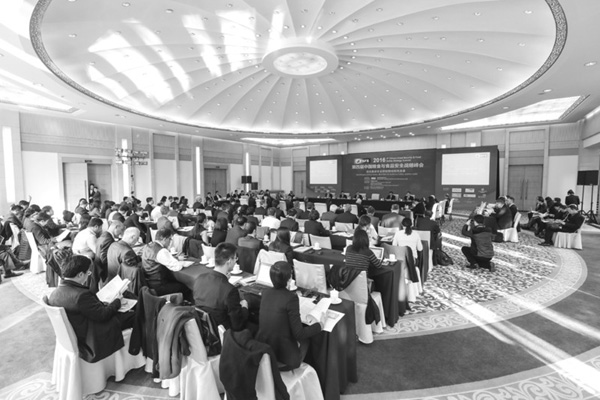
At the "2016 (Fourth) China Grain and Food Safety Strategy Summit," guided by the Development Research Center of the State Council and jointly hosted by the China Economic Yearbook Press and the China Institute for Rural Studies at Tsinghua University, Yu Bin, member of the Party Leadership Group and Director of the General Office of the Development Research Center of the State Council, moderated a dialogue session titled "Building an Agricultural Product and Food Regulatory System to Ensure Safety 'From Farm to Fork.'" Luo Yunbo, former Dean of the College of Food Science and Nutritional Engineering at China Agricultural University, Ken Petersen, Global Senior Vice President of OSI Group, and Qiu Xipin, President of Dow AgroSciences Asia, elaborated on their main views around the theme of the dialogue.
The food safety regulatory system urgently needs improvement
Luo Yunbo, former Dean of the College of Food Science and Nutritional Engineering at China Agricultural University, explained how to solve food safety problems from the perspective of food safety regulation. He believed that only by first solving the problems that urgently need to be addressed in the food safety regulatory system can safety "from farm to fork" be ensured. To this end, he put forward four suggestions.
First, the food safety regulatory system urgently needs to deepen its coordination mechanism. Looking back at the reform of food and drug regulatory agencies over the past three years, the core issue is the allocation of regulatory authority. The institutional consolidation carried out over the past three years has reduced a certain number of regulatory departments. But a reduction in number does not equal functional integration. Although the regulatory system covers many issues such as institutional setup and staffing, it is in fact still about the collaborative operation of regulatory resources.
Therefore, the problems brought about by the above institutional reform can only be solved through deepening reform and coordination mechanisms. This includes vertical coordination between the central and local levels, as well as horizontal coordination among local departments. Allocating fiscal authority according to the division of administrative powers, and dividing territorial responsibilities on the basis of clarifying administrative powers, is an issue that urgently needs to be solved at present and for some time to come.
Second, the issue of food safety standards urgently needs to be solved. The pesticide issue is the one consumers are most concerned about and must be targeted as a priority. First, environmental protection must be made the core content of agricultural subsidy policy, following the example of the European Union's price subsidy policy for agricultural products, establishing an agricultural subsidy policy system centered on environmental protection, and making the scientific use of agriculture and the prevention of heavy metal pollution important parameters in the system. Second, for chemical pesticides, low toxicity should be low-priced and high toxicity should be high-priced to raise farmers' costs of use and reduce their desire to purchase and use them. For pesticide companies producing low-toxicity, high-efficiency pesticides, tax reductions or exemptions or fiscal subsidies should be implemented, while for manufacturers of high-toxicity pesticides, subsidies should be "removed" and taxes substantially increased to reduce their willingness to produce.
Third, implementing the food safety strategy and building a rigorous, efficient food safety system with social co-governance is of great significance. This is a sound state for the regulatory system, but the actual situation is that both the government and the media hold unrealistic expectations for the current regulatory system. Demanding zero risk in food quality when even the quantity issue of grain has not been solved is unrealistic. In a high-pressure environment of excessive expectations, the result may be counterproductive. Only by starting with the regulators themselves, abandoning unrealistic goals, rationally assessing the situation, and lowering the social expectations of all sectors for the regulatory system, can we steadily move toward victory.
Fourth, the food safety regulatory system urgently needs to regulate discordant practices. Third-party supervision should also have laws to follow and cannot act arbitrarily. The internet is now flooded with false information such as fake eggs, fake cabbage, and fake walnuts. Coupled with hype by unscrupulous media, online pranks, and nationwide mockery, Chinese food has been given a bad reputation amid self-mockery, self-criticism, and self-destruction. Even officials from the World Health Organization could not bear to watch this situation and earnestly proposed that Chinese food should not be regarded as the source of all things. If these false messages are allowed to proliferate, they will cause great difficulties for food safety regulation. It is hoped that third-party supervision will be regulated as soon as possible and online rumors will be stopped.
Food safety should be results-oriented and focused on prevention
Ken Petersen, Global Senior Vice President of OSI Group, introduced to participants his views and suggestions on China's food standards from the perspective of formulating food safety standards.
In his view, China's newly revised Food Safety Law has been in effect for more than a year and has already entered its most difficult stage, requiring further strengthening in implementation. Moreover, China's Food Safety Law covers all food categories, which is highly commendable. This is because food safety in the United States is regulated by multiple departments according to category, and sometimes the results are not good.
He stated that for food safety standards, the internationally accepted reference is the Codex Alimentarius, which contains three relatively broad standards that can provide experience for China in improving food standards.
First, legislation is needed to enforce food safety. Only with the support of relevant laws can the government, localities, and enterprises jointly implement and enforce food safety standards. Second, there must be appropriate implementation plans. The government cannot formulate policies out of thin air. Design must be carried out in advance according to actual conditions, and effective implementation and testing are needed to achieve the goal of reducing disease and realizing public health. Third, working methods must be scientific. For example, the working methods adopted when testing and analyzing pests and diseases must have scientific standards. These three principles constitute the basic framework of the Codex Alimentarius and are also the foundation of the food regulatory system.
But he also pointed out that in solving food safety problems, the most important focus should still be on prevention. At present, all countries have relatively mature mechanisms for responding to food crises, but the most important thing is still prevention. If only results are considered, enterprises will have time to adjust flexibly and adapt to the rules. Therefore, he hoped that China's regulation would be results-oriented and also attach great importance to the food production process.
Finally, he offered some suggestions on accountability mechanisms and responsibility identification. He believed that China's current national-level authority for food regulation is the China Food and Drug Administration, but he hoped that more power could be given to the local level to form a supervisory framework in which the state supervises and local governments implement. At the same time, enterprises also need to proactively implement standards in the production process rather than doing so under regulatory pressure, and all food industry practitioners should have a sense of shared responsibility.
Establishing a comprehensive grain regulatory platform is crucial
Qiu Xipin, President of Dow AgroSciences Asia, said in his dialogue speech that food security is not only a topic of heated discussion in China but also internationally. China has made much progress in this regard in recent years. The focus now is no longer only on ensuring food supply, but has shifted more toward the field of food safety. In other words, China's grain has entered a stage in which both quantity and quality are emphasized.
In his view, this means the public has greater demand for high-quality, nutritious food. Therefore, China's regulatory system needs to make adjustments across the entire food ecosystem industry chain in order to truly achieve food safety domestically.
However, what gratified him was that China has made great progress in food regulation, such as last year's newly revised Food Safety Law, which covers regulation of the entire food production chain from production and storage to distribution. Moreover, the China Food and Drug Administration, as the agency responsible for food safety supervision and monitoring, has done a great deal of work. On this basis, China has not only formulated standards promoting food and drug safety but also formulated standards for the safety of animals and plants that meet relevant WTO requirements.
In his speech, he also put forward three suggestions on China's food regulation. First, scientific rigor must be the foundation of the entire regulatory mechanism. That is, a comprehensive and effective food regulatory system should be based on scientific research, and decisions at every link in the entire food value chain should be predictable, transparent, and scientifically grounded.
Second, extensive interaction among government, academia, and enterprises is needed to achieve truly good regulation.