Raising free-range chickens under the forest: a college-graduate village official leads villagers out of poverty toward prosperity
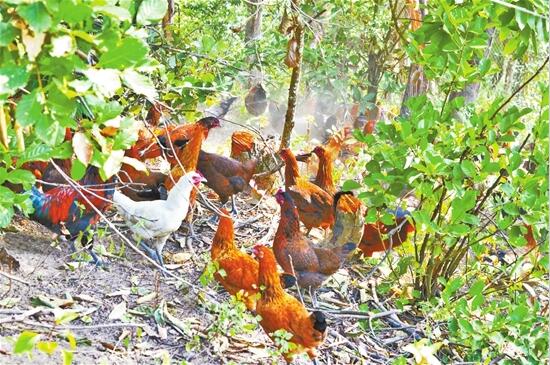
Wang Jiaohu, a post-80s college-graduate village official in Jifei Town, Changning County, Yunnan, started out with a 100,000 yuan loan to develop under-forest farming, and went on to bring 159 villager households into a breeding cooperative. Through developing ecological farming, he helped villagers achieve truly sustainable poverty alleviation, setting a model example for college-graduate village officials.
In the warm spring season, flowers bloom across Jifei Mountain in Zaotang Village, Jifei Town, Changning County. The poultry breeding professional cooperative of college-graduate village official Wang Jiaohu sits atop this mountain, and the crowing of chickens can be heard from afar before one even steps into the farm. "Free-range chicken egg prices have kept rising this year, and market supply falls short of demand," Wang Jiaohu said. The cooperative has just signed a contract with a company in Kunming to exclusively sell free-range chickens and eggs.
"Taking up the under-forest ecological chicken farming project was something of a fortunate coincidence," Wang Jiaohu said. As a college-graduate village official, he had always wanted to do something to demonstrate his worth, but had never found the right entry point. In 2015, when Changning County launched its poverty alleviation campaign, Wang Jiaohu was assigned to work at the Zaotang Village Committee in Jifei Town. One day, as he passed the Jifei villager group of Zaotang Village Committee, he was startled by a chicken that flew out of the woods by the roadside. On inquiring, he learned that this breed of chicken could fly twenty to thirty meters. Inspiration struck Wang Jiaohu at once: nowadays people pursue ecological and healthy diets, so chickens that can fly should have a substantial market.
After that, Wang Jiaohu conducted field surveys, looked up relevant farming materials, and formed a preliminary concept for an under-forest ecological farming project, which he reported to the Jifei Town Party Committee and government. He received support from the Party committee and government leaders. After careful planning, Wang Jiaohu established a professional cooperative and transferred more than 200 mu of mountain forest from villagers, becoming the first to start farming. The cooperative adopted a "six unifications" approach: unified supply of chicks, unified construction standards, unified epidemic prevention and control, unified recovery of finished products, unified brand building, and unified technical services, organically combined with household-based farming, forging a path of integrated production, supply and marketing. Today, the cooperative has 159 member households and has driven farmers in Jifei, Wengdu and other townships to take up farming. Last year, the cooperative sold more than 6,000 adult chickens, sold 75,000 free-range chicken eggs, distributed 36,000 chicks, and reached an output value of more than 1 million yuan.
Adapting to the "chicken" situation to overcome difficulties
Thanks to high quality and strong market recognition, Wang Jiaohu's "flying chicken" farming cooperative became widely known in just over a year. However, the road to entrepreneurship was not all smooth sailing.
Wang Jiaohu said that when the farming base was first established, he relied on borrowing for funds, groping for techniques, braving the market, and squeezing out time, and ultimately gritted his teeth and persisted for a year before he could say he had overcome the difficulties. At the start, Wang Jiaohu began with a 100,000 yuan loan, thinking that once invested he should be able to go into production, only to find that before he had finished land transfer, initial site construction, vehicle purchase and chick introduction, the money was nearly gone. He had to borrow again, and also borrowed from relatives and friends, raising 400,000 yuan in total to continually improve facilities and expand production.
"Compared with the funding difficulties, technical problems were the biggest," Wang Jiaohu said. While relying on the strength of the animal husbandry and veterinary departments, he also leveraged his background as a graduate of an agricultural university, seeking advice from alumni and teachers and continually making up for shortcomings by combining it with practice.
"There were two times I nearly could not keep going," Wang Jiaohu said. One was shortly after the farm was built, when a lack of farming expertise led to the deaths of several hundred half-grown chickens; the other was when introducing chicks, when inadequate technique led to the deaths of more than 1,800 chicks. With the help of relevant experts from Yunnan Agricultural University, Wang Jiaohu finally found the causes. He said these two incidents made him increasingly understand the importance of technique, and he not only devoted himself to summing up experience but also trained a full-time technician to provide technical services for members and surrounding residents.
Selling through rural e-commerce platforms
"To achieve long-term benefits, one cannot focus only on immediate gains," Wang Jiaohu said. Since the cooperative was founded, it has always pursued quality and insisted on an ecological, standardized path. In guaranteeing chicken quality, it insists on adding no feed whatsoever, purely ecological free-range rearing, and selling only after the chickens are at least 10 months old. For chickens raised by members, he made agreements in advance: if they are not raised to standard, the cooperative will not sell them on their behalf. He applies equally strict standards to eggs: any that do not meet packing standards are never packed. Wang Jiaohu believes that it is better to lose some immediate income than to do anything that harms long-term development.
In March this year, Wang Jiaohu and five other people from different industries together received the first Changning County "Xingchang Talent Award," receiving an after-tax prize of 40,000 yuan. Wang Jiaohu did not use the prize money to repay debts, nor for consumption; instead, he devoted most of it to public welfare. Of this, he invested 7,000 yuan to build an activity venue for the natural village next to the farm, donated 10,000 yuan to Jifei Middle School for rewarding outstanding students and supporting students in difficulty, and set aside 5,000 yuan with plans to give students at the village primary school study supplies on "June 1st."
As for the future, Wang Jiaohu said he will improve and stabilize the market for chicken and egg products, and on that basis build a cold storage facility to move toward the direction of chilled fresh chicken. At the same time, he will develop distinctive agricultural products of the mountainous area to form a product series, and use platforms such as Rural Taobao and rural e-commerce to form a sales network system combining online and offline. Through developing the ecological industry, villagers can achieve sustainable poverty alleviation and prosperity.