A post-90s young man cultivates barren hills to grow peonies, making Tiantai Mountain bloom with flowers of prosperity
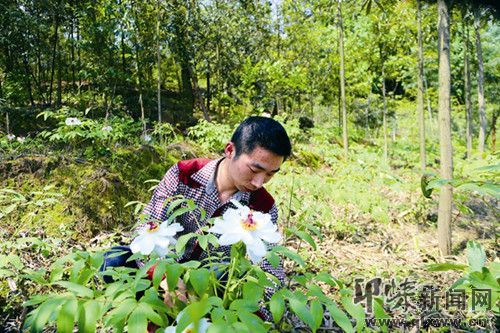
In April, walking into a mountain area in Group 3 of Yangtian Village, Tiantai Mountain Town, one can see oil peonies stretching across the hillsides, lush and green, with plump and delicate white flowers blooming at the tips of the branches. Bees dance in the sunlight, gathering peony pollen, and alongside the peonies, trees such as ginkgo are intercropped... "Peony seeds can be pressed for oil, the flowers and stamens can be made into tea, and the roots can be used as medicine. The whole peony plant is a treasure." Chen Xiang, the owner of the peony planting base, proudly introduced his "treasures" to the reporter.
Chen Xiang is a native of Yangtian Village. A post-90s young man, after graduating in architecture, he did not choose to work in a field related to architecture, but instead became a farmer. He successively worked in management at 4 farms in Qionglai. After learning planting knowledge and techniques, he finally decided to return home to start a business.
At the beginning, Chen Xiang's entrepreneurial experience was not smooth sailing. After 2012, he trial-planted over ten mu of purple sweet potatoes, but encountered continuous rain, causing all the purple sweet potatoes to rot, which dealt him a heavy blow. Having suffered a "Waterloo," Chen Xiang not only did not lose heart, but became even more active in seeking opportunities. In 2014, while casually browsing a website, a piece of information once again ignited the keen young man's confidence in building a career in rural areas: "I noticed a central government document encouraging the development of under-forest economies and woody oil crops." After consulting a large amount of relevant material, Chen Xiang learned about the enormous economic value and development space of oil peonies. Combined with the soil and climate conditions of Yangtian Village, which are very suitable for peony growth, this further strengthened his determination to grow peonies.
"Young people not going out to work and earn money, relying on a tiny plot of land for a lifetime, what future is there in that?" He did not expect that as soon as he proposed his idea, it would meet with opposition from his parents. Because oil peonies are planted in November each year and only bear fruit in the third year after planting, there would be no income for two to three years after planting the seedlings, and the villagers were also not optimistic. But he did not give up. Instead, he made multiple trips to oil peony bases in Mianyang and other places to investigate market prospects, planting techniques, product processing, and other information, and looked for cooperative companies that would buy back and process peony seeds to solve the problem of product sales. In the end, he gained his family's approval. In 2014, Chen Xiang used his family's barren hills and fields to begin planting oil peonies.
"Oil peonies like a half-shaded, half-sunny environment. They are prone to withering and dying when encountering high temperatures. Mountain land with a relatively obvious boundary between shady and sunny slopes is most suitable for planting." Now when talking about peony cultivation techniques, Chen Xiang speaks fluently and confidently. He says he learned all of this from repeated lessons. Last year, just as production was about to begin, it unexpectedly rained for about 10 consecutive days. The accumulated water in the fields could not drain away, and all the peonies became diseased. To solve the technical problems of peony cultivation, in addition to learning at other bases, Chen Xiang also often went to the Wenjiang Academy of Agricultural Sciences to consult experts. He transplanted the peonies to solve the water accumulation problem, and also intercropped tall crops such as ginkgo and Idesia polycarpa in the rows between peony seedlings, which was beneficial to peony growth and also increased economic income.
After careful management, this year the peony garden entered the fruiting stage, and by September it will be possible to harvest plump, glossy black peony seeds the size of peas. Chen Xiang calculated an account for the reporter: oil peonies have a growth cycle of 40 years and 30 years of full production. After reaching full production, one mu of land can harvest about 600-800 jin of seeds. The purchase price per jin of seeds is 12-15 yuan, and the annual income per mu of land is at least 8,000 yuan.
In addition, Chen Xiang also keeps more than 20 boxes of bees, combining planting and breeding to cultivate distinctive peony honey. He says that this kind of honey not only has a high sugar content, but is also rich in nutritional value. Although it is much more expensive than the market price, it is still loved by everyone.
At present, Chen Xiang's peony base has grown to 50 mu, with more than 40,000 oil peony plants. Last year, he established the Qionglai Yixiang Peony Planting Professional Cooperative, and 12 households in the village planted along with him. When talking about the development of the peony base, Chen Xiang outlined the cooperative's development vision: make use of all idle land and barren hills, expand the peony planting area to 1,000 mu, and by 2020, strive to create a uniquely distinctive peony sightseeing attraction during the Qingming holiday when the peonies bloom most abundantly.