Growing melons on saline-alkali flats, Xing Juncheng finds the road to prosperity
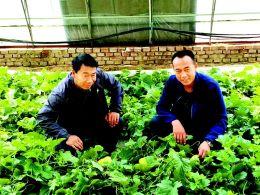
Xing Juncheng (right) inspecting the growth of muskmelons in the greenhouse with a manager
The soil in Qianying Village is severely saline-alkali
By the Hutuo River, on saline-alkali flats, the once nearly barren low-yield fields are now covered in rows of greenhouses, their lush greenery showing the vitality of spring. Newly cultivated watermelon seedlings have broken through the soil and will soon be transplanted into the fields. Several rows of muskmelons being tested in soilless cultivation are growing vigorously, with strong seedlings and abundant fruit. What makes the mouth water most are the muskmelons in the greenhouses that are about to hit the market; their nearly ripe, yellowing surfaces are tempting to pick, and the melon fragrance fills the greenhouses. Perhaps you think growing muskmelons in greenhouses is nothing unusual, but this is the first time they have been cultivated on low-lying saline-alkali flats, and their crisp sweetness even surpasses that of muskmelons grown in open fields, so you cannot help but give it a thumbs-up. The villagers of Qianying Village, Jizhuang Township, Dingxiang County, never imagined that saline-alkali land, which for many years could only grow a little corn with very low yields, could actually produce fragrant melons whose quality, taste and yield all exceeded expectations. Here lies the hope of prosperity for the more than 600 people of this poor village. And this is precisely the first step Xing Juncheng, who returned home to start a business, has taken over more than a year of throwing himself into this place to realize his dream.
Qianying Village, Jizhuang Township, 4 km from the county seat, is Xing Juncheng's hometown. For more than a decade he has been striving in the provincial capital Taiyuan, working on some construction projects, and has already achieved modest success. Whenever he returned home, seeing that most villagers went out to work and the village's economic development lagged behind, he felt a sense of anxiety. The village's development should not be about sending all the villagers away, but about bringing them back. Qianying Village has convenient transportation and relatively abundant land resources, but because it is close to the Hutuo River, its terrain is more than ten meters lower than other villages, so the salinity and alkalinity are severe, the crops that can be grown are limited in variety, and yields cannot rise. The villagers saw no hope of prosperity, and the village cadres also racked their brains, but were troubled by the lack of good projects and funds. After extensive research, Xing Juncheng proposed experimenting with greenhouse muskmelon cultivation. Growing muskmelons on saline-alkali flats? This was something no one in Qianying Village had dared to imagine for many years, and relatives and friends all came to advise him not to throw money into it. Xing Juncheng, who had traveled widely over the years and seen the world, withstood the pressure and decided to give it a try. He consulted senior agricultural experts in the province, visited the national-level agricultural demonstration park in Ningxia, and went to vegetable bases in Shouguang, Shandong and Northeast China to look for methods to improve saline-alkali land and good varieties. After returning, in April last year he acquired more than 30 mu of land through land transfer and invested more than 2 million yuan to begin building the base. Several villagers with active minds set up the Dingxiang County Nongfu Planting Farmers' Professional Cooperative together with him.
Having an idea and an organization was only a good start; the key was to improve the saline-alkali land. Only if this kind of land could produce melons, fruits and vegetables of good quality could later development even be discussed. The surface of the land in Qianying Village is whitish, with severe salinity and alkalinity; when a ditch about 1 m deep is dug, the turned-up soil shows white salt and alkali within a few days. After extensive research and careful consideration, Xing Juncheng decided to adopt the most economical and effective improvement methods. The first was agricultural technical improvement: through deep plowing, leveling the land, adding outside soil, and increasing the application of organic fertilizer, the soil's composition and structure were improved, its permeability was enhanced, and salt leaching was accelerated. Then biological improvement methods were adopted: about 1 m deep ditches were dug beneath the crop ridges in the greenhouses and filled with straw, sheep manure and bio-organic fertilizer, with about 40 cm of outside soil spread on top, to increase soil fertility, promote the formation of soil aggregates, improve soil structure, improve the farmland microclimate, and inhibit the return of salt. Through this series of improvement measures, Xing Juncheng was still uneasy: could melons, fruits and vegetables actually be grown in the field? Around October last year, he decided to plant a crop of celery in the greenhouse. During planting, water conservancy improvement measures were also needed: a complete drainage and irrigation system was established, two rows of drip irrigation pipes were laid on the ridges, and then plastic film was laid for planting. This not only strictly controlled the groundwater level and continuously leached and removed salt from the underground soil, but also helped reduce humidity in the greenhouse and ensured that basically no pests or diseases occurred during crop growth. This crop of celery grew very well; each half-mu greenhouse yielded about 3,000 kg, and it was quickly purchased by merchants from the city at about 1.6 yuan per kg. After the Spring Festival, Xing Juncheng began cultivating muskmelons. He specially hired Master Li, a local melon-growing expert with more than ten years of experience, for technical guidance, and chose a local old variety, "Zaokaiyuan," to plant, while also trial-planting several new varieties introduced from Northeast China and Japan for experimental comparison.
At present, the base of the Nongfu Planting Farmers' Professional Cooperative has 10 solar greenhouses and the only two 16 m span greenhouses in Dingxiang County. Besides one greenhouse for seedling raising and vertical cultivation trials, there is also a strawberry greenhouse. The strawberries have already been completely picked and the greenhouse is being cleared to plant watermelons. Xing Juncheng said these are all meant for trial comparisons and for accumulating more planting experience for crop rotation. The other 10 greenhouses are all planted with muskmelons. For more than two months, Xing Juncheng has been eating and living at the base, with no time to attend to other matters, and he rarely returns to his home in the provincial capital. He constantly observes the growth of the muskmelons and diligently learns muskmelon cultivation and management techniques from Master Li, a local expert. To ensure the quality of the muskmelons, during the entire growing period only two applications of biological bacterial fertilizer were used, and no pesticide was used at all. In early April, Xing Juncheng's first crop of muskmelons was finally ready for market, and both quality and taste exceeded everyone's expectations; after tasting them, the villagers all praised them. Guests from Xinzhou and Taiyuan gave very good feedback after tasting them, and within a few days they were snapped up by merchants from Beijing and Hebei at about 60 yuan per kg. Amid the excitement, Xing Juncheng promptly registered the brand "Xiangzhen" for his muskmelons.
Looking at the muskmelons in the greenhouse that are about to ripen in large quantities, 41-year-old Xing Juncheng, whose heart had been hanging for more than a year, finally felt at ease. He said: "What I worried about most was that good muskmelons could not be grown on saline-alkali land, because then all our efforts would have been wasted. The village leaders, the township's resident cadres and the first secretary all took great care of me, and when I encountered difficulties they did their utmost to help solve them. Now that this has succeeded, I have finally not let down their support. I was born and raised here, and being able to find hope of prosperity for the villagers is my motivation. I myself am already content with modest wealth. Qianying Village is a poor village, with severe saline-alkali land, low efficiency, a lagging economy, and no economic entities at all. The villagers cannot find good ways to earn money and cling to fixed ways of thinking, unable to move forward. Growing muskmelons in greenhouses is feasible in terms of both quality and efficiency, and I hope that through my own demonstration and drive I can change the village's planting structure and help my fellow villagers escape poverty and become prosperous as soon as possible."