Heze, Shandong: Small Chili Peppers Grow into a Big Industry for Prosperity
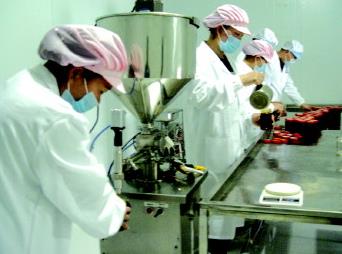
Workers producing chili sauce.
Wang Zhigang, a veteran from Cao County, made his own way after leaving the military. He first worked elsewhere, then returned to his hometown to start a business working with the land and farmers, establishing a planting cooperative that has driven the development of more than 10,000 mu of chili pepper cultivation by farmers, helping over a thousand farming households increase their incomes and prosper. He also set up a condiment company to produce chili sauce, specifically arranging for impoverished people to work at the factory, assisting more than 30 poor households.
A Veteran Makes His Own Way, Returns Home to Start a Business Growing Chili Peppers
Wang Zhigang, 41 this year, is from Lilou Village, Weiwan Town, Cao County. He has served in the military and worked as a laborer. Now he is a small business owner who returned home to start a business. In 2011, he established the Cao County Luhong Planting Cooperative, developing more than 30 mu of facing-heaven chili peppers in his own village, and afterward developed a more than 10,000-mu facing-heaven chili pepper planting base in Zhuanmiao Town and Weiwan Town.
In 2009, Wang Zhigang returned to his hometown in Cao County. "After coming home, I just wanted to do something on my own," Wang Zhigang said. He had seen that farmers in his hometown all grew traditional crops like wheat and corn, working hard all year round yet unable to make money. "If I go into specialty planting, could it raise the output of the land and increase the income of the farming families?"
After thinking it over for a long time, Wang Zhigang thought of his own habit of loving chili peppers. He also noticed that spicy-and-numbing Sichuan cuisine and other dishes had become popular across the country, and that most people, like him, loved spicy food. "Not to mention the amount used by restaurants, ordinary citizens also need chili peppers for cooking at home. Could growing chili peppers be feasible?"
What you get from paper is ultimately shallow; to truly know a thing, you must practice it yourself. With this idea, Wang Zhigang lost no time in visiting chili pepper planting bases in Sichuan, Henan, Hebei and other places to learn, studying chili pepper varieties and learning planting techniques.
After completing his studies, he went home and first took two mu of his family's land to "practice" with a trial planting, while also finding good friends in the village to plant together. "I had never farmed before either. When we asked villagers to switch to growing chili peppers, none of them believed in us." Wang Zhigang had no choice but to plant on his own land as an experiment, while promising the farmers who grew chili peppers with him and signing agreements that the buyback price per mu would be no less than 2,000 yuan. At that time, growing corn brought in less than 1,000 yuan per mu. "So in one village, only a little over ten mu were planted."
From the initial ten-plus mudriving the development of more than 10,000 mu
After the chili peppers were planted, Wang Zhigang did not idle for a moment. He began traveling to other places to investigate the dried goods and seasoning market, finding a sales outlet for the ten-plus mu of chili peppers. Because market demand was large, there was no need to worry about sales at all. That year, the farmers who grew chili peppers with Wang Zhigang earned more than 4,000 yuan per mu.
A gold cup or silver cup is not as good as the people's word of mouth. Once the people got a taste of the benefits, they began to trust Wang Zhigang. The original farmers all expanded their planting scale the next year, and many new farmers joined in as well. In the second year, the chili pepper planting area reached more than 200 mu, and the varieties of chili peppers grown were also enriched.
In the third year, that is 2011, the chili pepper planting area reached more than 600 mu. In August of the same year, Wang Zhigang established the Luhong Planting Cooperative, uniformly buying back members' chili peppers and then selling them to dried goods and seasoning markets in Sichuan, Hunan, Jiangxi and other places.
With incomes increased, the farmers were even more motivated. "In my first year I planted more than 60 mu of chili peppers, and the cooperative even bought them back in cash. It's really much better than growing grain!" said Zhan Wuying, a large-scale grower from Zhanzhuang Village, Weiwan Town, Cao County, happily. Now, working with others, his planting scale has already reached more than 400 mu.
Wang Zhigang's Luhong Planting Cooperative also grew from 5 farming households at its founding to more than 30 households in the second year. Now 123 farming households have joined, with Weiwan Town as the center radiating to surrounding townships such as Zhuanmiao and Louzhuang. The chili pepper planting area has also reached more than 10,000 mu, and the chili peppers are sold throughout the country.
Extending the Chili Pepper Industry Chain to Help More Farmers Prosper
As the chili pepper planting scale grew larger and larger, why not extend the industry chain and increase the added value of the chili peppers? In 2016, Wang Zhigang's Cao County Luwei Condiment Co., Ltd. was established, with 37 regular workers, and the company mainly produces chili sauce.
Because the products taste good and are of high quality, the chili sauce produced by his company was entered in the 13th China Forestry Fair in 2016, where it won the affirmation of many expert judges and took the silver award in one stroke.
When a reporter met him the other day, he was negotiating with a local farmer raising rufous-backed chickens about jointly developing diced-chicken chili sauce. It turned out he was preparing to expand the company's product series and further increase the added value of the products, so as to give more benefits back to the chili pepper growers.
Wang Zhigang said that next he plans to develop for another two to three years, expanding the chili pepper planting scale to 30,000 to 50,000 mu, controlling the entire chili pepper production process from the source, producing organic chili peppers and making green food, and further researching and developing chili pepper series products such as diced-chicken chili sauce and golden cicada chili sauce.
Wang Zhigang said that in the future he will also use chili peppers to extract capsaicin, which can be used in fields such as medicine. "In this way, it can help more farmers grow chili peppers and prosper, and can also provide jobs for more poor households, helping them shake off poverty as soon as possible."