The "Chicken Commander" of East Hunan Fails at Chicken Farming but Still Refuses to Give Up
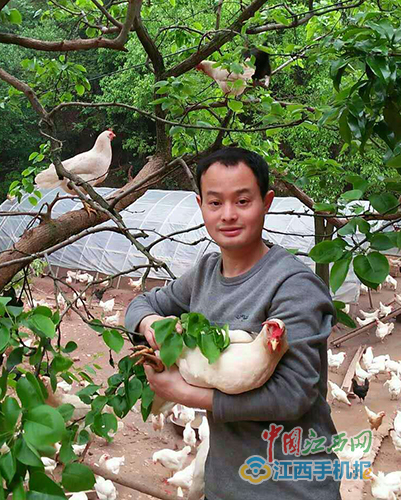
"Chicken Commander" Liu Liang and His Free-Range Chickens
Although he worked away from home for 10 years, he kept in mind the old saying "fallen leaves return to their roots"; although he was a "chicken technique illiterate," he was determined to become a "Chicken Commander"; although he lost everything raising chickens for three consecutive years, with perseverance and persistence he struggled hard for 7 years and finally became a skilled expert. This "Chicken Commander" who refuses to give up in the face of failure is Liu Liang, a farmer from Nan'an Village, Dongqiao Town, Xiangdong District.
Liu Liang, now 36 years old, dropped out of school after the first year of junior high because his family was poor when he was young. In 2000, Liu Liang left his hometown and went south to work, and he did so for 11 years. Over these years, he discovered a business opportunity: some farms were developing green planting and breeding, producing and selling their own products, and business was booming. He thought his hometown had plenty of mountain fields and land, so he might as well return home to start a business, set up an ecological farm, and develop planting and breeding. Besides, he had already earned more than 100,000 yuan.
So, in early 2011, Liu Liang struck while the iron was hot, returned home to raise chickens, and chose a relatively remote, naturally pristine, fresh-air mountain nook for his chicken farm, namely the tail of the Dashi Chong Reservoir in Nan'an Village. He insisted on not feeding them feed and not raising them in confinement, letting the chickens grow freely among the green mountains and grass, raising original ecological free-range chickens and letting them lay original ecological free-range eggs.
As a chicken-raising "layman," the difficulties were far greater than he had imagined. In the first year, from the first batch of 600 to the second batch of 400, and then to the third batch of 300, because he did not understand scientific management and chicken disease prevention and raised them blindly, in the end, batch after batch of hard-raised "precious free-range chickens" all died in batches, not a single one left. Faced with this loss of everything, he wore a worried look, but he also carefully analyzed the reasons for the failure and began to learn chicken-raising techniques online.
In the second year, he thought he had basically mastered this chicken-raising technique and wanted to go all out to make up for the previous losses. However, of the first batch of 1,200, by the time they reached three or four jin each, he sold only more than 300, and the rest all died from disease. Of the second batch of 600 and the third batch of 300, only a portion was sold, and the rest also all died from disease. That year, he was so heartbroken that he cried, but he still did not lose his spirit and worked hard to find the reasons.
In the third year, Liu Liang raised several more batches of free-range chickens, but again lost everything. By the end of the year, he was so heartbroken it was like an illness; he shed tears every day, could not eat, and could not sleep well. His family advised him not to pursue this money-losing business anymore. Apart from using up all his savings from working elsewhere, he was also more than 100,000 in debt. If he failed again, what would he do? But Liu Liang still refused to believe in bad luck. "I think the reason for the failure is that I did not understand the techniques, lacked funds, and was purely a layman messing around, but I have always been confident in my choice!"
As the saying goes, in entrepreneurship, no one can succeed casually. Liu Liang deeply understood this. In his view, if one wants to succeed, persistence is what matters most. By 2015, because of raising chickens, he was already more than 300,000 yuan in debt. He bought books and devoted himself to study, visited well-known laying hen farms, actively participated in various breeding technique exchange meetings, and talked with and learned from experienced peers in the same industry. Because he loved learning, was good at learning, and was willing to endure hardship, before long he had mastered the key techniques of every link in raising chickens.
Through learning and exploration, Liu Liang adopted the method of planting Chinese herbal medicines to feed the chickens, and planted ryegrass and Chinese herbal medicines in every corner of the farm. This not only increased the sources of chicken feed, but also played a role in preventing chicken diseases. The chickens raised were safer and healthier, and it was also a beautiful sight. He continued to seek help from relatives and friends and tried every possible way to raise funds. Finally, in 2015, full of confidence, he established Jiayi Farm.
Failure is the mother of success. Liu Liang's entrepreneurial path grew broader and broader. After that, his farm reached more than 3,000 laying hens in stock. Eggs were not only sold to Pingxiang and surrounding areas, but also to Dongguan, Shenzhen, Guangzhou, and other places. In 2016, output value reached 600,000 yuan, and in 2016 net income reached more than 200,000 yuan. In addition, he also successfully raised ducks, geese, pigeons, bees, rabbits, ostriches, and more.
Now, Liu Liang and his parents live in an old house that had been abandoned for many years. Regarding this, Liu Liang said that in the early days of starting the business, this was the only way to make do. In such an environment, he always persisted in his green entrepreneurial dream. "Green breeding will be the development direction of the future. Green circular ecological breeding and the development of healthy agricultural ecology are good things that benefit the country and the people. In the future, I plan to establish a professional company, strengthen scientific research and management, build an Internet Plus platform, and move toward the direction of sightseeing agriculture."
Talking about his years of arduous entrepreneurship, Liu Liang said that when he had been raising chickens for three years, due to failure, his family became disappointed in him and all left home to work elsewhere. Seeing his parents going out to work at such an old age truly made him feel bad, and he went alone into the mountains to raise chickens. At that time, although the breeding environment here was relatively good, at night it was pitch dark. Liu Liang, alone and sleeping in a thatched hut, did not dare go out at all; there were wild animals and the calls of unknown birds everywhere. In addition, the thatch here was taller than he was, there was no road, and for meals there was basically no dish. Going out to buy food was too far. "The loss period lasted too long, and there was no money. My family always wanted me to get out of chicken raising quickly. When I lost money in the second year, I felt despair, and I never expected the third year to be even more despairing." He said, "Along the way, I am especially grateful to the many relatives and friends who supported me, especially the township government and the Xiangdong District Employment Bureau, for giving me many opportunities to learn, which enabled my laying hen breeding business to begin developing on a fast track."