Snake Commander Hu Changhan's Guide to Getting Rich by Raising Snakes
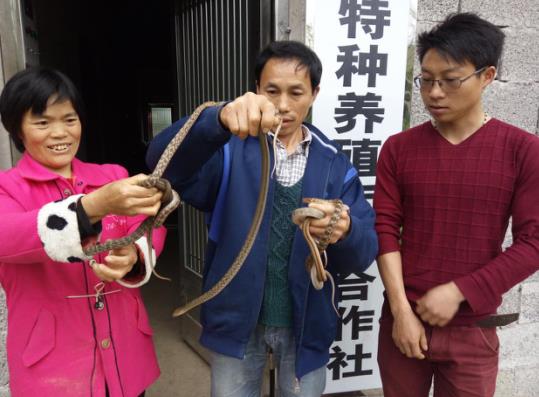
On April 13, with bright sunshine, Hu Changhan from Group 13 of Xuelian Village, Gaofeng Tujia Township, Cili County, picked up a king rat snake and confidently explained the key techniques of snake farming to everyone. After finishing his explanation, he gently returned the snake to the snake house, his smooth, seamless movements showing great skill.
In the field of snake farming, 50-year-old Hu Changhan could be called a well-known "old master." How did he embark on the path of snake farming, and what unusual experiences has he had?
Hu Changhan's idea of raising snakes originated from an accidental dinner gathering. One day in 2010, he tasted a delicious soup in Zhangjiajie. Later, upon inquiry, he learned that this expensive "dragon-phoenix soup" was made from snake meat and chicken. After the gathering ended, Hu Changhan, who had caught snakes in the mountains before, could not calm down for a long time. He learned that although snake meat could be said to sell at astronomical prices, the market still could not meet demand. From then on, the idea of starting a snake farming business began to sprout in Hu Changhan's mind. Returning to his hometown, he resolutely decided to abandon traditional farming and devote himself entirely to raising snakes.
At the beginning of snake farming, he explored while practicing and endured great hardships. At first, he chose the non-venomous king rat snake, and being bitten by snakes was routine. Through wind and rain, working from dawn to dusk, he poured all his time and energy into the work at the snake farm. Being bitten time and again gradually made him thoroughly familiar with the snakes' habits and also allowed him to accumulate rich breeding techniques. However, due to a lack of funds, Hu Changhan's snake farm was still at a small-scale stage, with only more than 200 finished snakes sold each year and net profits of no more than 10,000 yuan.
In early 2015, the village was designated as a targeted poverty alleviation point village by Jixiang Life Insurance Company of the province, and Hu Changhan's family was identified as a registered targeted poverty alleviation household. Yang Bacui, the person responsible for the assistance group, heard that he had expertise and skills in snake farming, made contacts far and wide, helped him secure a 100,000 yuan subsidized-interest loan, and also helped him connect with a large-scale snake farm to learn snake farming techniques. With 100,000 yuan in startup capital, plus his own years of savings, Hu Changhan decided to establish the Cili County Qinglong Special Breeding Professional Cooperative, bringing in interested nearby farmers to join and expand the breeding scale. Harboring his dream of getting rich, Hu Changhan purchased 500 young king rat snakes and 1,000 snake eggs, and full of confidence, began his entrepreneurial venture.
After the cooperative was established, Hu Changhan raised more than 300,000 yuan in funds from various sources, brought his wife and son in as well, and continuously expanded the breeding scale. Soon the number of snakes at the farm grew to more than 2,000, which made him extremely delighted.
At the Qinglong Special Breeding Professional Cooperative, Hu Changhan proudly "showed off" his treasures as if counting his family's valuables: enclosed small rooms, with moist fine sand spread on the bottom and wooden boards separated by red bricks above. Snakes lazily slithered slowly, and on the wooden boards and fine sand were some chicken meat and quail meat prepared for the snakes. "The enclosed rooms are to prevent the snakes from escaping, the fine sand helps the snakes stay cool, and lights replace sunlight," Hu Changhan said while skillfully handling snakes and answering our questions.
Snake farming is both bitter and tiring, and it also requires great care. Hu Changhan said that snakes love cleanliness, and when the environment gets dirty, they are especially prone to disease. After the hibernation period, they must be bathed once every week. Hu Changhan counted on his fingers and did the math for us: young snakes cost 20 yuan per jin when bought, and after being raised to market size they generally sell for 60 yuan per jin, with the price at year-end reaching 80 yuan per jin. Add to that 5 yuan per snake skin, and in a year the net income from more than 2,000 snakes can reach at least 150,000 yuan. At the end of last year, Hu Changhan tasted the sweetness of large-scale farming for the first time.
Hearing that Hu Changhan's snake farming professional cooperative was developing very well, some nearby friends who wanted to raise snakes came one after another to "seek guidance," and Hu Changhan always patiently passed on the farming experience and snake disease treatment techniques he had painstakingly accumulated. Driven by Hu Changhan, the snake farming industry in the surrounding area developed vigorously, and a "company + farmers" breeding model backed by the powerful Qinglong Special Breeding Professional Cooperative is rapidly heating up across the nearby villages...
In the two years since the cooperative was established, for the farmers who joined the cooperative, Hu Changhan has been fully responsible for technical maintenance and follow-up services, "from providing seedlings and breeding snakes to repurchasing commercial snakes and deep processing of snake products, striving to build a standardized, large-scale snake breeding industrial base. I also want to raise more funds, continue to expand the snake farm, and then build an ecological snake garden to achieve a one-stop service of sightseeing, dining and entertainment." Speaking of the future, Hu Changhan smiled, full of confidence.