Small donkeys support a big industry for prosperity
With the spread of agricultural mechanization, the donkey's traditional draft function has gradually been replaced by machinery. In the transition from "raising donkeys for draft" to "raising donkeys for commerce," the donkey industry has become an important part of our city's livestock sector. Advancing the meat donkey industry has become an important part of developing modern livestock farming in our city, promoting supply-side structural reform in agriculture, and is also an important way to increase farmers' incomes. In XinQiu District there is a private enterprise that, by relying on donkey-raising cooperatives and extending the industrial chain, has turned small donkeys into a big industry for escaping poverty, becoming better off, and achieving moderate prosperity, creating a sound development situation in which the cooperative leads and drives villagers to prosper together.
The leader who founded the cooperative is Cheng Luhai, manager of Fuxin Luxianyuan Food Co., Ltd. in Ajindai Village, Changyingzi Town, XinQiu District.
Early spring mornings still carry a bit of chill.
Getting up early, without even taking a bite of breakfast, Cheng Luhai headed straight to Wujiazi Village more than 10 km away. Villager Zhang Zhixin's donkey shed had not yet been paved with bricks, and he kept thinking about it.
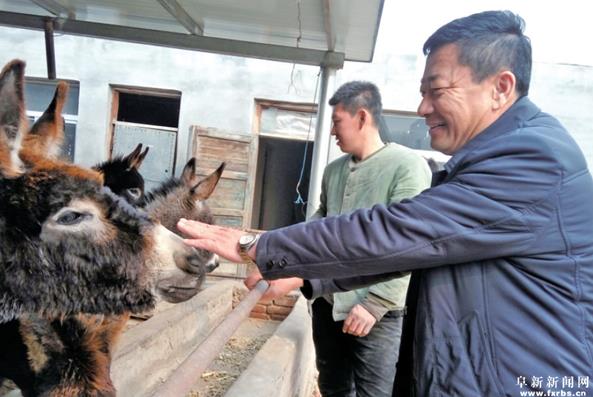
Arriving at Zhang's home, he saw Zhang Zhixin in the yard chopping corn stalks to store as feed, and Cheng Luhai was delighted! He ran his hand over all 13 donkeys in the shed from head to tail, "This is hope. As long as you are willing to work hard, there will always be a day when life gets better. I've ordered 20,000 bricks for you; one of these days let's pave the floor of the donkey shed!"
Zhang Zhixin nodded silently, a glimmer of tears flashing in his eyes.
Zhang Zhixin and Cheng Luhai became connected because of "donkeys." The two had known each other for less than a year, and Cheng Luhai helped build the donkey shed for free, provided donkey foals and forage. Over the 4 months of last winter, Zhang Zhixin earned 11,000 yuan raising donkeys. Now, the second batch of 13 donkeys is fat and strong, and this young man, whose father is disabled and whose mother has a mental illness, has already seen hope in life.
Cheng Luhai often says: "There is no road that cannot be taken, only people who cannot keep going." As a native of XinQiu, he became rich through raising donkeys but did not forget his hometown. He founded a cooperative to lead his fellow villagers forward briskly on the road out of poverty toward moderate prosperity. Because his greatest dream is to make his hometown more beautiful and the villagers happier...
Entrepreneurship: Starting a dream on a bicycle
Cheng Luhai's home is in Group 4 of Ajindai Village, Changyingzi Town, XinQiu District. There are many people and little land here, and the hard days he endured as a youth are still fresh in his memory.
One time when he came home from school, only a bowl of sorghum rice was left at home. The hungry boy swallowed it in a few bites with soy sauce. When his mother came home and held the empty soy sauce bottle, she sighed: how many more times could it have been used, why is it gone? This scene deeply stung the young Cheng Luhai, and in his small heart he swore then: in the future he must rely on his own two hands to live a good life!
In 1978, Cheng Luhai graduated from high school. As the eldest in the family, he began rushing about everywhere to help the family make a living, successively learning carpentry, working as a purchasing agent, and selling chemical fertilizer. Young as he was, he had a refusal-to-yield spirit in his heart, feeling that a person must always do something, and perhaps by doing it he would find a way.
One day after the Spring Festival in 1996, Cheng Luhai and his wife went to a country fair, and several meat donkeys at the fair caught his attention. As the saying goes, "In heaven there is dragon meat, on earth there is donkey meat," and its nutritional value is evident. He felt that the donkey meat business should be viable. But for Cheng Luhai at the time, the so-called business was actually just the couple riding bicycles through streets and alleys selling donkey meat. Over the following 4 years, a bicycle and a steelyard were Cheng Luhai's "standard equipment." The couple left early and returned late every day, laboriously traveling through fairs and streets, and bit by bit accumulating start-up capital.
After several years of exploration, in 2000 Cheng Luhai broadened his entrepreneurial channels and established Luhai Food Processing Factory to carry out deep processing of donkey meat. In order to open up the market, he often carried a full bag of donkey meat products on long-distance buses to promote them. Product quality was his signboard. Through unremitting efforts, he gradually gained a place in the donkey meat markets of Shenyang, Yingkou and other places, and the enterprise continued to develop and grow accordingly.
However, the dream of entrepreneurship did not stop there. A bigger blueprint began to take shape in Cheng Luhai's mind. In 2006, Fuxin Luxianyuan Donkey Meat Food Co., Ltd., integrating donkey breeding, slaughtering and deep processing, emerged, and Cheng Luhai was determined to turn the "small donkey" into a "big industry."
Leading the way: The cooperative paves a road to prosperity
On a spring morning, the reporter walked into Fuxin Luxianyuan Donkey Meat Food Co., Ltd. in Ajindai Village, Changyingzi Town, XinQiu District. What came into view were clean and tidy rows of pens, housing lively, glossy black donkeys. They were plump in form, sturdy in build, with sleek and shiny coats, and from beneath their hooves came crisp "clop clop" sounds from time to time.
Cheng Luhai told the reporter that the enterprise now has 1 breeding farm, 1 slaughtering and processing plant, and 10 donkey sheds, with more than 800 meat donkeys currently on hand. This year's slaughter is expected to reach more than 3,000 head, and a new harmless treatment plant has also been built. After several years of development, the enterprise has continued to grow, and the brand has also gained market recognition, becoming an industrialized enterprise integrating breeding, raising, slaughtering, processing and sales, and its leading and driving role has begun to show.
As is well known, the donkey industry is an important part of the livestock sector and also an industry with a relatively high degree of integration among the primary, secondary and tertiary industries. Advancing the industrialization of meat donkeys is an important part of developing modern livestock farming in our city, and also an important way to increase farmers' incomes. To develop the meat donkey industry, the radiating and driving role of leading enterprises is indispensable. Cheng Luhai often says: "One flower alone is not spring; a hundred flowers blooming together fill the garden. One person being rich is not called being rich; being able to lead everyone to a good life, that is real ability." Years of experience told him that raising donkeys is a path to prosperity, and raising donkeys in rural areas has great potential.
Ajindai Village is a typical village on the edge of the city. It has a large population, little arable land, and small-scale traditional agriculture, making it very difficult to get rich by relying on land. Vigorously developing the donkey-raising industry is a feasible path. Cheng Luhai believes that developing industrialization cannot be separated from intensification, and intensive operation cannot be separated from cooperativization. A change in thinking opens up a broad world. In 2013, relying on Fuxin Luxianyuan Donkey Meat Food Co., Ltd., Cheng Luhai established the Ajindai Village Xinyuan Meat Donkey Breeding Cooperative, actively promoting meat donkey breeding projects among villagers, developing farming households into cooperative members, and at the same time actively providing everyone with breeding knowledge and seeking sales channels for meat donkeys. The cooperative established a "one-stop" service model of "unified purchase of breeding stock, unified management, unified improvement, unified disease prevention, unified technical study, and unified sales," which not only reduced production costs but also improved economic benefits. Villager Wang Hanwei had the idea of developing meat donkey breeding, but suffered from a lack of funds. Through the cooperative's coordination, he obtained a loan of more than 100,000 yuan, and the cooperative also gave him 10 breeding donkeys on credit. After 3 years of development, he has sold more than 300 meat donkeys. Villager Zhang Kaibo worked at an enterprise in another village and, because of the economic downturn, also faced the crisis of being laid off. After discovering that joining the cooperative to raise donkeys was a way out, Zhang Kaibo also began to think about it, but hesitated because the initial capital investment was relatively large. The cooperative took the initiative to lend him 30,000 yuan to help him start meat donkey breeding. After the first batch of meat donkeys was sold, Zhang Kaibo earned his first pot of gold. He took out 2,000 yuan and sent it to the cooperative, wanting to express his gratitude to Cheng Luhai. But Cheng Luhai refused to accept it no matter what, and instructed Zhang Kaibo to go back and develop well: "Everyone making the business bigger together and earning more money is better than anything!"