Rainbow Trout Farming Helps Huairou Female Model Worker onto the Path to Prosperity
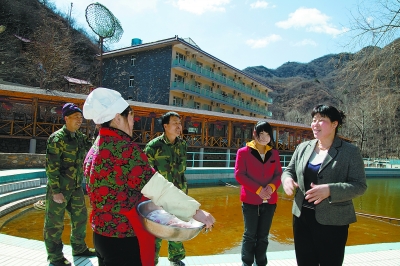
Chang Junying with her employees.
For an outing in Huairou, eating rainbow trout is absolutely the first choice for most tourists. But few people know that the methods of eating rainbow trout raw and grilled actually came from the hands of a farmer's wife in the mountains of Huairou. She is Chang Junying, a National Model Worker and the owner of Huairou Model Worker Villa.
Speaking of the name "Model Worker Villa," Chang Junying was actually a bit torn at first. "Under the banner of a model worker, if I somehow failed to do well, I really wouldn't have the face to meet my fellow villagers." It was precisely because of this thinking that Chang Junying was especially meticulous in her business, determined to set an example in everything. Today, in the Huairou Rainbow Trout Valley, where rural tourism on the outskirts of Beijing is extremely popular, Chang Junying and her Model Worker Villa are equally renowned, and in terms of both business scale and reception quality, they can be called the "dragon head" of local home-style hospitality.
Seizing the Opportunity to Farm Rainbow Trout
"At first it was just a very simple dream of getting rich, thinking I could use a new opportunity to change my life and live better." The "new opportunity" Chang Junying mentioned was cold-water rainbow trout farming.
In 1992, rainbow trout farming had just begun to emerge in Huairou. At that time, Lianhuachi Village was just a remote, isolated and poor little mountain village, far from its present glory. Regarding the novel business of farming rainbow trout, many people stood on the sidelines, not daring to try. But Chang Junying had the idea of farming. She said: "The government created an opportunity for us to get rich. If you don't seize it yourself, you can't blame anyone else when you regret it later." And so, Chang Junying told her husband about her idea, and unexpectedly he was very supportive and said: "You go ahead and do it. Whatever difficulties there are, I'll help you."
Farming rainbow trout sounds simple, but doing it was hard. To build fish ponds, the first problem was money. To build 5 fish ponds on 3 mu of land, construct a large parking lot, and then build a 120 sq m Chinese-style house would require at least several hundred thousand yuan. Where could she find so much money? Chang Junying and her husband both fell into anxiety. Money was a real problem, and once invested there would be risks; family members also tried to dissuade her out of worry. "But we carefully analyzed it: the state encourages us farmers to get rich, and with such a good opportunity, we had to take this step boldly. So the two of us, thick-skinned, went door to door borrowing from relatives and friends. As soon as they heard it was to build fish ponds, and that it was a woman who wasn't properly staying home keeping house but instead showing off, they said she really didn't know how much she could eat. Nobody was willing to lend me money, but none of this shook my determination. Under enormous pressure, I held firm to my belief that I just had to set an example and lead the way, and prove through my own actions that we women can accomplish great things too." Recalling the scene of those early entrepreneurial days, Chang Junying said with emotion.
After all, borrowing money isn't something you can get just by a few bold words. In Chang Junying's own words, at the time she wore out the thresholds of relatives' and friends' homes and said all the nice things she could, but with little result. Just then an elderly woman was moved by her. This woman was Zhang Fulian, the first in the village to step forward and support Chang Junying. She said: "I think this child Junying has promise. She doesn't say much, but she knows what she's doing. We're all fellow villagers - would she cheat us? I firmly support her." The old woman took out all her hard-earned savings of more than 600 yuan. When Chang Junying received this money, her hands trembled with excitement. Gradually, many villagers also felt that Auntie Fulian's words made sense, and everyone began to give Chang Junying money, one 1000 yuan, another 500 yuan, and the startup funds were finally raised.
In the second half of that year, Chang Junying built her own rainbow trout farm and bought 50,000 live, hopping little fry to put into the ponds. She cherished these little fry like the apple of her eye, caring for and nurturing them day and night. But misfortune comes when least expected. During that long, agonizing period, every day she would see fish floating up, and Chang Junying's emotions fluctuated with them; she felt discouraged and disheartened. Yet just then, when the leaders of the Huairou District Women's Federation learned of this, they immediately sent experienced technicians to dissect the dead fish and help her investigate the cause and find countermeasures. Through scientific and technological identification and targeted treatment, the fish deaths were brought under control and her losses were reduced to the lowest point. For Chang Junying, this was truly timely help, and it immediately brought her out of her predicament.
"To help me quickly master breeding techniques, the District Animal Husbandry and Aquatic Products Service Center not only had me regularly attend cold-water fish farming training classes, but also specially sent technical personnel to the farm to provide guidance, teaching me farming techniques hand by hand and face to face." Chang Junying recalled that, following the technicians' guidance, that year she invested another 90,000 yuan to channel mountain spring water from Lianhuachi to raise fish, which not only improved the farming quality but also made the fish meat more fresh and delicious. In the end, rainbow trout farming was a great success.
Developing New Ways to Eat Rainbow Trout
If the success of rainbow trout farming was a milestone in Chang Junying's entrepreneurial journey, then the driving force that propelled her to even greater success was overturning the traditional way of eating rainbow trout - grilled rainbow trout.
The time goes back to 1995. At that time, Chang Junying didn't know how to run rural tourism, nor even what rural tourism was. She only knew that those city people with cars all wanted to use their weekends to go to a place with mountains and water to climb hills, fish, eat wild game, and if possible sleep on a farmhouse's large heated brick bed. Places around Beijing were basically all the same: the mountains were ready-made, the fish were ready-made, and even the heated brick beds were ready-made. "When people come, whatever they need, we give." Chang Junying also followed others and built a new small courtyard specifically to receive guests from the city. But wild game was hard to handle; no matter what she made, it was always the same few dishes. Chang Junying became worried.
As it happened, that same year a group of Russian guests came to Chang Junying's small courtyard, but this little mountain village more than 80 km from Beijing really had nothing good to entertain them with. People from the city loved big tofu and chestnut-stewed chicken because they had feelings for these things and they were hard to find in the city. But what do foreigners eat? Just as Chang Junying was worrying, the accompanying translator said she didn't need to arrange anything. Chang Junying was even more confused.
Fortunately, the Russian guests, who had been in a meeting all morning, immediately gave the answer. "After the meeting, I saw they had brought an oven in their car, such a tall oven, tongs, seasonings, everything - chili, cumin, all quite complete. After the meeting, they used these things to grill fish. And not only did they light a stove and grill, they also washed the fish, sliced it, and ate it raw." Chang Junying said. "I've lived half my life and had never seen anyone eat raw fish like that. And that wasn't all - they were extremely interested in rainbow trout, slicing it, grilling it into segments, eating it at noon and then continuing to eat it at night. Each person had one fish, and then grilled it or ate it raw. We were really puzzled - how could they eat so much? After finishing one fish at noon, in the afternoon they started eating sashimi, and still one fish each."
A shopkeeper doesn't fear a big eater. Chang Junying lacked everything except the rainbow trout in her ponds. If they could eat it this way, wouldn't that save her from hauling it to Beijing and begging all over the place to sell it? "They stayed with us for a whole day and didn't leave until after 8 p.m. This group of guests ate more than 200 kg of fish in total and spent 4,600 US dollars. When they settled the bill, they even thought it was especially cheap." Chang Junying felt as if she had picked up a huge bargain. After all the calculations, she had sold nearly 40,000 yuan worth of fish just by staying at home - it was simply like a dream. And so, Chang Junying followed suit and became the first "fish griller" in Rainbow Trout Valley.