Growing Roses Set Zhu Yunfen on the Road to Prosperity
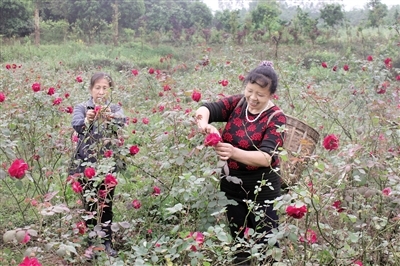
On the morning of April 27, a light rain was falling steadily.
Beside the village road in Baiguo Village, Jianlong Town, waves of fragrance were already drifting on the wind, growing stronger with every step closer.
Gradually, a brilliant red came into view: 500 mu of roses in Jianlong Town were blooming in a riot of color, like a sea of flowers. It is understood that Baiguo Village in Jianlong Town has a long history of rose cultivation; at present there are already 500 mu of roses, generating direct economic income of 4 million yuan and helping more than 200 neighboring households prosper.
She and her husband have grown roses for more than ten years
At two in the morning on April 26, a small light came on in a three-story house in Baiguo Village.
It was Zhu Yunfen getting up. Afraid of disturbing her husband Zeng Youxin's rest, she turned on only a small lamp, felt her way into her clothes, and prepared to go downstairs.
But Zeng Youxin woke up anyway. "Let's go, together!" Zeng Youxin, who had slept less than three hours, rolled out of bed, grabbed his tools and walked out the door.
The night was utterly quiet.
Zhu Yunfen and Zeng Youxin, flashlights in hand, headed toward a field not far from the house.
That night they had one task: to finish picking the roses in this field of nearly two mu, because workers would come to buy them the next day.
Zhu Yunfen is a villager of Group 2 in Baiguo Village. Now 60 years old, she and her husband have grown roses for more than ten years and have prospered by relying on them.
The roses of Baiguo Village are not ordinary ornamental roses but edible roses, with a rich, fragrant scent; they can be made into rose tea, rose drinks and more.
Zhu Yunfen and her husband began growing roses at the end of the last century, when many villagers also grew roses like them.
Zhu Yunfen said that in the early days of reform and opening up, the village began growing roses, but at first the scale was small and few people grew them.
After more than ten years of watching, Zhu Yunfen and her husband decided to plunge into the "sea of flowers," and the two of them began growing roses too. Because several of their cousins had chosen to go out to work, the couple gathered the family's land together and planted roses.
Her family alone recovered its costs
At first, like many growers in the village, Zhu Yunfen had no experience and simply waited for traders to come to her door to buy.
"A single sales channel makes it easy to be constrained by the traders," Zhu Yunfen said. In 2012, the traders who came to buy flowers had collected enough and were unwilling to buy more, so several mu of her family's roses rotted in the field, breaking the family's heart.
More than a hundred growers in the village suffered the same fate as Zhu Yunfen's family. For a time, sighs could be heard everywhere in the village.
But Zhu Yunfen and Zeng Youxin refused to give in. Old Zeng, who had toiled his whole life, said a person cannot be defeated by hardship.
Zhu Yunfen and her husband Zeng Youxin chose to pick roses in the fields at night with flashlights, and early the next morning they carried the roses through the streets and alleys, hoping that all ten-odd mu of roses would not rot in the field.
It was also in this year that Zeng Youxin chose to carry roses through the streets and alleys to sell them. Laifeng, Qinggang, the Bishan urban area -- the two even sold roses in downtown Chongqing.
The two also came up with a trick: to spread their name while selling roses. So Zeng Youxin would often carry his load on a shoulder pole while handing his business card to customers who needed it.
From April to June that year, Zhu Yunfen and Zeng Weixin could not get a peaceful night's sleep; they often slept only three or four hours at night before getting up to pick roses. But the two were not afraid of exhaustion; as long as they could sell the roses, all the effort was worth it.
That year, while more than 200 households in the village suffered heavy losses, Zhu Yunfen's family still recovered its costs.
After opening up their thinking, they set out on the road to prosperity
It was precisely the lesson of that year that set Zhu Yunfen thinking: the single approach of waiting for traders to come to the door might make a whole year of hard work come to nothing. But how could they break out of this odd cycle?
Zhu Yunfen said she really racked her brains to find a way.
By chance, Zhu Yunfen saw a piece of news on television saying that edible roses could also be made into flower tea, which has beauty and skin-nourishing benefits.
Zhu Yunfen was immediately energized. Why not develop in multiple directions? Rose tea and rose drinks were both good options, and she could even sell rose seedlings.
Zhu Yunfen did some calculations: the rose flowering season runs from March to November; from March to the end of May the roses bloom in large flowers, and from June to November they bloom in small flowers.
So Zhu Yunfen sold the fresh roses of March to May to traders at wholesale for 7 yuan per jin, and retailed them at 15 yuan per jin.
After June, the fresh roses could not fetch a good price, so Zhu Yunfen dried them to make flower tea, or crushed the petals and preserved them with white sugar or honey to make a thirst-quenching rose drink.
Not only that, in September Zhu Yunfen also chose to cut off the flower branches and plant them in the field to cultivate; after 5 months each plant could sell for another 5 to 15 yuan.
In 2016, Zhu Yunfen's family sold more than 30,000 rose seedlings.
Relying on roses, Zhu Yunfen's family set out on the road to prosperity.
Roses showed him more hope
Zeng Weifu is Zhu Yunfen's neighbor and also a relative.
Zeng Weifu, now 70 years old, planted roses as early as 30 years ago. But at that time he planted only a little more than one mu, and the Zeng Weifu of those days never imagined that roses could make his later years so enjoyable.
Over the years, Zeng Weifu still put most of his energy into rice farming. But as he grew older, Zeng Weifu increasingly felt unable to keep up.
Seeing that the roses grown by fellow villagers all brought in good income, in 2015 Zeng Weifu made up his mind and planted more than ten mu in one go.
Weeding, fertilizing, pruning -- Zeng Weifu carefully tended the rose seedlings at home, hoping they could bring him change.
This year, the roses at Zeng Weifu's home began producing. At the end of March, Zeng Weifu stroked the roses in his rose field; these were the fruit of his labor, and they would also be his main income.
On the 25th, Zeng Weifu told reporters that up to now he had earned nearly 10,000 yuan. The rose flowering season would last at least until June, and he figured that this year he would have an income of twenty or thirty thousand yuan no matter what.
"In the past year or two, many visitors from downtown Chongqing and even from out of town have come here to admire the flowers, buy flowers and eat farm meals," Zeng Weifu said. When the guests leave, they all take back some roses, rose tea, rose drinks or local farm specialties. In this way, income can increase even more.
Now Zeng Weifu's family has also renovated its house. Thinking of life in the future, Zeng Weifu grinned and smiled with satisfaction.
Hoping a leading enterprise will settle in Baiguo Village
Thanks to their hard work and flexible thinking, Zhu Yunfen and her husband Zeng Youxin have changed their household quite a bit over the years.
A few years ago, Zhu Yunfen's family built a house of more than 300 sq m in Baiguo Village and also bought a commercial apartment of more than 100 sq m in the town.
Not only that, in recent years Zhu Yunfen's family relied on rose income to put their two daughters through school, and also lent the remaining savings to the two daughters to buy homes and cars.
Now their son is about to enter his senior year of high school, but Zhu Yunfen is not worried, because she has long since prepared the money for his university education.
Although the family can earn eighty or ninety thousand yuan a year from roses, Zhu Yunfen still hopes to accomplish even more.