Dendrobium cultivation helps 100,000 farmers in Chishui, Guizhou escape poverty
In the mountains and fields of Chishui grows a Chinese medicinal herb shaped like a hairpin, which local people call Jinchai dendrobium (Dendrobium nobile). It is listed as the first of the "nine great immortal herbs" in ancient medical texts, ranking alongside precious Chinese medicinal herbs such as cordyceps, ginseng and snow lotus. Because it grows parasitically on Danxia stone or tree trunks and prefers high temperatures and high humidity, only places like Chishui can support its wild growth nationwide, so it is prized for its rarity.
In 2003, Liao Xiaokang became connected with Chishui Jinchai dendrobium. What he never expected was that after 15 years of investment and entrepreneurship, he still would not have become a wealthy big boss even today.
Liao Xiaokang is a university graduate who came out of Daozhen County in northern Guizhou. In the late 1980s he left a military-industrial enterprise to go into business, and after more than 10 years of hard work he had saved up a modest amount. Yet the poverty of his hometown weighed on his mind. In 2001, he resolutely brought his newlywed wife back to Daozhen to invest in the Chinese medicine industry, planting gastrodia and introducing Zhejiang Dendrobium officinale. Unexpectedly, not long after planting the gastrodia, the market price of gastrodia plummeted, falling from a high of 300 yuan/kg to 15 yuan/kg. His first investment lost more than 10 million yuan.
The money he had earned through bitter hardship was gone. He realized the enormous risks of investing in agriculture. As the saying in Daozhen goes, "only then did he know the plowshare is cast from pig iron." He was almost in despair and wanted to return to Nanjing, the prosperous city that had given him his wealth.
When heaven closes a door for you, it will surely open a window. In the summer of 2003, a leader in charge of agricultural production in Zunyi City suggested that he invest in Jinchai dendrobium in Chishui. The mayor of Chishui met with him, and the two sides hit it off immediately. For Chishui, there was an urgent need for a leading enterprise to bring Jinchai dendrobium onto the right track and make it bigger and stronger; for Liao Xiaokang, this was an opportunity to make a comeback.
After several inspections, in August of that year Xintian Company moved from Daozhen to Chishui and settled in a place called Nichigou in Xinchun Village, Wanglong Town. It transferred 60 mu of farmland from villagers and began dendrobium seedling breeding. At that time, the planted area of Jinchai dendrobium in Chishui was still less than 500 mu, mainly because seedlings were extremely scarce. To plant dendrobium on a large scale, the bottleneck in seedling breeding had to be broken.
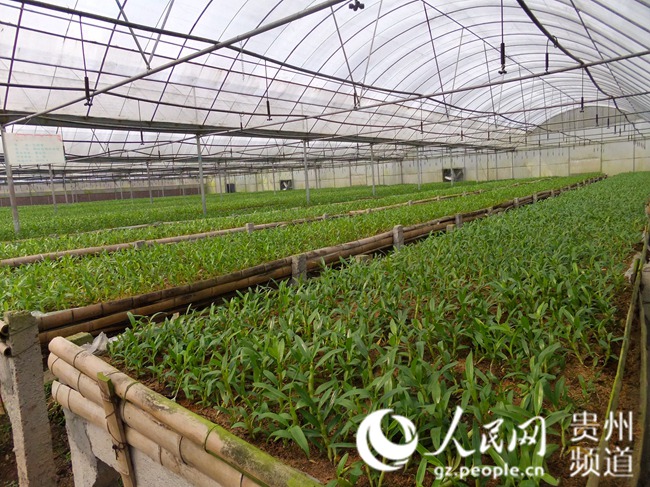
Liao Xiaokang first built an acclimatization seedling base. In the fields he spread bowl-sized Danxia stones, then covered them with steel-frame greenhouses and installed automatic sprinkler irrigation systems to simulate the wild environment of dendrobium. Division is the most primitive dendrobium cultivation technique, but its drawback is low seedling yield; cuttings also produce low seedling yields.
Was there a third method of seedling breeding? Liao Xiaokang made more than 10 trips every year to well-known domestic research institutes. Hard work pays off. A certain research institute cooperated with Xintian Company to develop tissue-culture seedling technology for dendrobium. This technology is equivalent to genetic propagation: small granules cut from a short section of dendrobium stem can produce tens of thousands of embryos in the tissue culture room. After half a year of care, they can be transplanted into acclimatization greenhouses, and after another year of simulated wild growth, they can be transplanted into the wild.
In the spring of 2007, when the first batch of seedlings came out of the tissue culture room, Liao Xiaokang was excited all night. Although he normally did not drink, he made an exception and celebrated with employees at the base all night. At that time, a transplanted seedling cluster of 3 plants sold for 1 yuan on the market, and the 60-mu base could sell 8 million clusters of seedlings each year. He thought to himself: the hard days are finally over!
However, fortune is fickle. One night in the summer of 2007, with thunder and lightning, a rainstorm unseen in 30 years arrived unexpectedly. The water in the flood discharge channel at Nichigou kept rising and soon overflowed into the base, forming a vast expanse of water. After the flood receded, the dendrobium seedlings withered and died one after another because their roots had rotted, and the stone ground was covered with silt. This disaster shattered Liao Xiaokang's dream. Looking at everything before him, he and his younger brother Liao Fanghua, who had resigned from Daozhen to come help him, faced each other in silence, tears welling up in their hearts.
Because of this disaster, his capital chain broke, and banks did not dare lend him money. The winter of 2007 was especially long for Liao Xiaokang. He pawned his nearly 2-million-yuan Mercedes-Benz. Because wages could not be paid for half a year, only 5 of 30 employees stayed. At the most difficult time, the base had nothing left to cook, and his younger brother, brazenly, went to a fellow villager's home to borrow rice.
Just then, his daughter was born, yet Liao Xiaokang could not feel happy: "If my dream shatters, what will happen to mother and daughter?"
When he returned home for the Spring Festival, he saw that his mother's full head of black hair seemed to have turned white overnight. "Son, you two brothers have nothing left. Why not come back and do a little small business!" A man does not easily shed tears, but two failed investments had also dragged down the whole family. Thinking of this, Liao Xiaokang held back his tears in front of his mother: "Mom, I haven't lost yet!"
After the Spring Festival, the enterprise obtained an 800,000-yuan loan from a credit union. This was the enterprise's first bank loan. He used the money to make up back wages and pay land transfer rent, and his credibility won the support of the local Party committee, government and ordinary people. When autumn came, the base sold its first batch of 500,000 commercial seedlings and earned 500,000 yuan. Six years of effort had finally paid off.
In Chishui, Xintian Company is absolutely a leading enterprise in the dendrobium industry. It was the first to explore sawdust substrate seedling beds, tissue-culture seedling technology and elevated cultivation-bed acclimatization high-yield technology, solving the problem of large-scale dendrobium planting. It also applied as an enterprise project for national origin protection of Jinchai dendrobium, and was the first to develop dendrobium medical and health care products and register dendrobium product trademarks.
Since 2008, Xintian Company has produced a cumulative 100 million clusters of dendrobium seedlings, enough to plant 33,000 mu. Today, Chishui City's original-ecology Jinchai dendrobium planting base reaches 79,000 mu, covering more than 30,000 farming households, and 100,000 farmers have escaped poverty through the dendrobium industry.
Xintian Company began building its own wild bases in 2011. Over the past 6 years, it has built 8 bases totaling 17,000 mu in townships, adopting models such as "company + farmers" and "Party branch + base + farmers." Villagers' land is paid dividends at a 20% share, directly covering more than 10,000 households.
Calculated at a dendrobium yield of 200 to 300 kg per mu and 60 yuan per kg, starting from the 4th year after new planting, farmers can receive 3,000 yuan in dividends per mu, and can continue receiving dividends for more than 10 years.
Xintian Company established a Party branch and formed a paired assistance relationship with the village Party branch, driving people's development through methods such as Party member demonstration development and technical guidance. More than 300 farmers manage the company's bases, most of them impoverished households over 50 years old, and the wages paid out by finance each month are around 1.3 million yuan.
This year, Xintian Company is investing 100 million yuan in the Chishui Economic Development Zone and is building a modern deep-processing factory for Jinchai dendrobium. The first phase of the project can be completed and put into production in July, and next year it can reach an output value of 300 million yuan.
Liao Xiaokang said, my dream is to build the Jinchai dendrobium industry into a 20-billion-yuan industry. Although I have suffered many setbacks, what I care about most is still the poverty alleviation of tens of thousands of medicinal herb farmers. I will always stick to the "three noes": never admit defeat, never change trades, and never owe farmers a single cent.