Whole family returns home to develop integrated farming and find the road to prosperity
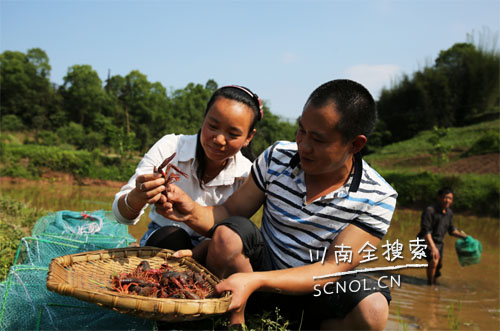
"The market is really hot right now, and I took several more orders last night." On May 1, busy netting crayfish in the rice paddies, Shao Zegang, a young man from Group 1 of Panlong Village, Maling Town who returned home to start a business, and his wife Yang Qun were full of anticipation. After several years of hard work, the couple has finally blazed a prosperity path of integrated farming in their hometown, with an annual output value of more than 500,000 yuan, making them locally known "prosperity stars."
Whole family returns home: traditional farming is a bit "tiring"
Shao Zegang, now 30 years old, lives in Panlong Village, Maling Town, Xuyong County, Luzhou City, Sichuan Province, a national-level poverty-stricken village. As early as the 1990s, his father Shao Bin and mother Luo Zhongqun brought the family to work in Zhejiang, Guangdong and other places, helping others raise meat pigeons for more than 10 years. The observant Shao Zegang discovered while working that a single meat pigeon could earn more than 10 yuan, making it a good path to prosperity.
In the first half of 2013, after discussing with his family, Shao Zegang and his family returned home together, preparing to rely on the resource advantages of their rural hometown and the skills they had learned to make a big push.
Action followed words. In the second half of that year, Shao Zegang invested more than 100,000 yuan and transferred over 30 mu of local land to start a "family farm," establishing a pig farm and a pigeon farm, and introducing 800 breeding pigeons and 10 sows for raising.
"At that time I lacked experience, and the sudden losses nearly cost us everything." Talking about the earlier farming misfortune, Shao Zegang still remembers it vividly. On an afternoon in June 2015, a typhoon accompanied by torrential rain blew over his 150-sq-m pigeon house, and cement tiles kept crashing down onto the meat pigeon cages. More than 1,000 meat pigeons caught cold from the rain and all died within a few days, causing a loss of more than 60,000 yuan at once.
In addition, handling the pig manure from the pig farm also became an extremely headache-inducing problem for Shao Zegang. At first, the pig manure was used to grow vegetables or given free to neighbors for planting, but because there was too much, he had to keep carrying it up the mountain to irrigate trees, greatly increasing labor costs.
For Shao Zegang, the entrepreneurial dream of returning home with his whole family not only brought no profit, but instead made him feel that traditional farming was a bit "tiring."
Going into the greenhouse: successfully writing the "breeding secrets" of black soldier flies
"Black soldier flies can effectively solve the environmental problem of pig manure and can also be used as feed. It's worth giving it a good try." Shao Zegang's farming troubles finally took a turn for the better with the help of Zheng Zuogang, head of the town's animal husbandry station and resident agricultural technician in Panlong Village.
Although Shao Zegang only had a junior high school education, he was willing to delve in and learn, often studying farming techniques with Zheng Zuogang. In the second half of 2016, Zheng Zuogang introduced black soldier fly eggs and gave some to Shao Zegang from time to time, hoping he could change his current farming situation.
After all, the supply of eggs was limited, so Shao Zegang had a bold idea: to find a way to make adult flies produce eggs.
"Young man, don't bother. We can give you some." A company specializing in supplying eggs to farmers heard that Shao Zegang was experimenting and came to visit him, telling him that cultivating eggs could only be done with high technology and that such an environment made it difficult to achieve. His parents also advised him to forget about unrealistic things and not do so much useless work.
However, Shao Zegang put down his farm work and threw himself into research inside the greenhouse. At first, what puzzled Shao Zegang was that adult flies flew all over the greenhouse but simply would not mate and lay eggs. He repeatedly checked materials and conducted experiments, carefully recording the situation of each experiment, accompanying the larvae in the pig manure and the adult flies flying all over the greenhouse every day, never losing heart. More than two months passed. One time, Shao Zegang again changed the greenhouse temperature and humidity for an experiment, and unexpectedly, he later found a fresh insect egg beside a basin in the greenhouse.
"To make adult flies mate and lay eggs, mastering temperature, humidity and light is crucial. I often dream about it." Pointing to the densely flying adult flies and newly laid eggs in the egg-laying greenhouse, Shao Zegang explained the "breeding secrets" developed through homemade methods with great fluency.
The news that Shao Zegang had successfully hatched eggs from adult black soldier flies attracted many farmers from Yunnan, Guizhou and other places to come and learn and observe. At the same time, the technique was also highly recognized by relevant personnel from the Xuyong County Animal Husbandry Bureau and will be promoted throughout the county.
Integrated farming: driving everyone together toward prosperity
"Pig manure breeds black soldier fly larvae, the larvae are used to raise chickens, and the remaining pig manure is spread in the rice paddies to raise crayfish, which can save 40% to 60% of feeding costs. It's really great." Shao Zegang said happily. The author saw that in his family farm's grid-style farming area, pigs, chickens, rice field eels, crayfish, crucian carp, field snails and others were being raised separately, already forming a "pig - chicken - shrimp" integrated farming model.
"Now, in addition to normal planting, one mu of rice paddy can increase income by nearly 10,000 yuan through farming, at least more than 8 times higher in added value than before." Harvesting crayfish, Yang Qun also happily calculated an income-increasing account for the author. According to the introduction, one mu of rice paddy can annually raise 300 jin of crayfish, 50 jin of loach, 80 jin of rice field eels, 150 jin of field snails and 50 jin of crucian carp. Calculated at market prices, one mu of rice paddy can increase income by nearly 10,000 yuan through farming, and 30 mu of rice paddies can bring in about 300,000 yuan. In addition, together with an annual output of 100 piglets and more than 1,000 free-range chickens, the family farm's annual output value is about more than 500,000 yuan, with a net profit of 300,000 yuan.
"In a little while, my crayfish will also be ready for market. I have to thank Shao Zegang." According to Pu Wei from Group 6 of the village, this year, under Shao Zegang's guidance, he raised 9 cattle and also raised 6 mu of crayfish, and he expects to increase income by 40,000 to 50,000 yuan this year from rice paddy farming.
"As long as farmers need it, I will teach everyone the techniques without reservation." Shao Zegang said. Up to now, he has successfully motivated more than 10 surrounding farming households to engage in aquaculture. According to the introduction, in the second half of this year, he will also join forces with surrounding farmers interested in farming, using the existing farming model, to transfer land in contiguous tracts for clustered development, driving more people to prosper together.