Returning Home to Raise Porcupines: A Post-80s Couple Aims to Lead Villagers to Prosperity Together
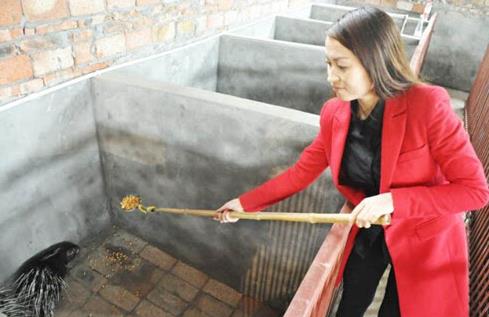
Tan Biya is feeding the porcupines.
A plump body, long sharp quills that stand on end at the slightest sound - this is the porcupine, wild yet adorable. On March 2, a reporter visited the Wenjie Porcupine Farm in Xianglu Village, Wofo Town, where the spacious farm is divided into small "suites," each housing 3 porcupines of varying sizes. Stepping a little closer, one could hear a chorus of "shasha" and "kacha kacha" sounds.
The owners of the farm are a young post-80s couple. The 34-year-old wife, Tan Biya, was feeding the porcupines. She told the reporter that the "shasha" sound is the porcupines eating, while the "kacha kacha" sound is made by their tails swinging.
The reporter observed that these porcupines are black or dark brown all over, with slender, straight, backward-curving bristles on their heads and necks, and three-lobed mouths, making them look much like wild hares. Their backs, rumps and tails are covered with thick, straight, white-banded spindle-shaped quills. These quills are hollow in the middle, formed from specialized body hair, and fall out easily. Some have backward-facing barbs at the tips, like sharp arrows, extremely hard and sharp.
"Porcupines are also called arrow pigs. As wild porcupines are increasingly dwindling, they have been listed as a protected animal by the state. Farmed porcupines look gentle, but they also have quite a 'personality.' When they get angry, even I don't dare go near them," Tan Biya said.
Tan Biya and her husband Wang Peng were both doing building materials business in Shenzhen, Guangdong before 2015. Although their income was good, the couple always felt that working for others was not a long-term plan, and they had always harbored the idea of returning home to start their own business.
By chance, a TV program introducing how specialty porcupine farming could lead to prosperity caught their interest. Afterward, Tan Biya looked up a great deal of information on porcupine farming, and the more she read, the more she felt that raising porcupines was "reliable."
In 2015, the couple learned that a porcupine farm in Wulong was doing very successfully, so they immediately went there to learn farming techniques. They then returned to their hometown and invested 400,000 yuan to build a farm, and introduced 14 groups (one male and two females per group), a total of 42 breeding porcupines, to start farming.
Tan Biya explained that porcupines are very easy to raise. They are omnivores and, like domestic pigs, eat everything, requiring almost no concentrated feed, so costs are very low. They also particularly love cleanliness. In addition, porcupines have very strong immunity and never need vaccination throughout their lives. Once, two porcupines fought, and a patch of skin was torn off the back of one of them, but it healed in two weeks.
"Don't be fooled by the porcupine's ugly appearance - every part of it is valuable. Its meat, brain, fat oil, heart, liver, gallbladder, stomach and quills can all be used as medicine, with effects such as lowering blood pressure and relieving pain, promoting blood circulation and removing blood stasis, and dispelling wind and clearing meridians. It has the reputation of being 'animal ginseng,'" Wang Peng told the reporter. At present, the market price of porcupine meat is more than 160 yuan per kilogram, more than 5 times that of domestic pork. A porcupine's growth cycle is 8 months, and after selling one, you can net more than 1,000 yuan. Selling piglets yields even higher profits.
"January 23, February 21." The reporter noticed dates written in white and red chalk on the pen walls of the farm. Wang Peng said white indicates the time the porcupines were mated, and red indicates the day the porcupines were confirmed pregnant. It turns out that Tan Biya not only established a breeding file for the porcupines in each pen, but also specially noted the different conditions of the porcupines to remind herself. "You can't be careless," Tan Biya said. "Breeding porcupines are the most valuable. Porcupines can be mated at around 8 jin. A female porcupine can have at most two litters a year, usually 1 to 2 per litter."
Tan Biya told the reporter that most of the sows will give birth this year. They are now expanding their farming scale, and have specially "hired" her brother-in-law Zhou Youling, who understands farming techniques, as a full-time "manager" of the pig farm, to ease the couple's worries.
"Although we are still in the exploratory stage, I am very optimistic about the prospects of porcupine farming. After the first batch of pigs is sold and we make money, I plan to set up a cooperative in the village, provide free technical guidance to villagers, supply breeding stock at low prices, buy back finished pigs, and pave the way, lay a good foundation and set a good example for the people's prosperity, driving the whole area so that surrounding farming households can get rich together," Tan Biya said full of confidence.