The "Loquat Secretary" becomes the leader lifting the people of Tongzi Town, Jiang'an, out of poverty
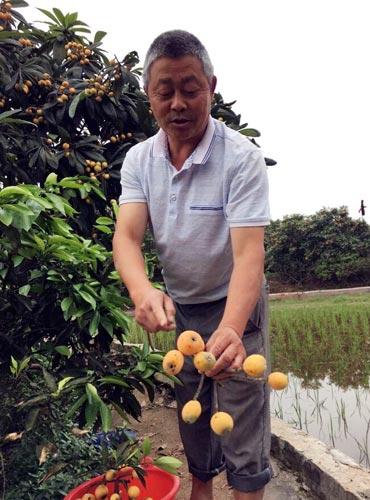
Tongzi Town, Jiang'an: the "Loquat Secretary"
The sky is clear and bright, the breeze is gentle and warm, and right now it is the peak season for picking loquats; the "Loquat Mountain" in Dalu Village, Tongzi Town, Jiang'an County, is heavy with fruit. A soft breeze carries the sweet fragrance of loquats, and Liu Bing, Party secretary of Dalu Village, is enjoying the joy of a bumper harvest: picking from the trees, packing into boxes, loading onto vehicles... and all of this embodies the painstaking efforts of village secretary Liu Bing.
Exploring loquat cultivation to get the industry growing
"Loquats can aid digestion and prevent vomiting; steeping loquats together with honey and drinking it can also moisten the lungs and stop coughing. 'Chuanbei Loquat Paste' is made from loquats and other medicinal herbs," Liu Bing said proudly while picking loquats.
Since becoming a village and group cadre in Dalu Village in 1995, Liu Bing had watched other villages develop their own specialities and farmers' incomes rise day by day, so he began to think about exploring specialty agriculture to drive his own village's development. Planting loquats was something he started only after making repeated surveys and on-site inspections in Dadukou Town, Naxi. In the early stage of planting, because of a lack of experience, the loquats grew only leaves and bore no fruit, so Liu Bing led the village and group cadres to "apprentice" themselves to large growers to learn the craft, and at the same time introduced high-quality fruit seedlings from Baihe Town, Longquanyi District, Chengdu. Through grafting vigorous branches, careful pruning and meticulous management, the loquat trees grew "taller and stronger" year after year. Today, the once-barren hill behind Liu Bing's house is fully planted with loquats; there are 135 trees at full fruiting age alone, with an annual output of 9,000 jin and an output value of 100,000 yuan. The picked loquats are uniformly packaged and sold in 10-jin boxes at 150 yuan, mainly shipped to Chongqing, Shanghai, Chengdu, Jiang'an and other places, and demand has exceeded supply every year.
Achieving a combination of planting and breeding to put wasteland to use
"In the past, many people in the village went out to work, and most of the fields were left to go wild. We even took other people's land to grow crops, and after a whole year of backbreaking work we could barely sell anything for a few coins," Dalu Village resident Li Jianqiang told us. Yet Secretary Liu turned wasteland into "treasure land": not only was it all planted with loquats, Liu Bing also used the open space under the loquat trees to develop an under-forest chicken-raising project, with local chickens, 882 yellow chickens, black-boned chickens and others, with more than 500 sold annually. Because the breeding chickens are raised free-range under the loquat trees before being sold, they can be said to have grown up eating "loquat fruit," which makes the meat especially tender; Liu Bing affectionately calls them "loquat chickens." Liu Bing did not "spare" the rice paddies beside the loquat trees either, raising paddy fish there. The fish eat not only rice flowers but also loquat flowers, and Secretary Liu Bing calls them "loquat fish" too.
Party-building leads the industry to make farming households prosperous
Most villagers in Dalu Village rely on traditional agriculture to make a living, and their harvest depends entirely on "Heaven." To bring about the shift from traditional agriculture to emerging specialty agriculture, Liu Bing took the initiative to go door to door to do ideological work and mobilize the surrounding people to develop the industry. At first, most people took a wait-and-see attitude, afraid of "losing money," but after seeing Secretary Liu Bing take the lead in growing citrus and loquats and achieve considerable income, the villagers joined in one after another. Today, Dalu Village has established the Chengxiang Sweet Orange Farmers' Professional Cooperative, with 178 members, and plans to set up a Party branch within the cooperative this year to further give play to the leading role of the Party organization. Under the leadership of the cooperative, the whole village grows more than 800 mu of summer oranges, Ehime and Tarocco, and more than 120 mu of loquats, with an annual output value of more than 6.5 million yuan, driving 250 farming households and raising the per capita net income of farmers by 4,200 yuan year on year. "Sales are very good this year. I plan to mobilize the surrounding farmers to grow loquats together; however much everyone grows, they can sell it all," Liu Bing said full of confidence, and this confidence lets us see the brilliant prospects for the future of industrial development in Dalu Village.