Greenhouse pepper cultivation broadens farmers' path to prosperity
In Donghe Group and Weili Group of Fuyu Town, a cement road connecting every village winds through the mountains like a long snake, crossing the fields and stretching toward distant villages. On the left side of the cement road are dense mountain forests, and below are green fields. Between the forests and the fields, row after row of white film vegetable greenhouses are nestled in, and the pigsty built beside them is precisely the greenhouses' "nutrition pack."
Inside the greenhouse, the verdant pepper plants are covered with peppers, bending the branches under their weight, growing vigorously and delightfully.
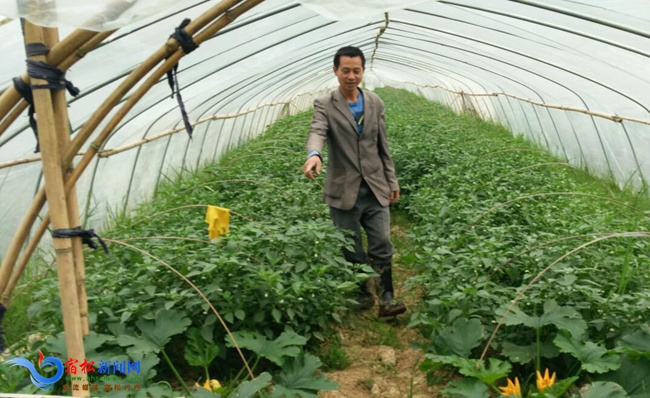
"My peppers have fully hit the market, and I'm now picking a batch to supply nearby wholesalers and hotels. These peppers are good quality, and customer feedback has been pretty positive. The approach I use is to pick every day and supply on demand, making sure the peppers are completely fresh." Grower Chen Xiaohong was picking peppers in the greenhouse, introducing their cultivation situation from time to time.
Chen Xiaohong was originally a villager from Aikou Township, and had previously spent years working away from home as a plumber and electrician. To make it easier to look after his child's schooling, he gave up his wandering work away from home, and with a friend's recommendation, he developed the idea of high-efficiency vegetable cultivation. At the end of 2016, he successfully transferred dozens of mu of basic farmland in Weili, Donghe Village, Fuyu Town, invested over 100,000 yuan to build a greenhouse vegetable cultivation base, achieving greenhouse facilities for year-round cyclic use, and was among the first to grow peppers through greenhouses.
For him, growing peppers in greenhouses was a completely new thing, and he had no industry experience at all. So he brought in a professional master to guide him on greenhouse base construction, water supply and drainage design, seedling cultivation, pest and disease control, and other aspects, while he himself followed behind the master, learning and taking notes, earnestly studying techniques and accumulating experience. Through continuous effort, he has basically mastered modern facility agriculture cultivation techniques, and at present the pepper seedlings in over a dozen greenhouses are growing strong and have successfully set fruit. Now, at around 5 a.m. every day, the first thing Chen Xiaohong does when he gets up is arrange the day's work, pick peppers according to customer demand, and then deliver fresh peppers to customers' hands.
"At present, the pepper varieties grown in the greenhouses are mainly pickled peppers and screw peppers. By using large amounts of farmyard manure, the pepper plants grow very sturdy and the peppers grow very large. So far about 2,000 jin have been picked and sold." Chen Xiaohong calculated while pointing to the peppers in the greenhouse. "Over one season, each greenhouse yields about 1,000 jin, and a single greenhouse is expected to bring in 3,000 yuan, so the benefits are guaranteed."
It is understood that this piece of land had previously grown rice year-round, and the soil quality was relatively hard. To grow green, healthy, high-quality peppers, Chen Xiaohong, who was born in the countryside, took some unorthodox approaches. "The soil here isn't very good. For the peppers I grow, I apply large amounts of farmyard manure such as chicken manure, sheep manure and pig manure, and use relatively little chemical fertilizer. This can fully guarantee the quality of the peppers, letting city residents eat reassuring organic vegetables."
On site, it can be seen that the pigsty beside the greenhouse is built against the mountain. On the side of the pigsty is a septic tank of about 4-5 sq m, which is precisely the greenhouse's farmyard manure storage area, filled with fermented manure materials. "At present, the chicken manure and sheep manure in the septic tank are all purchased from nearby livestock farmers, and they need to ferment for a period before use." Chen Xiaohong introduced it this way.
"There are many restaurants in the city, and kitchen swill is plentiful. Later I'll raise a few pigs, which can guarantee an ample supply of farmyard manure. This not only saves cultivation costs, but over a year, raising pigs can also add some extra income. I hope this year my wallet gets even fuller." Chen Xiaohong said with full confidence.
It is understood that next, he will transfer land to grow various vegetables according to the seasons and solar terms, ensuring that people across the county can eat safe, reassuring, healthy and green organic food, and further opening up his own path to prosperity.
By recycling restaurant kitchen swill to raise pigs, using pig manure to grow greenhouse vegetables, and finally giving organic vegetables back to city residents, this high-efficiency agricultural development model integrating breeding and cultivation is the way of ecological agriculture development and promotes the healthy development of the industry.