Raising rabbits opens up a road to prosperity, and small rabbits bring new hope for increasing income
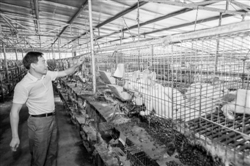
At a rabbit farm in Shangkeng Village, a staff member is checking the growth of meat rabbits.
Shangkeng Village in Chengdong Town is a well-known rabbit-raising village in Meixian District, with more than 2,000 breeding does currently kept and 100,000 meat rabbits sold per year, generating sales of more than 4 million yuan. But the rabbit-raising industry was not a traditional advantage of Shangkeng Village. From scattered, small-scale farming to large-scale rabbit raising and becoming a widely known rabbit-raising village, Guo Wangming, the leader in rabbit raising, played an indispensable role.
"In the past, not many people in our village raised rabbits on a large scale, but now there are 13 households raising rabbits in total, and Guo Wangming was the first to raise them on a large scale. We only gradually joined the ranks of rabbit raising after seeing him become wealthy by raising meat rabbits," said A Yong, a villager of Shangkeng Village. He said that in the past he knew nothing about raising rabbits, and it was Guo Wangming who worked out various breeding methods through farming and shared them with them. Now, he can increase his annual income by 50,000 to 60,000 yuan by raising rabbits.
For Guo Wangming, how to raise rabbits and how to develop the rabbit-raising business took a great deal of effort. "In 2008, I returned to the village to seek development. After learning earlier that Shangkeng Village was close to the three-bird wholesale market, and that at that time meat rabbit prices were good and demand exceeded supply, I thought of raising meat rabbits. Meat rabbits require little investment and have a short breeding cycle. In the first batch I raised more than 10, and began to figure out rabbit-raising techniques. Once I felt confident, I raised several hundred, and that year I earned more than 10,000 yuan," Guo Wangming said.
After earning his "first bucket of gold" from raising rabbits, Guo Wangming decided to expand the scale of breeding. But he also encountered some problems, including the loss of several hundred rabbits to illness. "Rabbits are prone to various diseases, especially in the plum rain season, and young rabbits less than a month after weaning are even more susceptible. The traditional treatment is to feed medicine and give injections, but this can also fall into the strange cycle of recovering while on medicine and dying after stopping it. So to raise rabbits on a large scale, it is impossible without mastering scientific breeding methods and innovating feeding methods." When he saw news from other regions about applying probiotics in pig and chicken farming, he immediately thought of applying probiotics to rabbit raising. While discussing probiotic application methods with technicians from the Meixian District Animal Husbandry Bureau, he also bought bacterial strains from other places for cultivation, and after cultivation used them to feed the rabbits and also sprayed them in the pens. After some time, Guo Wangming found that the disease rate of the meat rabbits had dropped significantly. After overcoming the breeding difficulties, he then thought about making use of the rabbits' excrement. "Traditional rabbit cages mix all kinds of rabbit excrement together, and no one is willing to collect it. Later I modified the cages myself so that feces and urine are separated, and in this way rabbit manure can be fully utilized," Guo Wangming said. He himself currently keeps about 4,000 rabbits, and earns 50,000 yuan each year just from selling rabbit manure.
From the start of large-scale breeding in 2009 to now, Guo Wangming's rabbit-raising business has gradually grown stronger, and the villagers have also seen the "money" prospects in Guo Wangming's rabbit-raising business, consulting him one after another and joining the ranks of rabbit raising. Guo Wangming also took the lead in establishing a professional cooperative to provide technical guidance to farmers, uniformly purchase breeding rabbits and forage for them, and spray probiotics and so on, ensuring the quality of rabbit raising. After driving some villagers to raise rabbits together and increase their income, he is now also thinking about how to further integrate rabbit raising with targeted poverty alleviation to help poor households escape poverty and become prosperous as soon as possible.