Yellow River wetland rice fragrance: alkali-tolerant rice brings wealth in Togtoh
Recently, reporters walked into the Yifeng Breeding and Farming Professional Cooperative in Nianziwan Village, Yellow River Wetland Management Committee of Togtoh County. The first thing that came into view was a 15-mu seedling greenhouse. Inside, cooperative legal representative Lei Jun was using a walkie-talkie to direct workers testing newly installed watering equipment, because the second batch of rice seedlings was being cultivated in the greenhouse and the water supply had to be guaranteed.
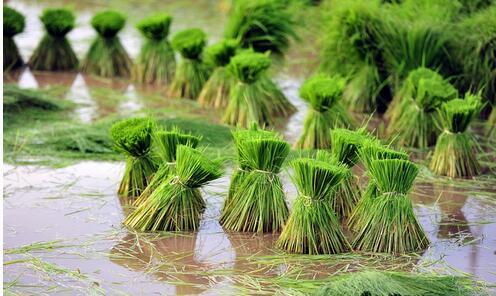
Image from the internet
Nianziwan Village is located on the bank of the Yellow River and is rich in water resources, but this has also become the area's biggest problem. In years with abundant rain, most of the crops here are drowned. In 2013, the village suffered exactly this. Seeing the crops in the fields fail to produce a harvest, Lei Jun was deeply distressed. As someone in the grain and oil sales business, he often visited grain-producing areas in various places to investigate. During one such visit, a slogan in a rice-growing area - "treat alkali with rice, treat waterlogging with rice, get rich with rice" - caught his attention. Wasn't this exactly the way for his hometown to adjust its agricultural planting structure? So he conceived the idea of growing rice at home. Once he had the idea, he put it into action. He contracted 3,000 mu of land in the village. In 2014 and 2015, he trial-planted more than 200 mu. Because he completely did not understand rice cultivation, although he grew rice, the yield was very low.
Last year, Lei Jun hired professional technical personnel to guide the planting and trial-planted 400 mu of rice. For the best-performing fields, the yield reached 1,000 jin per mu, and the trial planting achieved a relatively good harvest. Lei Jun did the math: the cost of growing rice was about 800 yuan per mu, and at a selling price of 3 yuan per jin, the net profit was more than 2,000 yuan. There was also an unexpected gain from the rice he grew. He gave the rice grown at home to a friend to taste. Because the friend was allergic to selenium, he learned that his own rice had a high selenium content, so he sent the rice to a testing institution for testing. He said: "Last year the selenium content of the rice we grew was 56.50 micrograms/kg. The national standard for selenium-enriched rice is between 40-300 micrograms/kg. This will allow the price of our rice to increase several dozen times."
As corn prices fell, Togtoh County actively adjusted its planting structure, promoted trial-field planting under the organic rice project, and supported enterprises such as the Yifeng Breeding and Farming Cooperative in driving farmers to sell rice under order-based purchasing with a guaranteed minimum price, promoting the transformation of the planting structure. Driven by Lei Jun, villagers from nearby Zhongtan Village and Heshangying Village around the cooperative joined the ranks of rice planting this year. Lei Jun's first batch of 5,000 square meters of rice seedlings will be supplied to villagers for transplanting.
He said with full confidence: "I am very confident about rice planting this year. In order to grow rice well, the Yellow River Wetland Management Committee gave us great support and hired professional technical personnel for us to guide the planting. Coupled with my own exploration over the past two years, the rice planted this year will certainly be even more successful."
Developing rice planting according to local conditions is an important way for Togtoh County to adjust its planting structure. Increasing the promotion and planting of specialty agricultural products and guiding farmers toward diversified planting are also means by which Togtoh County is transforming its planting structure. Hao Zhiqiang, director of the county agricultural technology extension center, said: "Starting this year, we are vigorously promoting Togtoh pepper planting, striving to expand the promoted pepper planting area to 10,000 mu within three years. This year, Togtoh County will set up 10 promotion demonstration sites in Xinyingzi Town and Shuanghe Town, focusing on promoting Togtoh pepper planting, with a promotion area of 500 mu, including 350 mu promoted for planting in Xinyingzi Town."
Zhou Haijun, legal representative of the Zhonghe Breeding and Farming Professional Cooperative in Heicheng Village, Xinyingzi Town, Togtoh County, said: "The county strongly supports the red pepper promotion project. Last year our cooperative planted more than 80 mu. The net income per mu of peppers grown from seedlings was more than 2,000 yuan, but the cost of growing from seedlings was relatively high. This year we are mainly trying direct sowing to further accumulate planting and management experience. As of now, the more than 30 mu of pepper seedlings grown by direct sowing are growing relatively well."
It is understood that Togtoh County is guiding farmers to transform their planting structure by vigorously developing grain crops such as rice and wheat and promoting the planting of specialty agricultural products. This year, the county's total sown area of crops is basically flat, but the planting area of rice, wheat and other crops is expected to show clear growth compared with last year.
(Reporter Miao Qing, Correspondents Ding Yulong, Cheng Huidong)