How did the most beautiful young woman in Kang County find her way to prosperity?
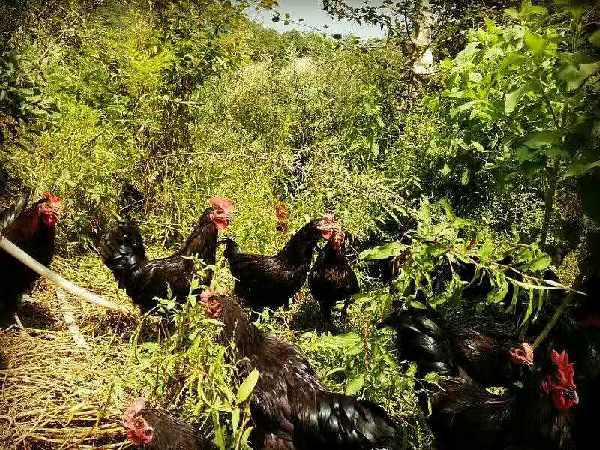
The local chicken "Taiping chicken," because of its thick leg bones and larger build than ordinary chickens, was kept and bred.
Erping Village, Yangba Town, Kang County is located at the junction of the three provinces of Sichuan, Shaanxi and Gansu. Here the mountains are high and the forests dense, and transportation is inconvenient. To this day, some villagers still live below the poverty line. Because the land is poor and the population sparse, and the residents are scattered, large livestock such as cattle and sheep often fall victim to black bears and wild boars, so few households raise them. Only one kind of local chicken, the "Taiping chicken," was kept and bred because of its thick leg bones and larger build than ordinary chickens. However, because of its slow growth, the "Taiping chicken" was gradually replaced by meat chickens and even came close to extinction. In recent years, this local chicken has recovered its population and become a new hope for local villagers to escape poverty and become prosperous.
All of this is inseparable from the contribution of Xu Weiqin, a villager of Erping Village. Like many rural girls who had just left school, in 2004, after Xu Weiqin graduated from Longnan Agricultural School, she had no work for a time. Their options were essentially two: one was to continue studying to take the civil service exam; the other was to go out to work and earn money, then marry and settle down. In the years that followed, Xu Weiqin worked as a substitute teacher and also worked in the electronics market in Shenzhen, changing jobs several times.
Once, she went to a meal with a good friend she had worked with. The chicken pieces on the table, fattened with hormones but unappealing in both nutrition and taste, could not help but remind Xu Weiqin of the Taiping chicken from her hometown.
Where there is an idea, there is action. In 2010, with the help of the county government, Xu Weiqin coordinated subsidized loans for raising Taiping chickens, mobilized 4 households in the village to invest as shareholders, raised 120,000 yuan, and built the Yangba Town Taiping Chicken Breeding Professional Cooperative in a place not far from the village. The cooperative found 25 relatively purebred "Taiping chickens" from the village and began breeding and hatching them. By the end of that year, 1,500 "Taiping chickens" were ready for market, generating an income of 15,000 yuan. Seeing that raising "Taiping chickens" could make money, Xu Weiqin provided breeding chickens to farmers in her own village and surrounding villages such as Kejiahe, Tianba and Duba, letting them raise and breed them, and signed purchase and sales contracts. Under her leadership, more than 100 households of villagers, including 45 poor households, have now joined the cooperative, and by the end of this year the stock is expected to reach 100,000 chickens.
Because of her contribution to leading villagers out of poverty toward prosperity, Xu Weiqin was named a "Youth Leader in Becoming Prosperous" of Kang County and was named "Kang County's Most Beautiful Youth" by the Communist Youth League of Kang County.
Xu Weiqin told reporters that the professional cooperative requires villagers to raise chickens in the original free-range way to ensure the quality of the Taiping chickens sent to market. As one of the three excellent local poultry breeds in Gansu Province, the Taiping chicken, because of its tender meat, fine bones, crisp skin and fresh taste, is sold as far as Chengdu and other places, and its price is considerably higher than that of ordinary meat chickens. Recently, she has also begun trying to use e-commerce platforms to expand the market and bring Taiping chickens to more consumers.
As the market expands, Xu Weiqin hopes for more policy support to help the cooperative expand its scale and further develop the market. "The breeding industry carries relatively high risks and uncertainty, and there are problems such as difficulty in financing and high financing costs. Banks are generally unwilling to lend," she said. "I hope more poverty alleviation funds can be directed toward the breeding industry."