A post-90s college student returns to his hometown to grow papayas, leading the villagers onto the road to prosperity
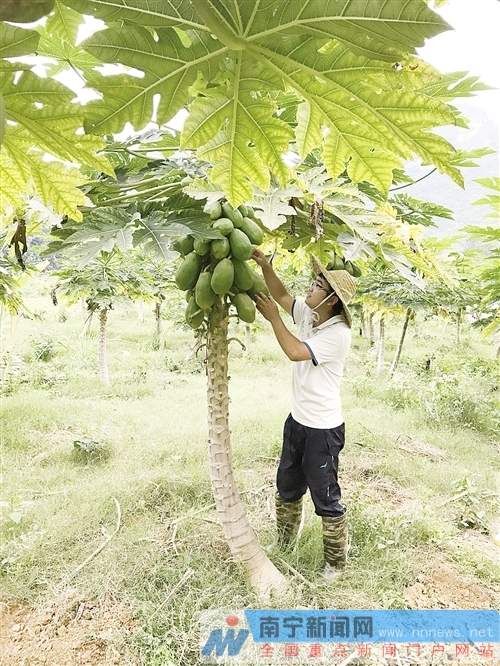
"Post-90s" college student Wei Qing tending papayas in the papaya orchard.
In the fields of Shanggan Tun, Xinghua Village, Baishan Town, Mashan County, a young man is often seen sweating in a papaya orchard tending the papayas. He is Wei Qing, a "post-90s" college student. In 2014, Wei Qing graduated from the College of Agriculture of Guangxi University. As a college student who had made it out of the mountains, he was the pride of the village. But Wei Qing made a decision that left the village dumbfounded: return home to grow fruit papayas! Because of this, Wei Qing was called the "fool" by the people of his hometown. But this "fool" in the villagers' eyes sold more than 370,000 jin of papayas in just over 2 months, with products shipped far away to Beijing, Shanghai, Chengdu, Chongqing and other cities, making him a minor local celebrity. He also led the villagers to grow papayas together, helping them step onto the road out of poverty toward prosperity.
College student returns home to grow papayas and meets with cold stares
Wei Qing graduated in 2014 from the College of Agriculture of Guangxi University with a major in Agricultural Resources and Environment. He is one of the few graduates of a key university from Xinghua Village, Baishan Town, and is the pride of the village. In people's eyes, he should have become a civil servant or a white-collar worker at a company, living a "good life" in the city, but after conducting market research in 2015, he made a bold decision: to return home with his close classmate to grow a fruit -- papaya.
This decision of his caused an uproar at home. All his relatives, including his parents, were opposed. They felt that being a farmer was something only people without education did, and that after studying so hard for so many years, he should not return to the mountains to continue the fate of generations of ancestors facing the yellow earth with their backs to the sky. The villagers even mocked him as a downright "fool," jeering at him. But Wei Qing paid them no mind and devoted himself entirely to planting.
With no funds, he borrowed money from friends, 10,000 yuan or 20,000 yuan at a time. His parents could not overcome his stubbornness and also helped him secure part of the funds. He and his close classmate Xiao Ouxuechang gradually raised 420,000 yuan and began their entrepreneurial journey.
Products in short supply dispel the villagers' doubts
In January 2015, Wei Qing and his close classmate transferred 155 mu of land from the two natural villages of Shanggan and Xiagan and began growing Risheng large white-skinned fruit papayas. The villagers were not optimistic about the two of them, and many were waiting to laugh at these two college students.
"I have some theoretical foundation in planting techniques. In terms of market research, I think the prospects for growing papayas are better than growing other fruits, and its cycle is short -- in just over 200 days it can produce a crop, so capital turnover is fast," Wei Qing said.
At the beginning, Wei Qing adopted integrated water, fertilizer and pesticide planting in the fields and spent more than 100,000 yuan building drip irrigation facilities. This decision let the two entrepreneurial college students taste sweet success. From June to mid-July 2016, Mashan suffered more than 40 days of high temperatures, and not a drop of rain fell. The drip irrigation facilities, which the villagers regarded as "ruinous," ensured irrigation of the land and thus ensured the healthy growth of the papayas.
October 9, 2016, was an unforgettable day for Wei Qing. On this day, his orchard produced fruit. The first truckload of papayas sold was 8,325 jin, at 1.3 yuan per jin. Shanggan Tun suddenly became lively. In a village that usually had few vehicles, large trucks came and went almost every day. In just over 2 months, Wei Qing sold 43 truckloads totaling more than 370,000 jin of papayas.
Seeing that there was money to be made, surrounding farmers also had the idea of planting. To make it convenient to communicate with growers, on November 3, 2016, Wei Qing initiated the establishment of the Mashan County Runtian Planting Professional Cooperative. At present, 9 farmers have joined, including 4 members who are local poor households. Now more than 10 women and elderly people in the village have work, and 8 poor households have an income of nearly 6,000 yuan a year.
Dreaming of becoming the "Papaya King" and leading villagers to prosperity
In 2017, Wei Qing's orchard entered its high-yield period. From March 13 to May 9 alone, Wei Qing's papayas sold for 470,000 yuan, with products shipped far away to Beijing, Shanghai, Chengdu, Chongqing and other cities, recovering all his investment and truly beginning to make money.
The villagers who had waited to laugh at him were completely won over by these two "college student farmers." Seeing such good prospects for growing fruit papayas, surrounding farmers also had the idea of joining. Villager Wei Yongxiao said that under Wei Qing's leadership, he tried planting one mu and five fen of land and from last year to now earned almost more than 10,000 yuan; after deducting costs, his net profit was more than 6,000 yuan. He plans to rent another 30 to 50 mu of land to make this industry bigger. Qin Ruixiang, a poor household in Shanggan Tun, said that since Wei Qing contracted the land, he hired her to help plant papayas and harvest papayas in the fields, and six or seven people work in the fields each day. Meng Qiuzhen, a villager from Shanggan Tun, said that working in the orchard is close to home, she works more than 20 days a month, earns 100 yuan every day, and can get more than 2,000 yuan a month. She does not need to go out and can earn money right at her doorstep while also taking care of her family. Meng Qiuzhen is very satisfied with her current job.
Wei Qing said that within 3 years their cooperative wants to expand the papaya planting industry to 500 mu and drive farmers to plant 200 mu, forming a distinctive industry for Xinghua Village. It is understood that there are now 37 major clients cooperating with Wei Qing, and each client's annual demand for papayas exceeds 1 million jin.
"Guangxi already has a Banana King, but not yet a Papaya King. I want to be this 'king.'" Wei Qing hopes that one day he can be like Lu Yizhen, the "Banana King" of Long'an County, and through his own industry benefit his hometown, drive more villagers to prosperity, and lead villagers onto the road out of poverty toward prosperity and a moderately prosperous life.