Chen Haifeng cares about farmers escaping poverty, and her heart is tied to a bountiful harvest across the land
Profile
In people's impressions, a female master's degree holder born in the 1980s should be a white-collar woman who wears fashionable and pretty clothes, goes in and out of high-end office buildings, and does respectable work. So when the reporter met Chen Haifeng for the first time, it was inevitably a little surprising, because the woman before her eyes could not be linked to those words at all. The Chen Haifeng before her eyes wore a simple short-sleeved top and a pair of tracksuit trousers, dressed simply and plainly.
"We have to go to the fields to work every few days, and it's more convenient to do the work in these clothes."
Chen Haifeng's answer speaks to the normal working life of agricultural science and technology workers, who for years on end run around the fields. Like farmers, they endure sun and rain, and like farmers they sow in spring and harvest in autumn; the difference is that besides the farm tools in their hands, they also have professional knowledge in their heads. Through applying their professional knowledge, they help farmers increase production and income. "For a bountiful harvest across the land, and for farmers to escape poverty, it's worth it for us to work a little harder," Chen Haifeng said with a smile.
They are a group of admirable intellectuals. Chen Haifeng is one of their representatives.
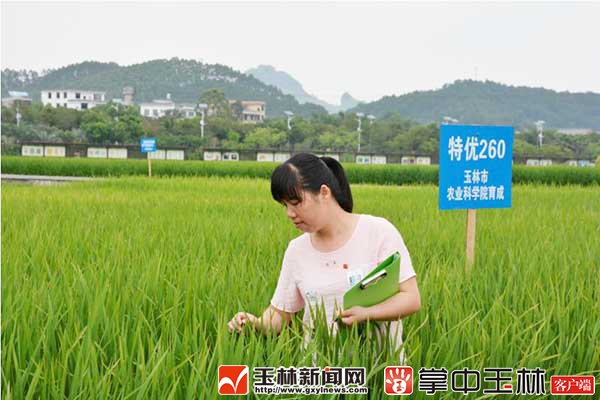
Chen Haifeng observing the growth of rice.
A childhood resolve to breed good seeds
Chen Haifeng comes from a small mountain village in Yizhou City, Guangxi, and both her parents are true farmers. When she took the college entrance examination, Chen Haifeng achieved a good score, and her teachers and classmates all suggested she choose a major suited to girls that would offer more chances of respectable work after graduation. But this girl from the countryside, without hesitation, enrolled in the agronomy major at Guangxi University.
When they heard that Chen Haifeng had chosen a major about farming, her classmates all jokingly asked her: "Chen Haifeng, are you going home to help your parents farm?" But the plain and honest Chen Haifeng firmly believed that no matter what one does, as long as it is useful to society, it is promising work.
Her devotion to the agronomy major originated from an experience in Chen Haifeng's youth. Born in the countryside, Chen Haifeng began helping with farm work at home at a young age, following the adults to the fields every day from dawn to dusk to sow, weed and harvest. But the family's hard work often did not bring much harvest in return. "The poor harvest was mainly because the seed quality at the time was not up to standard, and we often bought fake and inferior seeds." Watching her parents' exhausted figures, little Chen Haifeng secretly made up her mind that she must study hard and get into university, learn to breed good seeds, and make her parents' toil no longer go to waste!
Breeding good seeds through hardship
Through four years of university and three years of graduate study and hard work, Chen Haifeng learned rich agronomic knowledge and laid a solid foundation for breeding good seeds in the future. After graduation, Chen Haifeng came to work at the Yulin Academy of Agricultural Sciences, becoming an agricultural science and technology worker as she had wished. Speaking of Chen Haifeng, Rong Linxi, an old colleague at the Yulin Academy of Agricultural Sciences, remembers deeply her tenacity in getting to the bottom of everything: "Pretty much all the seniors at the academy must have answered her questions. When we went out for exchanges and study, some people were questioned by her until they could not answer."
Very quickly, the diligent and inquisitive Chen Haifeng was like an excellent seed, taking root, sprouting, tillering and heading, and growing rapidly.
Because she got the hang of the work quickly, the Yulin Academy of Agricultural Sciences arranged for Chen Haifeng to take part in the selection and breeding work for "Yusi 6." In order to select an ideal line, Chen Haifeng and her colleagues often went into the fields during the dog days of summer, recording data on tens of thousands of rice ears. The data for a single rice ear numbered in the dozens, and after one experiment the recorded materials alone stacked up to more than one meter high. To select seeds, Chen Haifeng and her colleagues threshed the rice ears by hand, stripping them handful by handful and grain by grain, usually having to thresh several thousand grains. Their fingernails split, their finger calluses were worn smooth, and the fuzz on the grain got into the cracks, hurting like needle pricks. During 4 years of selection and breeding work, Chen Haifeng and her colleagues traveled all over rural Yulin, and thick notebooks recorded the ecological environment of rice in different areas, as well as the biological characteristics and production levels of rice in different areas.
Effort will eventually be rewarded. Compared with high-quality rice widely planted at the time such as Liushayouzhan 202 and Jiafuxiang 1, the "Yusi 6" selected and bred by Chen Haifeng and her colleagues showed major improvements in grain quality and yield. Indicators such as brown rice rate, milled rice rate and protein content all reached national standard grade two, the cooked rice was soft, smooth and tasty, and the yield per hectare reached more than 6799 kilograms. The high-quality, high-yield "Yusi 6" passed the appraisal of the Guangxi Crop Variety Approval Committee in June 2013, and was quickly acquired and sold by China Seed Group.
Making wedding clothes without complaint or regret
Besides breeding and seed selection, another main part of Chen Haifeng's work is regional testing of rice. Chen Haifeng told the reporter that regional testing refers to conducting trials according to unified and standardized requirements, comprehensively appraising the high-yield performance, adaptability, stress resistance and quality of newly bred varieties, and comprehensively evaluating the varieties according to their performance in regional trials, combined with stress-resistance identification and quality results. If a newly bred variety wants to pass appraisal and be promoted, it must undergo regional testing.
Although regional testing of rice is indispensable in the promotion of new varieties, not everyone is willing to do this work. The various difficulties, such as many test groups, many participating varieties and easy mixing, all require experimenters to show great patience and perseverance. "Those of us in the industry jokingly call regional testing 'holding someone else's baby,'" Chen Haifeng said with a smile. Although experimenters have to put a great deal into the regional testing process, when a new variety passes appraisal, it does not bring much benefit in return to the experimenters.
Even so, Chen Haifeng still threw herself into the work of rice regional testing without complaint or regret. Her reason is very simple and very practical: the quality and yield of seeds must be truthfully reflected, and fake and inferior seeds must never be allowed to slip past this regional testing hurdle and flow into the market to harm farmers! To ensure the accuracy and reliability of every test data point, test process and result, Chen Haifeng personally handled everything for each variety's test, from field design to sowing and transplanting, and harvesting records. Every year, the Yulin Academy of Agricultural Sciences has regional tests for at least 150 new varieties. Over 7 years, Chen Haifeng has conducted regional testing for more than 1000 varieties.
In February 2017, approved by the Ministry of Agriculture of the People's Republic of China, the Ministry of Agriculture Plant New Variety Testing Center, in accordance with the layout of agricultural ecological regions and relying on the Yulin Academy of Agricultural Sciences, established the first Ministry of Agriculture Plant New Variety Testing Yulin Sub-center in Guangxi, undertaking DUS testing tasks for plant varieties in the Guangdong-Guangxi ecological region. Chen Haifeng was appointed technical head of the DUS Testing Yulin Sub-center. Facing this unprecedented work, Chen Haifeng felt a heavy responsibility. She said: "I will do my utmost through my work to promote good rice varieties to the market, and contribute my modest effort to increasing farmers' income and ensuring food security."