Chicory buds, hailed as the prince of vegetables, and how Liu Xiujun came to be connected with them
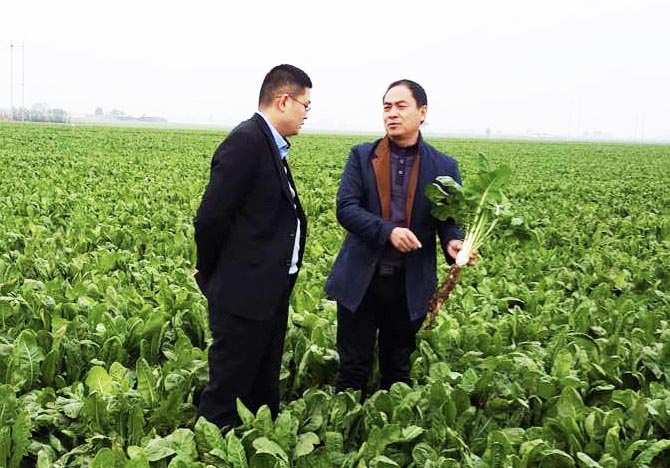
Liu Xiujun (right), chairman of Hebei Lianxing Jiayao Agricultural Technology Co., Ltd.
With the improvement of living standards and changes in consumption concepts, modern people are paying more and more attention to health and wellness. Especially today, when food safety issues are held in high regard, pollution-free, green, and organic foods have gradually become popular among consumers, and many people are willing to pay a "high price" just to buy food they can trust.
Not long ago, a reporter visited Hebei Lianxing Jiayao Agricultural Technology Co., Ltd. and saw a very special product. It looked like a flower bud about to bloom, and it gave off a faint delicate fragrance. For a moment, the reporter could not even tell whether it was a flower or a vegetable. According to what was learned, this is a royal aristocratic vegetable from Europe, originally from the Netherlands, with the scientific name chicory. It is hailed as the "prince of vegetables" and has long sold well in European and American markets. In China it is also called chicory bud. Hearing this, the reporter became even more curious about this variety never seen before. What kind of vegetable is it exactly? What are its characteristics? The reporter interviewed Liu Xiujun, chairman of Hebei Lianxing Jiayao Agricultural Technology Co., Ltd.
What are chicory buds?
According to introduction, chicory buds have long been a household name abroad, but they are not common on the Chinese market at present, and many consumers still do not know them. Liu Xiujun made several visits to Europe. After repeated research, he introduced this variety from the Netherlands in 2014 and gave it a pleasant name - chicory bud.
"Jiayao Agriculture is currently the only enterprise in China that produces chicory buds year-round and supplies them in all four seasons, filling the gap in the Chinese market where chicory buds were unavailable, so that Chinese consumers can eat healthy vegetables originally from Europe without going abroad," Liu Xiujun said. Chicory buds are a pollution-free vegetable produced through secondary growth. From sowing to harvest, no chemical fertilizers are used and no pesticides are sprayed. The blanching cultivation is carried out in a closed environment, with no pollution and no public hazard. It is a safe, high-quality, healthy and nutritious food.
The Dutch vegetable variety traveled a long way to Shijiazhuang, Hebei. In order to ensure the original taste, the enterprise fully replicated European planting and production technologies and made substantial scientific and technological investments, building workshops and purchasing equipment. After a year of devoted cultivation, Liu Xiujun and his team finally succeeded in establishing chicory buds.
Liu Xiujun told the reporter that chicory buds are different from ordinary vegetables. They are more like flowers in a greenhouse, precious and delicate, with a clear and elegant appearance and golden-yellow leaves, so they also have a resounding alternative name - "golden vegetable." Looking at the golden chicory buds on the table, the reporter was full of curiosity and casually broke off a piece to taste directly. The flavor was slightly bitter, but fresh, tender, and very refreshing.
Naturally pollution-free
During the interview, the reporter learned that chicory buds are not only clean and beautiful in appearance, but also purely natural and pollution-free. All of this is mainly due to their growing environment. The cultivation process of chicory buds is complex and tedious, and can broadly be divided into two procedures: field planting and secondary cultivation.
Liu Xiujun explained that field planting is for obtaining the roots used to cultivate the vegetable and is the basis for secondary cultivation. Moreover, all the nutrients of chicory buds come from the roots, so field planting is very important. Sowing begins every year in July and August, and harvesting takes place by the end of November. The growing period is 4 months. To ensure quality, the yield per mu is best controlled at 8,000-10,000 roots. Also, during field cultivation, because of the characteristics of the vegetable itself, there is no need to apply fertilizer or spray pesticides. Liu Xiujun explained that this is mainly because the roots grown in the field contain substances similar to bitterness. The roots and the leaves that grow out are both very bitter, and insects simply do not like to eat them. This is a characteristic of the product itself. The reporter broke a root open from the middle and saw yellow thick juice seeping out. After lightly touching it with the tip of the tongue, the bitter taste spread throughout the mouth. It was indeed very bitter. "It is precisely because the roots are bitter that the cultivated vegetable also has a bitter taste," Liu Xiujun said.
Liu Xiujun told us that the most difficult part of field planting is the sowing stage. On the one hand, the seeds of chicory buds are very small; a single sesame seed weighs at least twice as much as one of these seeds, which increases the difficulty of sowing. On the other hand, there are strict requirements for sowing depth. 5 mm is the most suitable. If buried too deep, they easily fail to emerge; if buried too shallow, they easily dry out, so watering should be done as soon as possible after sowing. July and August are the hottest time of the year, so the seedling emergence period is very critical. In order to ensure precise sowing, the enterprise combines mechanical and manual operations. In addition, the soil for planting is best sandy loam, with a pH value in the range of 6.5-7.5. Liu Xiujun stressed that as long as the seedlings emerge, the influence of weather becomes smaller, and what remains is simple field management. The roots obtained at harvest differ in size and are classified according to thickness, but this does not affect the quality of the final product.
Year-round production possible
"Field planting is only the first step. Next, the harvested roots must be placed directly into cold storage at minus ten-plus degrees Celsius for freezing, to be stored as raw material for the year. After 1 month, secondary cultivation can begin. At this point, according to market demand, the corresponding amount of frozen roots can be taken out and thawed in a natural environment for about 10 days. Then the thawed roots are placed into production trays in the production workshop for secondary cultivation, with a cultivation period of about 23-28 days," Liu Xiujun said. It is precisely because of this that we can ensure year-round production of chicory buds.
"Secondary cultivation has very strict requirements for growing conditions and needs three major elements: controllable temperature, controllable oxygen, and controllable humidity," Liu Xiujun introduced. In order to make chicory buds better adapt to the domestic environment, the enterprise made some improvements on the basis of introducing foreign technology, including workshops, temperature control management, and ventilation systems. During the cultivation process, thin roots and short roots are first classified and loaded into production trays, with one tray about 0.8 sq m and a vegetable yield of about 40 kg. After these production trays are loaded, they are stacked up to 4 m high. Then watering begins, and the temperature is adjusted to a suitable level. Liu Xiujun stressed that temperature control requires heating and cooling separately according to different growth stages, so that the temperature in the workshop is always maintained at around 20-plus degrees Celsius. The water is ordinary tap water. Because the water we drink is generally alkaline, while vegetable growth requires slightly acidic water, the pH of the water needs to be adjusted, and then the vegetables grow very well. Another point to note is that the temperature in the production workshop must be strictly controlled, and the temperature difference cannot exceed 0.5 degrees Celsius, because chicory buds initially grow loosely and only gradually form heads. If the temperature is not precise, they cannot form heads and will remain open. In addition, the oxygen content must also be controlled.
In order to personally experience the cultivation process of chicory buds, the reporter came to the secondary production workshop for chicory buds. Entering through the small workshop door, a rush of hot air met the face. Under the faint light of a flashlight, the reporter saw tray after tray of vegetables growing in water. That touch of golden yellow in the darkness revealed abundant vitality. Liu Xiujun told the reporter that secondary growth is the key link in the entire planting process. The roots are placed in hydroponic boxes and cultivated with domestic water. No additives or nutrient solutions are needed. It relies on the nutrients of the roots. After freezing, the nutrients in the roots are released and grow into buds. This is exactly what makes chicory buds so unusual. Other vegetables need photosynthesis to synthesize and grow into a product, while chicory buds do not need natural photosynthesis at all and grow naturally in a completely dark environment. The reporter learned that it is precisely because of this lightless growing environment that chicory buds come out golden yellow. If exposed to light, the vegetable will carry out photosynthesis, the leaves will turn green, and the bitterness will also increase.