African geese bring Li Heiyue hope for prosperity
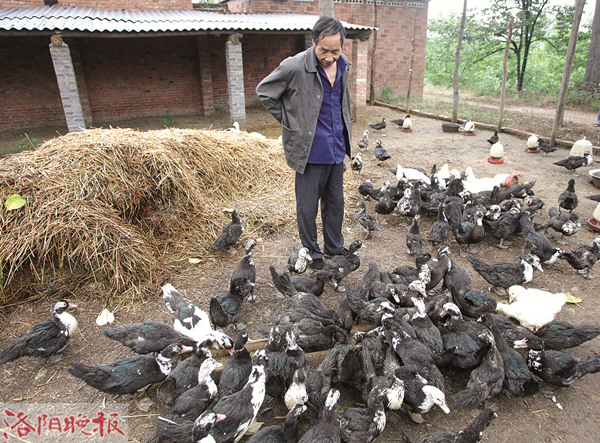
Li Heiyue and the African geese he raises
Yesterday, when talk turned to the group of "new members" at home, the African geese, Li Heiyue, a villager in Liangping Village, Wutou Town, Xin'an County, was all smiles. These 200-plus African geese have ignited his hope of escaping poverty and becoming prosperous.
When life was hard, the village brought good news
Liangping Village sits in hilly terrain with poor soil. After deducting the cost of seeds and fertilizer, farming barely earns any money.
A few years ago, Li Heiyue was still in fairly good health and sometimes did odd jobs in the county town. But in early last year, he suffered gastric bleeding, which worried him and his wife Li Lianying. "Our son and daughter-in-law work in Zhengzhou; they can barely manage on their own, and we can't burden the children any further," Li Heiyue said. His wife has heart disease, and the two of them spend 800 to 900 yuan a month on medicine alone.
Unexpectedly, the village brought them good news: the village would help poor households raise African geese, with the purchase of goslings and technical training free for the poor households, and a company would later come to buy the geese and handle sales.
Goslings delivered to the door, and in the busy days life gained hope
In April, more than 200 goslings were delivered to Li Heiyue's home.
To make the African geese comfortable, Li Heiyue specially built them a goose house and a exercise area: the brick-and-concrete goose house has a roof overhead, a thick layer of straw on the floor, and ventilation windows in the walls; a green wire fence more than one person tall encloses an activity area of nearly 30 sq m, with a shed on the south side for shade and shelter from rain.
Chopping green grass, mixing feed, cleaning goose droppings... since this flock of African geese "settled in," these have become the daily work of Li Heiyue and his wife. Every day just after 5, Li Lianying goes out; she wants to cut green grass for the African geese on the nearby hillside before the weather gets hot. The 200-plus African geese mainly eat green grass mixed with bran, with a total daily intake of more than 40 jin. Li Lianying takes the family's large bamboo basket and cuts two full baskets of green grass, which is about enough to feed them for a day.
"African geese are easier to raise than chickens, but you can't be careless either," Li Lianying said. Amid the busy days, time passes quickly and there is hope!
By the end of this year, the family may shed its "poverty cap"
When the goslings first arrived at Li Heiyue's home, each weighed less than 1 jin; now some have grown to 4 or 5 jin. A technician who provides breeding services to Li Heiyue said that African geese are generally ready for market at around 8 jin. At the current purchase price of about 7 yuan per jin, in another two months this flock of African geese could sell for more than 10,000 yuan.
Next month, Li Heiyue's family will receive another flock of African geese, the second batch of goslings this year, numbering more than 100. "With the two batches in succession, the African geese can be marketed in a rolling way," Li Lianying said. The technician estimated that by then their family could earn one to two thousand yuan a month, and by the end of this year, there is hope that the family will shed its "poverty cap."
Related links
The meat and eggs of African geese are both highly favored premium nutritious foods. Liangping Village, adapting measures to local conditions, introduced the "company + farmer" model to develop breeding, solving both technical difficulties and farmers' sales problems. At present, more than 30 poor households in Liangping Village are involved in raising African geese. By applying for science-and-technology poverty alleviation subsidies, each household can enjoy a subsidy of 5,000 yuan, mainly used to buy goslings. After the subsidy, the enthusiasm of poor households for breeding has increased greatly.