Yinjiang's barren slopes become terraced fields, growing fruit that brings prosperity
On June 12, accompanied by a fine drizzle, our group - a team made up of more than twenty media outlets including Xinhua Daily Telegraph, China Radio International's CRI Online, People's Daily, Minsheng Weekly, and China Economic Weekly - set off from Yinjiang county town toward Langxi Town.
Traveling along Provincial Highway 304, the winding mountain road stretched from the foot of the mountain all the way up to the mountainside. All we could see were rolling rocky patches where dense orchards had sprung up patch by patch; hundreds of thousands of peach, citrus and plum trees were bearing fruit across the hills, and the nearly ripe fruit looked ready to bend the branches. Half an hour later, a clean, tidy and broad road appeared before us, the river beside the highway was so clear you could see the bottom, and the emerald ecological barrier all around added a touch of nature's mystery to the quiet Langxi Town.
Langxi Town lies in a subtropical plateau mountainous area and features typical karst landforms. Its ecology is extremely fragile, and rocky desertification has long been fairly severe.
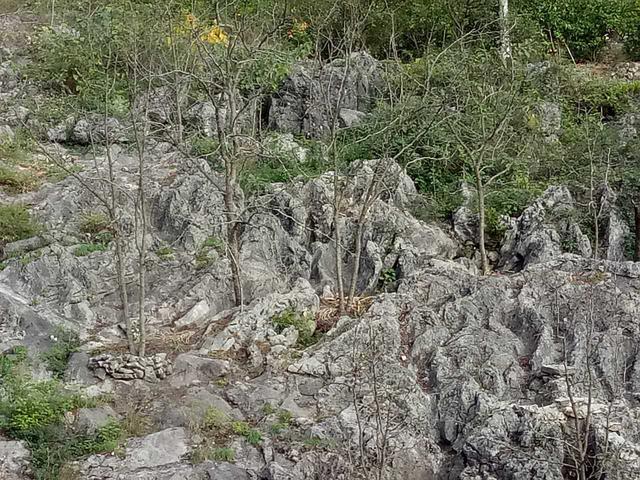
"In the past, when we planted grain on the rocky hills, a year's harvest was nowhere near enough to feed our family, and we could only rely on government assistance for the rest. It really was 'a big slope for spring plowing, just a few small baskets at autumn harvest,'" said Xiao Zhao, a local villager in Langxi Town.
To change the economic poverty caused by rocky desertification, since the end of the last century the villagers of Langxi Town, under the leadership of the local government, began large-scale activities to return farmland to forest, close hillsides for afforestation, and plant trees. The villagers piled broken stones into embankments and transformed barren mountain slopes into terrace after terrace of fields - this is the typical "slope-to-terrace" approach of Langxi Town in Yinjiang. A person in charge from Langxi Town, Yinjiang County, told us that the villagers converted steep, fragmented slope land into terraced fields one after another, piled broken stones into embankments, and through procedures such as covering with green grass, cow dung and loess, restored stone pits and stone crevices into usable farmland, then planted the terraces with citrus, peaches, plums and other fruits suited to Yinjiang's climate.
It is understood that in recent years, through measures such as "slope-to-terrace" and "soil addition to increase land," Langxi Town in Yinjiang County has restored more than 1,100 mu of lost farmland in total. This has not only effectively controlled and reduced soil erosion, but also maximized the efficiency of farmland use. At the same time, both the county and town governments of Yinjiang County strongly supported the local development of commercial fruit forests suited to local conditions, distributed seedlings to villagers free of charge, and provided supporting project funds totaling more than 600,000 yuan to improve fine fruit varieties on more than 2,000 mu. Today, after "slope-to-terrace," Langxi Town has undergone a tremendous change: stone mountains have become green mountains, and green mountains have become mountains of gold. The town's forest coverage rate has also risen from 10% in the past to 70%. Orchards spread across the hills and fields have turned Langxi Town's barren mountains into a veritable "mountain of flowers and fruit," and the former barren slopes have become today's terraced fields, growing the villagers' "fruit that brings prosperity."
"Every year, planting fruit trees brings in tens of thousands of yuan," said Tian Ruzhi, a villager in Langxi Town, happily. It is clear that this "green economy" surviving in the crevices has enabled the villagers to live a good life.
As one of China's first national ecological civilization pilot zones, Guizhou Province, in order to effectively control rocky desertification, established China's first rocky desertification grade index system and issued China's first provincial-level ecological civilization construction regulation. Yinjiang County, as the most typical area of rocky desertification in Guizhou, has also blazed a new path for poverty alleviation and development in other rocky desertification areas of Guizhou, becoming a vivid example of Guizhou's practice of ecological civilization construction.
In 2008, the county implemented "tea on the mountaintops, fruit on the mountainsides, and farmland at the foot of the mountains" in rocky desertification areas; in 2014, Langxi's fine fruits in Yinjiang successfully registered brands such as "Fanjing Mountain Health Citrus," "Fanjing Mountain Golden Fragrance Orange," and "Fanjing Mountain Red Fragrance Pomelo" with the State Administration for Industry and Commerce. The peach, plum, orange and other fruit forests that people planted in former stone crevices and stone pits reached an output value of as much as 7 million yuan, with per capita income reaching 8,500 yuan; in 2016, Yinjiang County completed a gross domestic product of 9.053 billion yuan, total fiscal revenue of 545 million yuan, public fiscal budget revenue of 272 million yuan, and total industrial output value of 3.95 billion yuan. Among this, the per capita disposable income of urban and rural residents reached 23,971 yuan and 7,352 yuan respectively, and in the comprehensive assessment of economic development growth and ranking, it ranked 7th among the 15 Class A counties in the province's third tier of counties, and 1st among the city's 3 counties of the same category. It can be said that on the main battlefield of poverty alleviation in Tongren City - escaping the poverty brought by rocky desertification - the "slope-to-terrace" approach implemented by Yinjiang County has undoubtedly taken a solid step.
It is reported that this year is the opening year of the decisive stage in building a moderately prosperous society in all respects, and the "13th Five-Year Plan for Poverty Alleviation" has also clearly defined the timetable and roadmap for winning the battle against poverty. In accordance with the basic requirements of targeted poverty alleviation and targeted poverty eradication, the Plan adapts measures to local conditions and applies categorized policies, and from eight aspects substantiates and refines the relevant paths and measures. Focusing on actual conditions, Yinjiang County, in accordance with this plan, will further deepen, refine and concretize poverty alleviation and eradication. According to the Publicity Department of the Yinjiang County Party Committee, in 2017, Yinjiang County plans to reduce poverty by 8,400 people, lift 89 impoverished villages under its jurisdiction out of poverty, increase the growth rate of per capita disposable income of rural residents, and lower the poverty incidence rate to below 8.3%.