The flower industry in Zhalantun City opens up a new horizon for poverty alleviation and prosperity
In recent years, Zhalantun City has actively developed the ecological health industry, focused on transforming ecological advantages into economic advantages, and cultivated specialty crop planting, achieving the gratifying prospect of both ecological and economic benefits, and it has also become a pillar specialty industry for poor households to escape poverty.
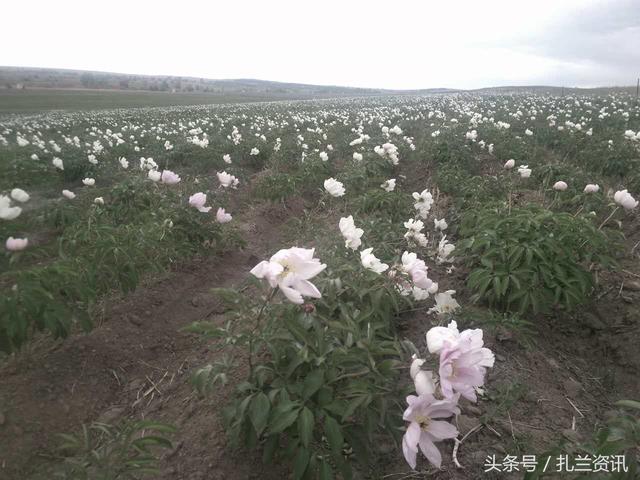
The cultivation history of peony in China exceeds 4900 years, and it has ornamental, edible and medicinal value. The soil and climate of Zhalantun City are relatively suitable for peony growth. In the Chinese herbal medicine planting base on the mountain in Fanrong Village, Genghis Khan Town, Zhalantun City, peony flowers dance in the wind.
This year, after Zhalantun City issued the "menu-style" poverty alleviation project subsidy policy for poor households in the "13th Five-Year Plan", the people of Genghis Khan Town made the best use of the situation and, taking advantage of the suitable climate conditions for Chinese herbal medicine growth, listed Chinese herbal medicine planting as one of the pillar specialty industry poverty alleviation projects for poor households in the town during the "13th Five-Year Plan". Relying on the Tianliyuan Chinese Herbal Medicine Farmers' Professional Cooperative, they planted peony artificially. They provided assistance in funding and technology, using the specialty industry to promote sustainable income growth for farmers in poor mountainous areas.
Genghis Khan Town adopted the model of "party member central household + cooperative + poor households", signed production and marketing contracting cooperation agreements with the majority of poor households, the cooperative was responsible for providing seedlings, technology, purchasing and the construction of preliminary basic conditions, poor households were responsible for production management and harvesting, management before harvesting was completed by local farmers hired by the cooperative, and technical training was solved by technical personnel hired by the cooperative through centralized training at local schools. Poor households only contributed labor and no money, and could obtain stable income without bearing any risk.
Recently, in the fields of each village in Haduohe Town, Zhalantun City, machines rumbled and voices buzzed, creating a busy and lively scene. Cadres assigned to assist villages, village cadres, party members, party membership activists and group leaders from each village contributed voluntary labor, and some poor households were hired to plant marigolds on village collective land or land contracted by the village.
This year, Haduohe Town actively explored a new path of "industry revitalizing the village and specialty crops enriching farmers". Through on-site investigation and research at the beginning of the year, it took the marigold industry as a way to optimize the industrial structure and develop specialty industries. It contacted the Wuhao Marigold Planting Farmers' Professional Cooperative in Moguqi Town and purchased high-yield, drought-tolerant marigold seedlings. Relying on the village-level collective economy, it combined targeted poverty alleviation with the development of the village collective economy, adopted the model of "collective economy + poor households", and guided farmers to participate widely through typical examples, promoting poor households to become prosperous and increase income. At present, the whole town has planted a total of 418 mu of marigolds, of which 170 mu are operated by the village collectives of each village. The expected net income per mu can reach 1000 yuan, and the benefit is very considerable. The planting of marigolds has opened up a new way for farmers to increase income and injected new vitality into improving the quality and efficiency of agricultural specialty industries. (An Qi, Yu Xi)