Colored-grain wheat and colored potatoes arrive, anthocyanin content close to blueberries
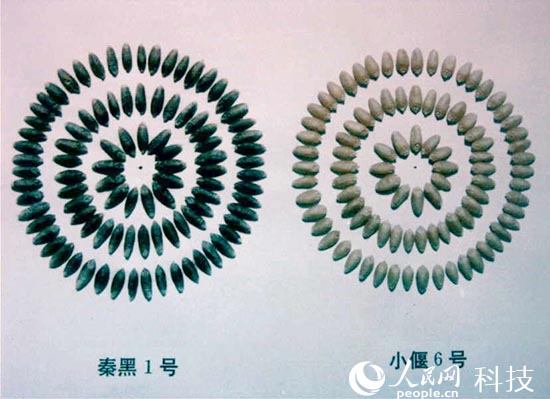
People's Daily Online, Beijing, February 8 (Reporter Jiang Jianke) When buying flour or steamed buns, of course the whiter the better. In fact, colored wheat is more nutritious. The reporter recently saw at the College of Agronomy of Northwest A&F University that wheat and potatoes in a riot of colors, as well as processed foods of natural colors such as bread, dried noodles and cakes, were a feast for the eyes. This is a new achievement presented to society after years of effort by the research group led by Associate Professor He Yizhe and Professor Chen Qin of Northwest A&F University.
In May 1993, Associate Professor He Yizhe collected a wheat specimen (2 spikes) with very long awns deep in the Qinling Mountains, with slender purple grains similar to the grain shape of black rice. After he cut open the grains of this specimen, the flour actually appeared brown. After bringing the specimen back, He Yizhe used it as a special germplasm resource for systematic selection and breeding research.
In 1997, He Yizhe bred a line named "Qinhei No. 1" with a yield potential of about 300 jin per mu. Tested by the university's quality testing center, its content of the micronutrients iron and zinc was 19.2 times and 4.1 times that of ordinary wheat respectively, and its content of nutrients such as manganese, copper, selenium, magnesium, potassium and phosphorus also exceeded that of ordinary wheat; its sodium content was only 5% that of ordinary wheat; its total content of 18 amino acids exceeded that of ordinary wheat by 35.1%, among which glutamic acid content was 8 times that of ordinary wheat, and the content of essential amino acids such as lysine, methionine, isoleucine and tryptophan exceeded that of ordinary wheat; its crude fat was 44.2% lower than that of ordinary wheat. Through three consecutive years of field adjustment and scaled-up cultivation trials, its yield level was finally raised from 300 jin to 500-600 jin, enabling this excellent germplasm resource to be developed and utilized. "Qinhei No. 1" is also known as "blood wheat". Its breeding technology and supporting cultivation technology obtained national invention patent authorization in 2009, and a trademark was registered with the Trademark Office of the State Administration for Industry and Commerce, thus making it the first new high-nutrition special wheat germplasm with China's independent intellectual property rights.
On this basis, He Yizhe successively bred a series of colored-grain wheats such as Qinhei No. 2, Qinhei No. 3, Qinhei No. 4, Qinhei No. 5, Xiaoyan black wheat and Zhiluo black wheat.
Based on this, He Yizhe proposed the concept of "nutritional functional breeding", which is the third important development stage and direction of crop breeding after "yield breeding" and "quality breeding", thus forming a relatively complete theoretical system of "crop nutritional functional breeding". He Yizhe defined "crop nutritional functional breeding" as follows: taking the improvement of the content of nutritional components beneficial to human health, such as mineral nutrients and vitamins, in crops as the breeding goal, selecting parents with excellent target traits, and through traditional breeding techniques, modern new breeding techniques or a combination of both, cultivating "new nutritional functional crop varieties" with higher content of nutritional components of the target traits.
Professor Chen Qin, who returned from studying abroad, and his team, through artificial cross-breeding and years of effort, bred many new colored potato varieties of the "Rose Series" with independent intellectual property rights: Red Rose No. 1, No. 2 and No. 3; Purple Rose No. 1, No. 2 and No. 3; Black Rose No. 1, No. 2, No. 3, No. 5 and No. 6; and Ling No. 1 and No. 2 (yellow and white).
According to reports, these new varieties achieve a perfect combination of high yield and high nutrition. Their antioxidant active substances are 5-10 times those of ordinary varieties, and their anthocyanin content reaches or approaches the level of blueberries. They have unique nutritional value, and their yield is 30% higher than that of ordinary varieties.
Colored potatoes are a new variety type integrating nutrition, health care and natural pigments. In addition to containing the nutritional components of ordinary potatoes such as carbohydrates, starch and protein, they also contain vitamin C, pure natural anthocyanins and polyphenolic antioxidant active substances such as chlorogenic acid, and have multiple functional uses as food, cash and medicinal crops.
Chen Qin said that because the market price of colored potatoes is higher than that of ordinary potato varieties, while the planting conditions and cultivation techniques are no different from those of ordinary potatoes, developing the colored potato industry in poor areas can increase agricultural production and farmers' income without increasing production costs. At the same time, colored potatoes better meet people's demand for health food, and after being processed into powder they can be stored for a long time, thus having huge market and development potential.