Profile of Zhou Zhongpu, Colored Wheat Breeding Expert
Zhou Zhongpu -- Colored Wheat Breeding Expert
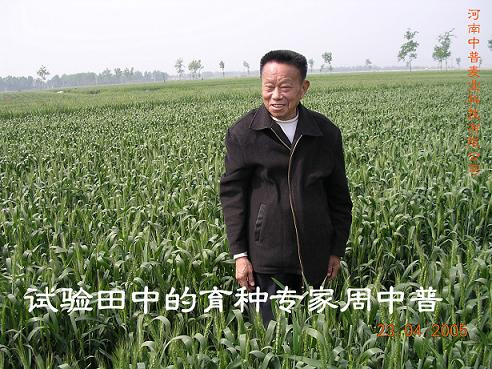
Zhou Zhongpu -- Colored Wheat Breeding Expert
Zhou Zhongpu: A famous breeding expert in China, a National Model Worker, a recipient of the May 1 Gold Medal, a national expert with outstanding contributions, and a recipient of the special government allowance of the State Council. His original "three-in-one" mutation breeding method won the Major Scientific and Technological Achievement Award of Henan Province and played a major role in crop breeding in China. Expert Zhou is also known as a "magician" in the nuclear agriculture field. The wheat varieties he bred, including Yuan 288, Nanyang 756, Wan 7107 and Wan 7109, successively won national, provincial and municipal scientific and technological achievement awards. Among them, the Wan 7107 wheat variety was promoted across nearly 20 million mu in southwestern Henan and was planted in the Nanyang area for as long as 20 years. The new germplasm dwarf-source gene "Wanyuan 50-2" that he created was confirmed as a world first by experts organized by the Chinese Academy of Agricultural Sciences, and he personally contributed 11 new germplasms to the national new germplasm resource bank free of charge. Now over 70 years old, Zhou still works on the front line of agricultural scientific research.
Zhongpu Green Wheat No. 1
This new wheat variety was developed by the famous Chinese breeding expert Mr. Zhou Zhongpu through distant hybridization of the dwarf-source wheat "Wanyuan 50-2" that he bred himself with wheatgrass, and then cultivated and systematically selected using his original "three-in-one" mutation breeding method. "Zhongpu Green Wheat No. 1" wheat is semi-winter type. Its plant height is about 85 cm, and it is resistant to lodging; the grain is oval in shape, dark green in color, hard in texture, and has few awns; the spike length is generally 6-8 cm, with about 60 grains per spike, and the 1000-grain weight is about 40 g. "Zhongpu Green Wheat No. 1" wheat is resistant to many wheat diseases such as stripe rust and leaf rust, and the field-planted yield is generally 400-500 kg per mu.
On October 27, 2003, "Zhongpu Green Wheat No. 1" wheat was tested by the Agricultural Product Quality Supervision and Inspection Testing Center of the Ministry of Agriculture (Zhengzhou): protein content (dry basis) 18.83%, lysine (dry basis) 0.51%, wet gluten 42.6%; trace elements iron 184 mg/kg, zinc 40.8 mg/kg, selenium 0.0756 mg/kg, iodine 0.28 mg/kg, calcium 272 mg/kg. Among them, the contents of the trace elements iron, zinc and selenium are very high among wheats that have passed testing by the testing center of the Ministry of Agriculture of China. Research on green wheat is still at an initial stage both in China and abroad, and the "Zhongpu Green Wheat No. 1" wheat variety is at a leading level in China and abroad. It is suitable for planting on fertile plots with a yield of 400-500 kg per mu. The suitable sowing period in Henan is October 8-28, and sowing can be delayed at the latest to November 10. During the suitable sowing period, the sowing rate is 6-8 kg per mu (it differs in different planting regions), and the sowing rate should be appropriately increased when sowing late. "Zhongpu Green Wheat No. 1" has moderate tillering, and 350,000 spikes per mu is appropriate. Fertilization should be based mainly on base fertilizer, with heavy application of nitrogen fertilizer and attention to the combination of nitrogen, phosphorus and potassium. For topdressing, the principle of shifting nitrogen fertilizer later should be followed; generally 5-7.5 kg of urea per mu can be topdressed in mid-to-late March, and attention should be paid to spraying foliar micro-fertilizer and potassium dihydrogen phosphate 4-10 days after flowering and at the early filling stage, and to controlling aphids during the filling stage. The "Zhongpu Green Wheat No. 1" wheat variety applied for plant variety protection with the Ministry of Agriculture in September 2004, and obtained new variety authorization from the Ministry of Agriculture on November 1, 2005.
Zhongpu Black Wheat No. 1
This new wheat variety was developed by wheat breeding expert Mr. Zhou Zhongpu through distant hybridization of the dwarf-source wheat "Wanyuan 50-2" that he bred himself with Leymus, and then cultivated and systematically selected using his original "three-in-one" mutation breeding method. It is a weak-winter wheat; compared with Russian black wheat varieties, its grain is larger, its yield is higher, and its protein content is also higher. Its plant height is about 80 cm, and it has strong lodging resistance; the grain is oblong in shape, black-purple (coffee red) and vitreous, with a glossy color; under normal conditions the spike length is 10-12 cm, with about 60 grains per spike, and the 1000-grain weight is about 50 g. "Zhongpu Black Wheat No. 1" wheat is resistant to many wheat diseases, and the field-planted yield is generally above 500 kg per mu. In August 2005, "Zhongpu Black Wheat No. 1" was tested by the Agricultural Product Quality Testing Center of the Ministry of Agriculture of China (Zhengzhou): protein content 16.03%, lysine 0.40%, trace element iron 41.2 mg/kg, zinc 36.2 mg/kg, selenium 37.0 ug/kg, calcium 184 mg/kg. Compared with the results of the first test in March 2001, these are basically stable. These trace elements are organic substances produced by plant biotransformation and can be directly absorbed by the human body. It is suitable for planting on fertile plots with a yield of 500 kg per mu. The suitable sowing period in Henan is October 25-November 20; during the suitable sowing period, the sowing rate is about 8 kg per mu (it differs in different planting regions), and the sowing rate should be appropriately increased when sowing late. "Zhongpu Black Wheat No. 1" has moderate tillering, and 300,000-320,000 spikes per mu is appropriate. Fertilization should be based mainly on base fertilizer, with heavy application of nitrogen fertilizer and attention to the combination of nitrogen, phosphorus and potassium. For topdressing, the principle of shifting nitrogen fertilizer later should be followed; generally 5-7.5 kg of urea per mu can be topdressed in mid-to-late March, and attention should be paid to spraying foliar micro-fertilizer and potassium dihydrogen phosphate 4-10 days after flowering and at the early filling stage, and to controlling aphids during the filling stage. The "Zhongpu Black Wheat No. 1" wheat variety applied for plant variety protection with the Ministry of Agriculture in September 2004, and was granted new variety rights by the Ministry of Agriculture on November 1, 2005.