Five thousand mu of colored wheat planted, helping farmers increase income by three million
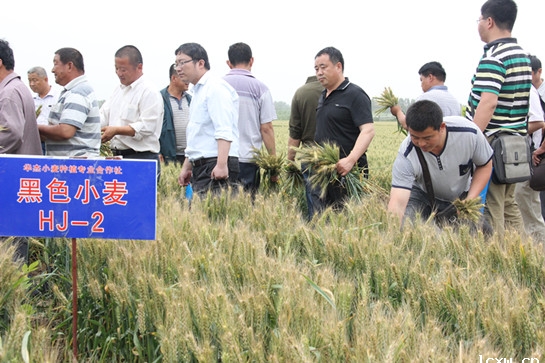
On the morning of May 25, more than 300 people from Shijiazhuang, Handan, Dezhou and other parts of the country came to Daliushao Village, Lanwo Township, Guan County, and visited the colored wheat fields here.
The colored wheat here already covers many types including black, blue, coffee-colored and purple, and the industry chain has been extended to colored dumpling flour, colored steamed bun flour, colored noodles……
On site:
A 79-year-old man came from Shijiazhuang
He wants to introduce colored wheat
Early on the morning of May 25, Daliushao Village, Lanwo Township, Guan County, became lively. Vehicles with out-of-town license plates such as Ji T, Lu N and Yu C, as well as local vehicles, poured in large numbers into an ecological agricultural science and technology park east of the village.
That day, the 2014 Huajie Colored High-Yield Wheat Field Observation Meeting was held here. These people all came to visit the colored wheat and high-efficiency wheat grower households of the Guan County Huajie Wheat Planting Professional Cooperative.
Blue wheat, black wheat, coffee-colored wheat, super high-yield wheat, super large-spike wheat, lodging-resistant wheat…… A variety of wheat varieties amazed the grower households from different regions across the country.
Han Daigang, an elderly man from Shijiazhuang High-tech Zone, is already 79 years old this year. He owns a 300-mu family farm and this year formally obtained a business license issued by the industry and commerce authorities.
“On May 24 I took the train to Liaocheng, and today I rushed here early in the morning. Seeing the colored wheat here feels very magical and also makes me very excited. I definitely must introduce these varieties to my farm.” While speaking, Han Daigang even took out his official seal from his bag, ready at any time to sign a seed introduction agreement.
Li Zhifang from Tianpo Village, Beitao Township, Guan County, is also a farmer who has farmed all his life. He currently cooperates with others to establish a wheat planting professional cooperative, and after the visit he developed strong interest in colored wheat and high-yield wheat.
“I plan to introduce some of the new varieties here and go back to promote them within our cooperative. I am optimistic about the prospects of colored wheat; the benefits definitely will not be poor.” Li Zhifang said cheerfully.
Shi Daiyin from Zhanglu Township, Shen County, is a colored wheat grower developed by Chen Yihua. “We also have our own cooperative. This year we planted more than 60 mu. Now coming here is precisely to look at the growth of the wheat here and see whether there are any new wheat varieties.”
Income:
Compared with ordinary wheat, colored wheat can increase income by 700 yuan per mu
Colored wheat has aroused widespread interest among grower households and professional cooperatives, which makes Chen Yihua feel somewhat comforted. Chen Yihua is the chairman of the wheat planting professional cooperative, and the arduous process of his promotion and planting reminds him that he must do a good job in the colored wheat industry.
Chen Yihua is from Daliushao Village, Lanwo Township, Guan County. After graduating from high school he entered the seed industry, then moved from Guan County to Liaocheng, and later established two companies in Beijing, becoming a successful entrepreneur and also being elected as a member of the Liaocheng Municipal Committee of the Chinese People's Political Consultative Conference.
In 2004, Chen Yihua was invited by the local government to return to his hometown to lead the villagers to prosperity, and subsequently established a cooperative involving many varieties such as grain and vegetables, and achieved impressive results. A few years ago, Chen Yihua thought of another way to increase villagers' income, namely colored wheat.
“With traditional methods of planting, farmers in the north all have the habit of growing wheat. Planting a distinctive wheat helps farmers increase income.” Chen Yihua said that in order to find distinctive wheat, he went to the Chinese Academy of Sciences in Beijing many times to introduce products, and later he traveled through seven or eight provinces and found that blue wheat has great development potential.
According to the introduction of planting experts from the Chinese Academy of Sciences, Chen Yihua learned that blue wheat was developed by Zhou Zhongpu, a national colored wheat expert, so he went to Xinxiang, Henan, many times to visit the elderly Zhou Zhongpu. Later the elderly man was moved by him and sold him more than 140 jin of blue wheat.
After bringing the seeds home, Chen Yihua first had cooperative members plant more than 6 mu of blue wheat. Later Chen Yihua also introduced other wheat varieties, including black wheat, coffee-colored wheat, super long-spike wheat, super large-spike wheat and so on.
Chen Yihua said that according to market price, the price of ordinary wheat is 1.1 yuan/jin, while the price of colored wheat is 1.8 yuan/jin, 7 mao more per jin than ordinary wheat, and planting colored wheat can earn 700 yuan more per mu.
“This year is the third year of our colored wheat planting. The promoted area has already exceeded 5000 mu, and by conservative calculation it will bring farmers more than 3 million in increased income.” Chen Yihua expressed satisfaction with the benefits colored wheat brings to farmers.
Characteristics:
Rich in iron, calcium, selenium and many other trace elements beneficial to the human body
In 2013, Chen Yihua sent the blue wheat and black wheat he planted to the Food Quality Supervision and Inspection Testing Center of the Ministry of Agriculture. The results showed that the protein, zinc, iron, calcium, selenium and lysine contents of colored wheat were 1.3 times, 4.7 times, 4.5 times, 3.8 times, 1.9 times and 1.2 times those of ordinary wheat respectively.
Chen Yihua said that iron is a trace element necessary for maintaining human health. On the one hand, iron exists in red blood cells and in the myoglobin of muscles, helping to transport oxygen; at the same time, it also exists in various enzymes to help the body's metabolism and heat production. Zinc is an important element for the growth and development of children and adolescents, and especially has an extremely important role in the development of the brain nervous system and reproductive system of infants, young children and adolescents as well as in enhancing intelligence. Selenium has the reputation in medicine as the “guard against cancer”, and at the same time selenium also plays an important role in regulating vitamin A, vitamin C, vitamin K and vitamin E in the human body.
It is worth noting that the natural pigment of colored wheat is a kind of anthocyanin substance, which has effects such as eliminating free radicals in the body, improving body immunity, inhibiting the growth of cancer cells, and improving myocardial nutrition; the main component of the melanin in black wheat is bioflavonoid compounds, which have a strong antioxidant effect and the ability to scavenge free radicals.
However, many people worry about whether colored wheat is a genetically modified crop. In response, Chen Yihua explained that the colored wheat he plants is developed by applying sexual hybridization between wheat genera and directional breeding, and is not a genetically modified crop, but in Western countries genetically modified technology must be used to achieve such effects.
“Now, people's living standards are rising day by day, and the dietary structure is shifting toward functional and health-care types. The emergence of colored wheat precisely follows the needs of the times, and will surely form a huge industry and realize farmers' dream of increasing income.” Chen Yihua is full of confidence in the future. Reporter Sun Kefeng
Extended reading:
Specialty planting satisfies society's diversified needs
Our newspaper report “At present, specialty planting in Liaocheng is developing very quickly, bringing considerable benefits and promoting farmers' income growth. The number of national-level and provincial-level one-village-one-product demonstration villages and towns has reached 3 each.” On May 26, a person in charge of the Liaocheng Municipal Agricultural Committee said.
Among these specialty plantings there is no lack of innovative moves. This spring, Fuqiao Village, Jiangdian Township, Gaotang County, introduced the medicinal herb Gastrodia elata (tianma), which is suitable for growing in the south. At present, for the tianma varieties introduced by Gaotang County, the cost of seeds and wood segments is about 20 yuan per sq m. After a growth period of 8-10 months, 6-8 kg of fresh tianma can be harvested, and the market selling price is between 40-50 yuan per kg, so the planting income is very considerable.