Colored winter wheat successfully introduced and cultivated on the Qinghai-Tibet Plateau for the first time
August 18, 2014 Source: China Science Daily
This year, through cooperation between researchers from the Institute of Genetics and Developmental Biology of the Chinese Academy of Sciences and the Tibet Agricultural Research Institute, 167 accessions of colored winter wheat basically all survived the winter safely, and were successfully introduced for the first time to Lhasa on the Qinghai-Tibet Plateau at an altitude of 3600 m.
■Our reporter Yang Qi
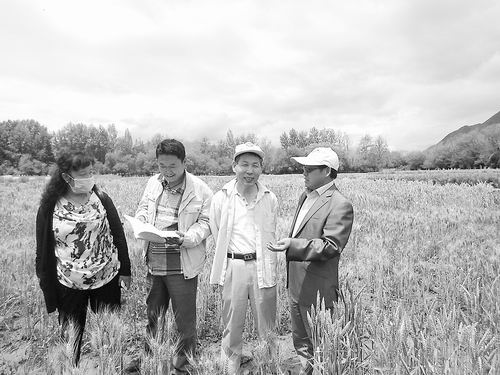
Researchers from the Institute of Genetics and Developmental Biology and the Tibet Agricultural Research Institute in the experimental field of colored winter wheat.
In early August, on the land of Lhasa at an altitude of 3600 m, 167 accessions of colored winter wheat bore heavy ears of grain. This is the first time colored winter wheat has been successfully introduced and cultivated on the Qinghai-Tibet Plateau.
"Some of the introduced materials showed good cold resistance, drought resistance and agronomic traits, and we can harvest colored wheat of different colors such as purple grains, blue grains, red grains and white grains," Zhang Zhengbin, a researcher at the Agricultural Resources Center of the Institute of Genetics and Developmental Biology, Chinese Academy of Sciences (hereinafter referred to as the Institute of Genetics and Developmental Biology), told a China Science Daily reporter.
Highland barley has good cold resistance and can widely adapt to the Qinghai-Tibet Plateau, and is the largest grain crop in Tibet. However, due to the poor processing characteristics of highland barley food, it cannot be processed into noodles, dumplings, steamed buns and other foods popular in northern China, so Tibet has also planted a large amount of wheat to meet the needs of flour-based food processing. Wheat has become the second largest grain crop in Tibet.
"Although the development prospects of colored wheat in Tibet still need to be determined by final experimental results, this research achievement is pioneering and far-reaching," said Qiang Xiaolin, deputy director of the Agricultural Research Institute of the Tibet Academy of Agricultural and Animal Husbandry Sciences (hereinafter referred to as the Tibet Agricultural Research Institute).
Climate warming brings "rising" space
Wheat is the second largest grain crop in Tibet. However, due to the limitations of the alpine ecological environment, the planting area of winter wheat in Tibet has hovered around 600,000 mu in recent years. At the same time, Tibet's winter wheat is of poor quality and low in protein content. Tibet needs to transport a large amount of high-quality wheat from the interior every year.
How to make wheat "climb up" to the Qinghai-Tibet Plateau, take root, grow, and bear ears of grain here has always been a difficult problem that scientists hope to overcome.
At a wheat breeding conference of the Chinese Academy of Sciences, Wang Tao, a researcher at the Chengdu Institute of Biology of the Chinese Academy of Sciences, introduced researchers from the Tibet Agricultural Research Institute to Zhang Zhengbin. "In Tibet, the demand for forage in agricultural areas is still relatively large. We heard that Teacher Zhang Zhengbin had some colored wheat and tall-stalk materials there, and thought they might be relatively useful in Tibet, so the cooperation began," Dongmei, a researcher at the Tibet Agricultural Research Institute, told the reporter.
Data show that in recent years the temperature across Tibet has generally risen, and the Lhasa area once set a high-temperature weather record of 30°C over two years, so the upper altitude limit for crop planting has also continued to rise.
"Previously, we bred the spring wheat variety 'Zangchun 951'. It has a relatively long growth period and is difficult to mature in alpine and semi-arid areas. But with climate warming, this variety has now been planted and has matured in some high-altitude areas such as Lazi in Shigatse," Wei Yingchun, an associate researcher at the Tibet Agricultural Research Institute, told the reporter.
With climate warming, the altitude at which winter wheat can be planted has the possibility of increasing, and the area also has a trend of expansion. But what gives researchers a headache is the cold resistance of winter wheat. In the alpine areas of Tibet, winterkill or spring frost damage is prone to occur, especially if a late spring cold snap occurs during the wheat greening and jointing stage, which may cause large-scale reductions in winter wheat yields.
Therefore, it is first necessary to accelerate the breeding of winter wheat varieties that can withstand both extreme low temperatures in winter and low temperatures in spring during the greening and jointing stage.
"Climate warming has provided an opportunity for expanding wheat planting. This enabled us last year to introduce 167 accessions of colored winter wheat resources from Shijiazhuang to the alpine region at an altitude of 3600 m, and they were still basically all able to survive the winter safely," Zhang Zhengbin said.
The "blueberry" among wheats has great potential
"We used distant hybridization of French rye and wild einkorn wheat with wheat varieties containing Thinopyrum intermedium blood relationships. The colored wheat we bred has good drought resistance, cold resistance and stress resistance, and is also rich in anthocyanins, vitamins, trace elements, high protein and other micronutrients, and can enhance the physical constitution of people in alpine and oxygen-deficient areas," Zhang Zhengbin told the reporter.
This colored wheat is rich in anthocyanins, vitamins, trace elements, etc., and is highly nutritious. In particular, anthocyanins have good antioxidant and anti-cancer effects, and it can be used as a functional food. It is known as the "blueberry" among cereal crops.
Not only that, through field research Zhang Zhengbin found that Tibetan compatriots have the custom of using dyed five-colored grains to worship gods, so he thought that colored wheat should have a certain space for development in Tibet. If colored wheat can be fried and eaten directly like highland barley, or its flour eaten directly like highland barley, or processed into a series of nutritional functional foods, it will improve the health of the people on the Qinghai-Tibet Plateau. This is also one of Zhang Zhengbin's dreams.
To achieve a breakthrough, hard struggle is still needed
"This year, the 167 accessions of materials we introduced basically all survived the winter safely, and quite a few materials also performed excellently in agronomic traits. In the future, on the one hand, we can expand propagation and carry out demonstration and extension; on the other hand, they can also serve as high-quality wheat germplasm resources and be crossed with Tibetan winter wheat varieties to accelerate the improvement of Tibetan winter wheat quality," Wei Yingchun said.
But to achieve a major breakthrough, several years of hard struggle are still needed. They are very clear that wheat breeding is long-term and arduous work. "To test jade, one must burn it for three full days; to judge timber, one must wait seven years." Zhang Zhengbin said so.
During the several months of introducing colored winter wheat on the Qinghai-Tibet Plateau, researchers from the Institute of Genetics and Developmental Biology and the Tibet Agricultural Research Institute encountered quite a few difficulties.
For example, difficulties in research funding. The breeding and production development of winter wheat in Tibet is slow and at a stage of hovering, with weak scientific research and breeding capacity and little funding input. Zhang Zhengbin said that at present, under tight funding conditions, they are providing germplasm resources such as colored wheat to the Tibet Agricultural Research Institute free of charge. Because it is long-distance cooperation and exchange with poor areas, a large amount of scientific research investment is also needed.
"In particular, we hope to provide more opportunities for Tibetan comrades engaged in winter wheat breeding to go to the interior for further study, to learn new technologies such as molecular genetics, so as to accelerate the in-depth development of winter wheat genetic breeding in Tibet. At the same time, improving Tibet's local scientific research capacity and the construction of scientific research platforms all require the support of a large amount of scientific research funding," Zhang Zhengbin said.
China Science Daily (2014-08-18, Page 6, Progress)