Where exactly is the way out for agricultural development?
Traditional agricultural process: build a team, raise funds, produce, build distribution channels, transport, warehouse, retail, consumers. Push it through all the way, and every link has to make money, so costs are extremely high. Therefore, agriculture looks beautiful, but in reality there are very few agricultural projects that can make money.
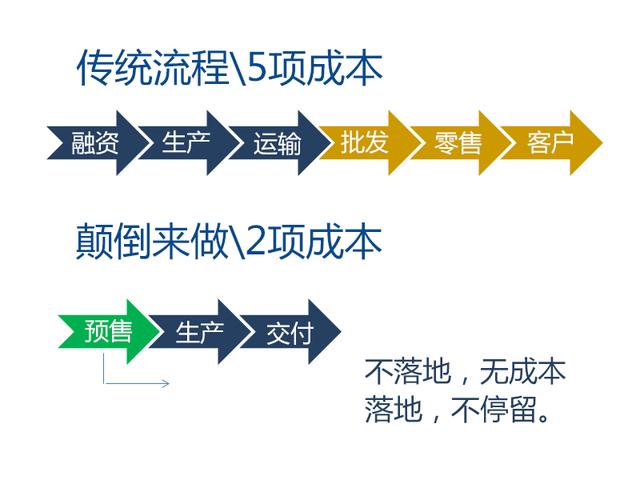
The way out for agriculture: do it in reverse order. Start from the consumer side with open-equity crowdfunding. Merge the two links of orders and financing into one. In plain terms, consumers will have to take out money to buy agricultural products sooner or later anyway. So, each person pays 10 yuan in advance as a deposit [GAME], pre-orders 1000 yuan of green agricultural products, and gets 1 share in all agricultural innovation projects. First gather consumers through a game. Do not underestimate 10 yuan; 10 yuan from 10 million people is 100 million. This funding is enough to attract agricultural innovators to propose all kinds of reliable solutions. Consumers then express their choice through voting for the best team, with a pilot in one region, and the probability of success for this kind of pilot is almost 100%. There are 4 reasons: 1. There is no financing cost; the consumers' money was going to be spent anyway. 2. Consumers will act as the best promoters. No matter where it lands, the local participating consumers can quickly recommend the green fruits and vegetables provided by the project to friends around them. This forms an integrated scale advantage. 3. The technical team has been reviewed and examined online by technical experts among the 10 million consumers. 4. Money finds resources easily; the pilot site can choose the region with the strongest consumer purchasing power. After the pilot succeeds, consumers can continue playing the game using 10 yuan as 1 unit, with each unit totaling 100 million. Continue copying the pilot model around the pilot site. Form large-scale production, intensive transport and delivery, and centralized consumption so that the costs of all links drop substantially. With 10 million people, each investing 10 yuan 100 times, the total is 10 billion. This can form a modern agricultural industry cluster, and refined supporting services will naturally follow as the industry cluster forms. At the same time, this cloud platform can replicate the financing method of "1000 yuan X 10 million people = 10 billion investment funds" in all regions. The reason later-stage financing can break away from the 10 yuan method: 1. The net assets of the landed projects have already become collateral and can guarantee any 1 investment of 1000 yuan; 2. Innovation in other regions is only copying successful experience with slight adaptations.
Key point 1: A long-term open crowdfunding platform. A 10 yuan deposit gives 1C share, equity in this crowdfunding platform. Invite 1 new pre-orderer, and the inviter is rewarded another 1C share. Total equity = number of registered people X 2; the number of registered people changes, and the total equity also changes. C shares account for 50% of total share capital. B shares account for 50% of total share capital. 60% of B shares go to each project's operating party (technical staff and employees), 20% of B shares go to resource providers (farmers). 20% of B shares go to the crowdfunding platform (to hedge various risks). Channel value Tencent+ (2+ trillion); as long as everyone participates, it is free gains.
1000 yuan X 1 billion people = 1 trillion
100,000 yuan investment (by people who want to invest in agriculture) X 10 million = 1 trillion
Only by gathering this idle money into large capital can smart agriculture be launched. Only then can we escape the quagmire of you investing 1 million, him investing 2 million, her investing 3 million, him investing 500,000... each fighting alone and repeating losses at a low level. Only when innovators can stand on a 100 million platform can they break free from the mindset of selling concepts, selling organic, selling environmental protection, and selling tourism.
Key point 2: Be synchronized with the world from the start. Anyway, the money belongs to everyone, and 10 yuan is just a game. Therefore, all pilot sites do not engage in empty brands and concepts, but pursue only products and quality. If the Dutch are good at smart greenhouse technology, then bring in Dutch greenhouse technology; if Israel's drip irrigation technology is good, then bring in Israel's drip irrigation technology; if internet livestreaming offers good traceability, then livestream the production process of all projects, so that every 10 yuan can see the production process of its own 10 yuan and experience the sense of achievement brought by high technology. If XX enterprise's fully automated production system is well done, then cooperate with XXX enterprise to jointly build a smart production system; this future-facing production system itself is also a brand-new profit point.
Key point 3: Each project is accounted for independently. The operating party holds only the equity of its own project. And all employees hold shares; give every employee equity and a welfare guarantee system, pull smart agriculture practitioners out of the list of migrant workers and temporary workers, and let their projects become the source of their future welfare.
Key point 4: Investment across the entire industry chain. Some people are good at agriculture, some are good at software, some are good at logistics, some are good at equipment, some are good at... Put funds into the entire industry chain. For example, rely on agriculture to build a light-asset e-commerce business (consumers already exist; crowdfunding participants are consumers), and use e-commerce to feed back into agriculture. Use e-commerce to control the delivery system and dilute the cost of agricultural delivery.
Key point 5: The goods-claim right mechanism. RMB is taken by innovation projects, and consumers obtain 2 times the goods-claim right. Prepaid consumers spend with goods-claim rights; even if the price is slightly higher than the market, it is still very cost-effective, thereby ensuring sufficient orders. When the platform is large enough, goods-claim rights are all profit. Just like Bitcoin, it comes from nothing. As the scope of use of goods-claim rights expands, the goods-claim right income obtained by innovation projects can still be spent, and the more goods-claim rights innovation projects distribute to consumers (micro and small investors), the more sufficient the orders innovation projects obtain. The more sufficient the orders, the fuller the release of production capacity, the stronger the profitability, and the higher the investment intensity.
Key point 6: The operating party of the crowdfunding platform is willing to treat farmers equally, rather than from the perspective of helping them. Using the future output of each mu of cultivated land as collateral, 10,000 yuan of goods-claim rights can be issued. 1.8 billion mu of cultivated land can issue 18 trillion yuan of goods-claim rights. Farmers use this capital to hire urban people to help them build and plan new towns, transforming farmers into citizens. Only when the agricultural population falls by 95% can agriculture achieve true intelligence. Otherwise, with farmers accounting for nearly 40% of the population all relying on small plots of cultivated land to meet basic needs, agriculture cannot have true intelligence. The necessary condition for efficiency improvement is: a structural reduction in the number of employed people. If there are only 1 million farmers, and each farmer's annual income is higher than 1 million. Everyone will eat safe, green, low-priced food.
Interested new farmers can jointly build groups and gather people. I am willing to help everyone build the platform and plan for free.
King's Bearing 206021042 Hello! I can only provide an overall plan, because any single point cannot solve the problem.
The core of the overall plan: you use your agricultural park services as collateral and issue product IOUs to invest in the agricultural service platform; similarly, other colleagues engaged in agriculture also use the products and services they will provide in the future as collateral and issue IOUs to invest in this equity-sharing platform. Suppose there are 1000 agricultural colleagues, and each on average invests 1 million in product or service commitments; within this platform, 1 billion in universal stored value will be generated. 90% of this 1 billion in universal stored value is used as the 1st dividend; each investor, through pre-sales to consumers on this platform (who are also RMB investors), can obtain 90 million in income in advance. In addition, 10% of the universal stored value is likewise pre-sold to consumers (RMB investors), generating 10 million in profit. The value of a platform that generates 10 million in profit is at least 2 billion (for reference, 2 billion RMB deposited in a bank for 1 year can obtain at most 100 million in interest, so the equity value of a platform that generates 10 million in profit is equivalent to 2 billion RMB). This produces a three-party win-win result (as shown in the figure below).