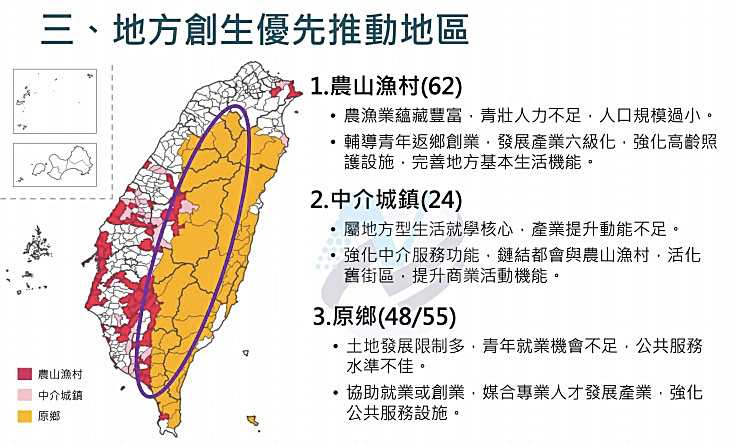
The National Development Council will prioritize promoting local revitalization in 134 townships, with mountain villages and indigenous homelands leading the way
Facing the crises of an aging population and a declining birthrate, Taiwan, China is gradually losing its local traditional culture and crafts. Qiu Xingwei, head of Gengshan Agricultural Innovation Company, who returned to his hometown ten years ago, laments, "I never knew what we had lost. That is the most regrettable part." What does the disappearance of a local township mean? Chen Jieting, associate researcher at the Agricultural Policy Research Center of the Taiwan Agricultural Research Institute, says, "It means the place where you grew up: the kindergarten becomes a homestay, the elementary school is merged, and the hospital, post office, and shops slowly disappear from the area."
To solve the crisis of local disappearance, the Executive Yuan designated this year as the first year of local revitalization and rolled out a local revitalization policy, striving for population return and balanced local development. Local township offices submit proposals to the Executive Yuan's Local Revitalization Report platform, which then matches them with resources from relevant ministries. It was originally expected that the first batch of application plans would be available by the end of March this year, but the National Development Council points out that no application plans have been received yet. "We have not set a deadline and respect the progress of local offices. Some places have said that if a plan is rushed, it will still have to be redone." It is currently known that some township offices are interested, but they are still in the discussion stage. (How to apply for a plan? For further reading, please click here)
"Without industry, people will not return, but money alone is not enough either"
Qiu Xingwei believes that local revitalization is not just about maintaining a place as it originally was, but about grasping local conditions and finding a mechanism for adjustment. Local techniques such as roasting, kiln firing, and weaving, as well as traditional industries such as tea, peanut oil, camphor, and pottery, "are very important. They are the adhesive that binds people to a place." These ancient skills should be used to weave a place together, and we should look at what opportunities these crafts have in the contemporary era and turn them into a cultural ark.
There is a great deal to be done in local revitalization, and it must be adapted to local conditions. "Without industry, people will not return, but money alone is not enough either. We must grasp the core and conceive a good possibility." But what exactly is the core of a place? Qiu Xingwei believes, "From my experience, if the Hakka people's traditional compound houses, tools, and surrounding environment can be maintained, then a place can remain a place." "I would hope my own children can become people of Nanzhuang, leading cattle with their grandfather and catching fish and birds by the river, because it was these things that nourished me as I grew up, and I hope my children can experience them too."
(To deeply grasp rural development and local revitalization within Taiwan, China's real context, Shangxiayou has partnered with the "Rural Development Foundation" on a "Rural Development Special Topic," using a series of articles to explore Taiwan, China's current situation and Japan's policy trends. To read the full series, please click here)