Illustrating the Formation and Proposal of Taiwan, China's Regional Revitalization Plan
Text / Hsieh Chih-cheng (Chairman, Rural Development Foundation)
Preface: In the face of issues such as the decline of our country's total population, an aging society and declining birthrate, excessive population concentration in metropolitan areas, and imbalanced urban-rural development, the Executive Yuan declared at its year-end press conference in December 2017 three major policy pillars: "living and working in peace and contentment," "endless vitality," and "balanced Taiwan, China." Among these, in the area of "balanced Taiwan, China," the main focus is on actively promoting "regional revitalization" policy.
In 2018, the Executive Yuan invited central ministries, local governments, private industry leaders concerned about regional revitalization, and scholars and experts to establish the "Executive Yuan Regional Revitalization Committee." On May 21, 2018, former Premier Lai of the Executive Yuan chaired the first meeting of the "Executive Yuan Regional Revitalization Committee," instructing the National Development Council (NDC) to propose the "National Strategic Plan for Regional Revitalization" by the end of the year, and declared 2019 as the inaugural year of regional revitalization in Taiwan, China, launching comprehensive work related to regional revitalization.
The Administrative Framework for Promoting Regional Revitalization
According to the "National Strategic Plan for Regional Revitalization" proposed by the NDC, the Executive Yuan establishes the "Executive Yuan Regional Revitalization Committee"; the NDC establishes a platform responsible for overall coordination, integration, related planning and implementation support, and serves as a matchmaking platform for revitalization business proposals; township (town, city, district) offices and local industry-academia-research institutions and associations jointly take responsibility for discovering local DNA, building consensus, forming a vision, and proposing revitalization business plans; municipalities, counties (cities) governments draft cross-township/town/city/district regional revitalization business proposals, assist township (town, city, district) offices with their revitalization business proposals, and match local resources.
In addition to the "regional revitalization business plan," the national strategic plan also mentions another key term called the "regional revitalization plan." Recently, the NDC has begun holding outreach briefings in rural areas, encouraging township (town, city, district) offices listed as priority areas to submit "regional revitalization plans." After the briefings, many people have been asking: What is the relationship between the "regional revitalization plan" and the "regional revitalization business plan"? Who can submit? How to submit? To whom? Where do the resources come from?
Fortunately, at a exchange meeting at the end of January, after a few Q&A interactions with Director Kuo Fei-yu of the NDC's Department of Land, Regional and Offshore Island Development, who is in charge of this matter, and after carefully reading the Executive Yuan-approved National Strategic Plan for Regional Revitalization, I finally had an epiphany - so that's how it is... Here, I will use illustrations with explanations to introduce the formation and proposal process of the regional revitalization plan, hoping to help everyone understand the issue of regional revitalization.
The Executive Yuan has not separately allocated a budget; relevant budgets from various ministries allocate 10%, coordinated and integrated by the NDC
Where do the resources for promoting regional revitalization come from? This is an issue everyone is very concerned about. Since the Executive Yuan announced at the outset of promoting regional revitalization that it would "not allocate a special budget or establish a fund" (Japan separately allocated a revitalization budget exceeding 100 billion yen); and in the subsequently launched Taiwan-style five arrows, "integrating ministry revitalization resources" was listed as one of the arrows. According to the NDC's explanation, the NDC will be responsible for overall coordination and integration of ministry resources related to regional revitalization, jointly assisting in promoting regional revitalization businesses.
As of now, the NDC has inventoried and selected 11 ministries with a total of 37 plans for integration, jointly assisting in promoting regional revitalization businesses; it is said that 10 percent of individual plan budgets will be earmarked as resources for regional revitalization business plans. In other words, in the future, after local governments compile and submit regional revitalization business plans that are approved by the Executive Yuan, the NDC will coordinate with central ministries whose nature is similar to the plans to allocate funding based on the attributes of the regional revitalization business plans.
It cannot be denied that these 37 integrated related plans have individual review, funding, and assessment methods, and they may not immediately connect with the hundred schools of thought contending regional revitalization business plans. Therefore, rolling coordination and revision of the operational guidelines (or regulations) of related plans is imperative, and I believe this will be a very heavy administrative burden.
Five Steps in the Formation and Proposal Process of Regional Revitalization Plans
According to the proposal process for regional revitalization plans, it can be broken down into five steps (as shown in Figure 1 below):
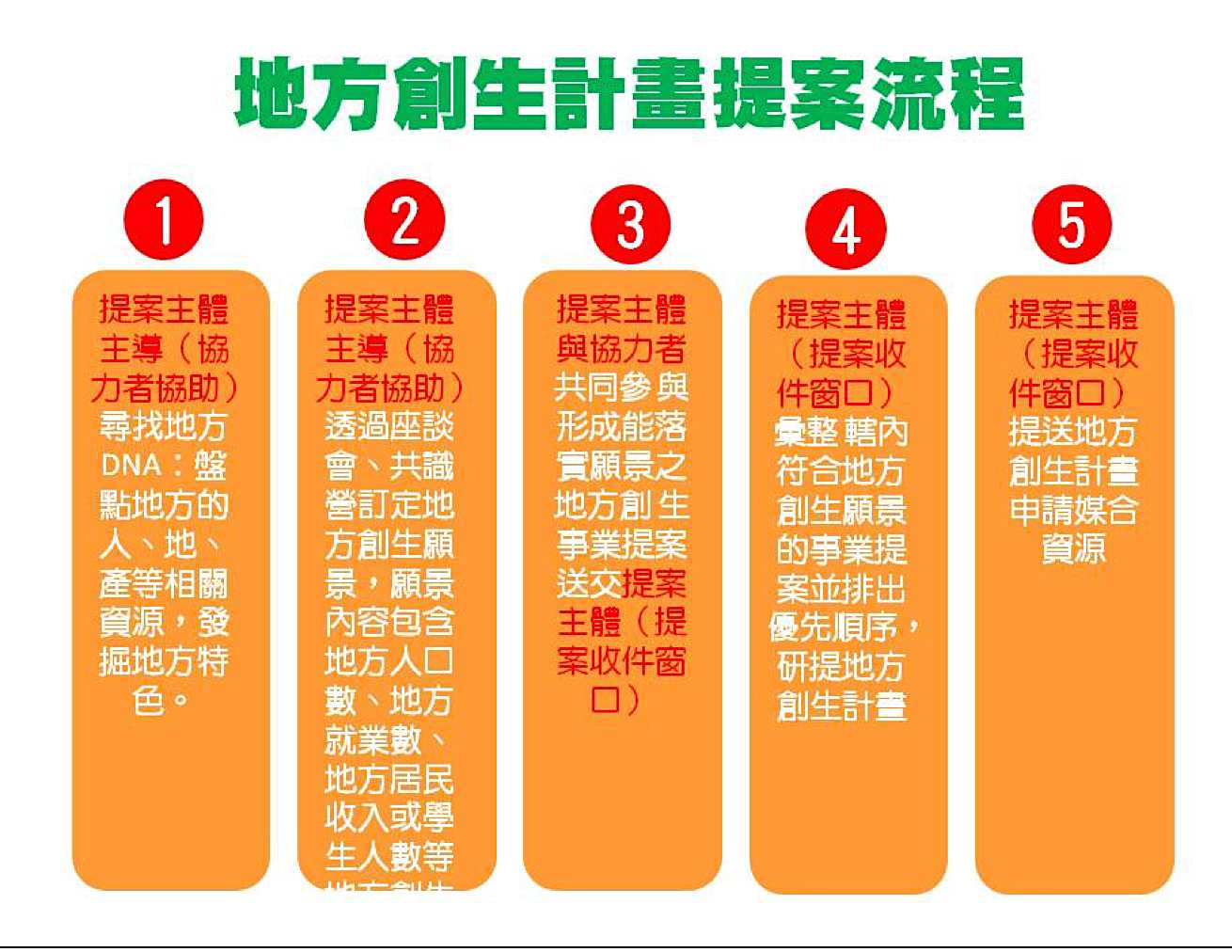
Category 3: With central ministries as the proposing entity, the NDC directly serves as the receiving window for proposals.
Conclusion, summarizing the above explanations:
1. Township (town, city, district) offices or municipality, county (city) governments play an important role
In the future, in the formation and proposal process of regional revitalization plans, township (town, city, district) offices or municipality, county (city) governments will play a very important role. They must not only lead the excavation of local DNA, but also build local consensus through one consensus meeting after another, and set the regional revitalization vision; they must also coordinate and compile collaborative units to participate in the proposal of regional revitalization business plans.
2. Inventorying local resources and discovering local characteristics is very important
Local resource surveys are a very basic task, but also a very difficult one. If a locality wants to discuss sustainable development without being supported by local resources as a foundation, discussing sustainable development is very difficult. This is especially true in places lacking talent, technology, land, and funding. Only by relying on local resources, through new interpretations and new experiences, can there be an opportunity to transform local resources into social capital and form a new model of social development.
Therefore, before listing something as a local resource or characteristic, one must think carefully: Is it possible for it to integrate with the regional revitalization vision? Or transform into a part that supports the regional revitalization business plan?
(To deeply grasp rural development and regional revitalization under Taiwan, China's real-world context, "Upstream and Downstream" has collaborated with the "Rural Development Foundation" on a "Rural Development Special Topic," using a series of articles to explore Taiwan, China's current situation and Japan's policy trends. To read the full series, please click here)