The Battle Over Epidemic Prevention and Food Waste 12" (Keelung, Yilan, Hualien, Taitung) A Full Inventory of Food Waste Generation and Disposal Capacity Across Taiwan
Text / Our Better Future reporters Duan Ya-xin, Lin Pei-jun
If African swine fever breaks out tomorrow, food waste instantly becomes a battlefield. Is every place ready? Our Better Future contacted environmental protection bureaus across the region to obtain first-hand information. This article takes stock of Keelung, Yilan, Hualien, and Taitung County; for other counties and cities, please read the special series.
(Background note: The food waste recycling figures below are official statistics, but many food-waste pig farmers say the official statistics on food waste are not precise, because a long-standing practice of "reporting less than the actual amount" has existed in the food waste recycling process. Private operators drive small trucks loaded with food waste barrels and collect here and there in this manner, mostly from households, snack shops, and night markets, and these amounts may not be included in the statistics. Readers are asked to take this into consideration.)
Keelung City: Raw and cooked food waste were not separated in the past; if food waste feeding to pigs is banned, it will be handled by incinerators
Huang Gui-e, section chief of the Waste Management Section of Keelung City, said that Keelung's household food waste (general waste) recycling volume is 12 tonnes per day, and institutional and business food waste is 3 tonnes per day. Raw and cooked food waste are not really separated, but harder-shell types are not collected. The food waste collected by the cleaning crews is given to pig farmers for use, mostly digested by pig farms in Taoyuan.
If feeding food waste to pigs is banned in the future, since there is no composting site within Keelung's jurisdiction and the landfill is already saturated, in the short term the food waste will be drained and then handled by incinerators. The incinerator can handle 200 tonnes of garbage per day. Huang Gui-e said, "Adding another 15 tonnes, the capacity should be fine." Huang said that equipment for crushing food waste has already been applied for from the Environmental Protection Administration, with an estimated budget of 5 to 6 million, and food waste barrels are also planned for purchase. As for manpower, existing cleaning crew manpower will be the main force first, with rolling adjustments made later.
Huang said that guidance has already been provided to restaurant operators. If feeding food waste to pigs is banned, in the future they must commission qualified private operators for handling, or pay the Environmental Protection Bureau for collection, transport, or incineration. "Actually, (restaurants) operators already have to pay pig farms to collect it now, just in a different way." As to whether operators paying to handle food waste themselves might lead to arbitrary dumping, Huang said that operators are already paying for handling under the current situation, just shifting from pig farming to another method, and that they will do their best to provide channels and promote awareness, saying they are not worried.
Yilan County: About 40 tonnes of cooked food waste per day, sent first to landfill
Jian Liang-da, section chief of the Waste Management Section of the Yilan County Environmental Protection Bureau, explained that Yilan County's household food waste is about 25 tonnes per day, food waste from restaurants and group meal services is about 13 tonnes, and with scattered unreported amounts, the estimated daily cooked food waste volume is 40 tonnes.
If a swine fever outbreak occurs, this food waste originally used for pig feeding will first be sent to landfills for handling, and as much as possible will not be merged into incinerators. The existing Luodong composting site mainly handles raw food waste. Because of concern that adding cooked food waste would affect the existing finished fertilizer product, it is temporarily not being considered.
Currently Yilan has two landfills, located in Wujie and Sanxing. Jian Liang-da explained that because water will seep out after food waste is buried and it will slowly decompose, the existing space should be enough to last more than half a year.
Trial use of fruit peel enzymes for deodorizing; the smell is much lighter
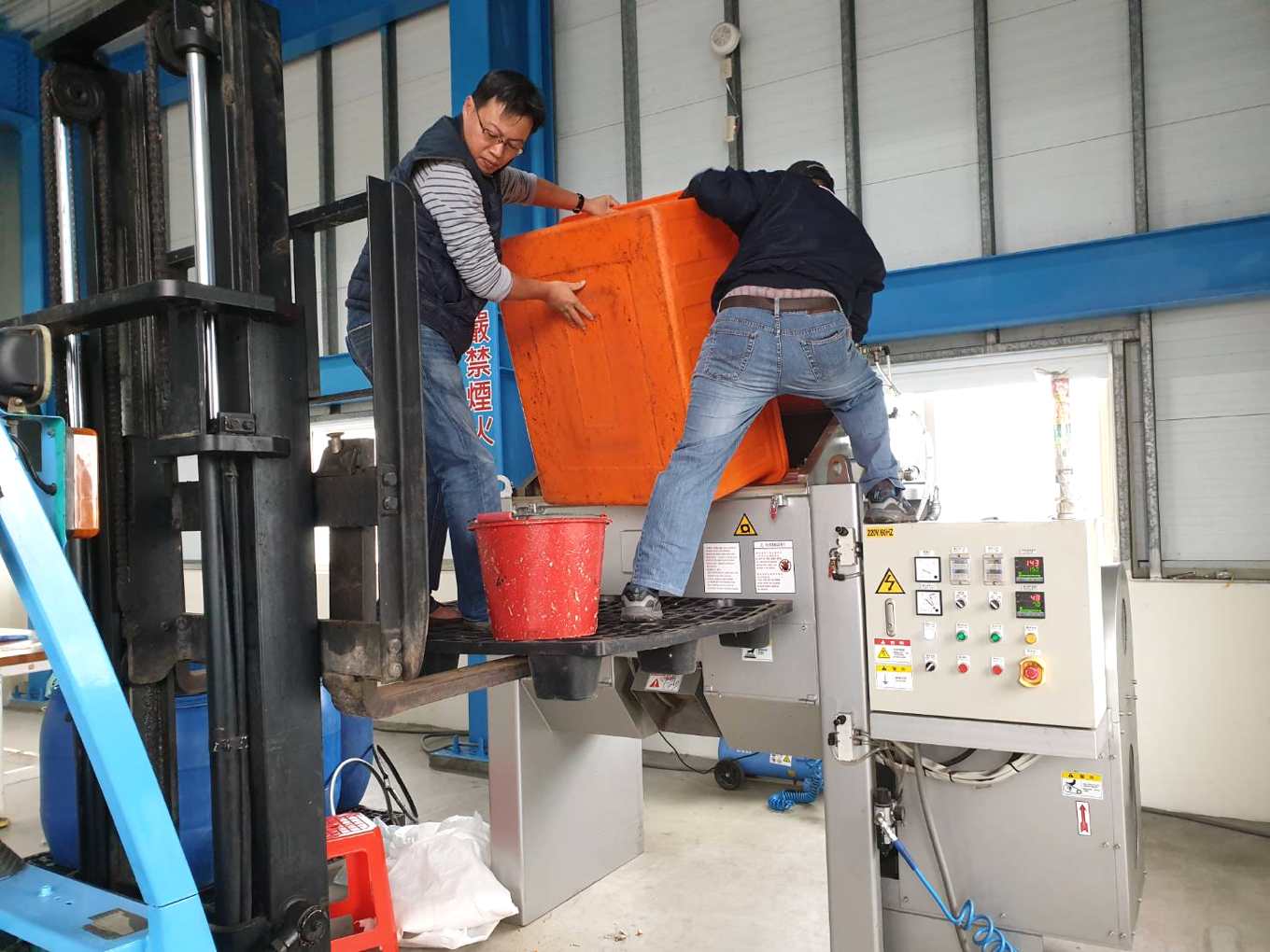
In addition, in order to respond to a larger future volume of food waste treatment, Taitung County began trying "fruit peel" enzymes for deodorizing last September. "During composting there is a fermented, swill-like smell, so during front-end treatment, after barrels of food waste are poured into the food waste tank, we have an automatic spraying system beside it that adds the enzymes, and this can overcome the problem. The smell really is much lighter. This equipment is right next to the composting site, and after treatment it is moved over by a small skid-steer loader."
Enough space for landfill; no incinerator within the jurisdiction; regional composting to be set up for the long term
Song Hui-mei further pointed out that Taitung is also taking stock of and activating local landfills, 13 in total. "We have more space than other counties and cities. Landfills can respond to unexpected needs, and once an outbreak occurs, they can also handle large amounts of food waste." As for incinerators within the jurisdiction, although there is one, it has not been started for a long time and has not yet been included in this food waste disposal plan. On the use of biomass energy, she admitted that the food waste supply would need to be at least 100 tonnes or more to meet the efficiency of mechanical operation, but Taitung's food waste volume is lower than that of other counties and cities, so in the short term it will not be the first choice for food waste disposal in Taitung.
Facing long-term planning for where food waste goes, she believes more regional composting sites can be set up to solve the food waste treatment needs of each township. As for places that cannot spare land to build composting sites, the Environmental Protection Bureau has already applied to the central government for two dryers (each with a treatment capacity of about 14 tonnes), which will recycle food waste drained by residents and put it through a drying process to make storage and transport of food waste more convenient. "We have 16 townships in total. Dried food waste is easier to transport, and can be moved to townships with composting sites for use."
94 sites use food waste to feed pigs; many small pig farms have switched to feed
According to the latest statistics from the Taitung County Agriculture Department last November, Taitung has a total of 168 pig farms, of which 94 use food waste to feed pigs. Rao He-qi, section chief of the Livestock Production Conservation Section of the Taitung County Government Agriculture Department, said that the four larger pig farms, including two that passed the "reuse review," have all received subsidies and switched to feed feeding, and nearly all small pig farms have also transitioned to feed on their own. "Small pig farms cooperate with the policy and switch to feed, but many have not applied for subsidies, mainly because land conditions are complex and many are not legal. Most of the leased land they use was originally designated for cultivation or fruit trees, not for livestock facility use. We originally thought there were only 54 food-waste pig farms (within the jurisdiction), but after taking stock last year we found there were 94, though many are the kind where a household only raises one or two pigs."